Who should care: Software vendors, open-source maintainers, and any security team that waits for a public write-up before patching.
What could go wrong: Full technical details of a flaw go public while your servers still run the old build.
Do this: Treat the vendor’s fix date as your deadline. The write-up date is too late.
Worth remembering: A low-severity bug and a critical one now run on the same clock.
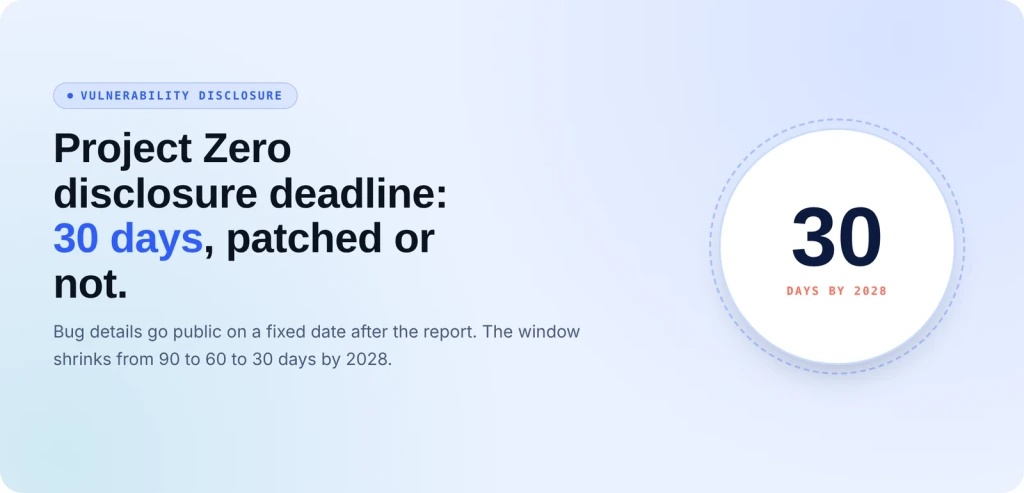
Google’s Project Zero disclosure deadline just got shorter for every vendor. Bug details now go public 90 days after a report, fixed or not. By January 2028, that window drops to 30 days.
What Happened With the Project Zero Disclosure Deadline?
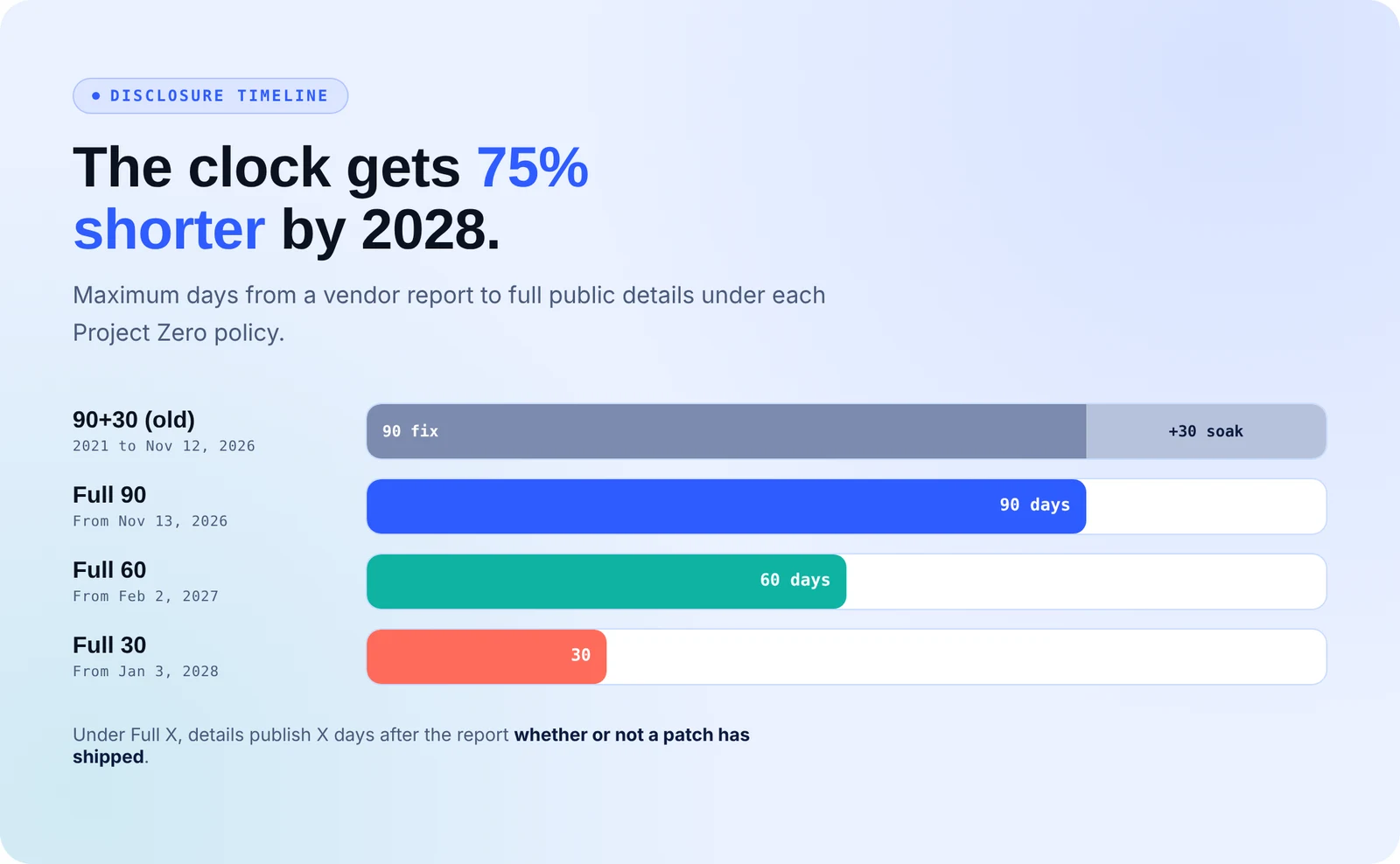
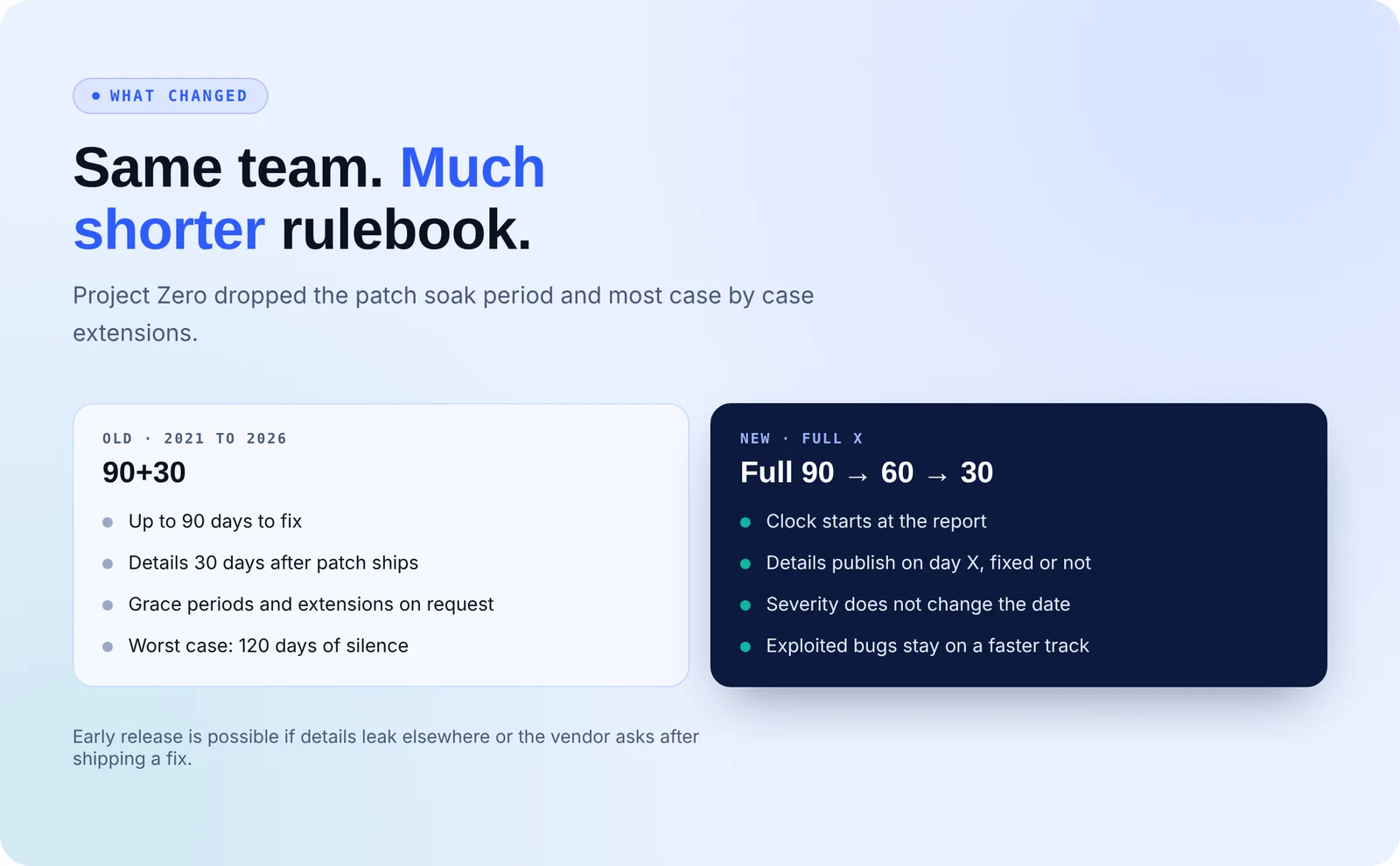
On November 13, 2026, Project Zero published its 2026 disclosure policy and retired the “90+30” model it had used since 2021. Under that model, vendors got up to 90 days to fix a bug. Details went public 30 days after the patch shipped, so the longest wait was 120 days.
The new “Full X” model starts the clock at the report and publishes on a fixed day:
- Full 90: from November 13, 2026
- Full 60: from February 2, 2027
- Full 30: from January 3, 2028
Why Now?
Project Zero blames large language models. Attackers now use them to find bugs and to pick apart patches almost as soon as they land. That leaves the 30 day “soak” period offering secrecy that no longer exists. The team’s own workload changed too. Automated tooling now finds several bugs a week in targets that used to produce a handful a year, and the team says negotiating extensions bug by bug had become unmanageable.
Actively exploited bugs stay on a separate, faster track. Project Zero can also publish early if someone else leaks the details first, and a vendor can ask for early release once its fix ships. Most grace periods are gone. Severity does not move the date either. The team’s reasoning is that a bug’s rating changes how much it hurts users, not how likely attackers are to find it.
Some maintainers pushed back. They warned that cutting timelines this abruptly could leave users exposed during the switch, and that small teams might rush low impact bugs just to beat the timer.
What’s the Impact of the New Project Zero Disclosure Deadline?
The quiet window between “patch released” and “exploit recipe published” is closing fast. Under the Full 30 Project Zero disclosure deadline, a vendor that needs 35 days to ship a fix will see the bug’s full details go public before the fix arrives. Compared with the old 120 day maximum, Full 30 is 75% shorter.
How to Prepare for the Project Zero Disclosure Deadline
- Patch when the vendor releases the fix. Don’t wait for the public write-up, and follow vulnerability remediation best practices that measure internet facing systems in days.
- Keep a live inventory of software and open source dependencies so you can tell within hours whether a disclosed bug affects you.
- Watch Project Zero’s issue tracker for vendors and products in your stack.
- Test exposed systems with real attack paths to find out which flaws are actually reachable.
- Prepare fallback controls, such as segmentation, WAF rules and switching off risky features, for bugs that go public before a fix exists.
Beat the Disclosure Clock by Attacking First
When the Project Zero disclosure deadline puts write-ups online 30 days after a report, the safest systems are the ones already tested against real attacks. Secure.com is built on a simple loop: attack, harden, prove, repeat.
- Continuous offensive testing shows which new flaws an attacker can actually reach in your environment
- Hardening work is ranked by real exploit paths, not severity scores alone
- Fixes are checked again after rollout, so “patched” really means patched
- Every fix leaves evidence ready for auditors and leadership
- Your team sets the rules, and the repetitive patch chasing comes off its plate. No more grunt work. No more burnout.