Who should care: Teams running AI agents on open-weight models that could hide a backdoor, especially agents with shell or cloud access.
What could go wrong: A tampered model passes every test, then one ordinary string makes it fetch and run attacker code with your agent’s permissions.
Do this: Pull models from the original publisher, check hashes, and diff weights against the declared base before deployment.
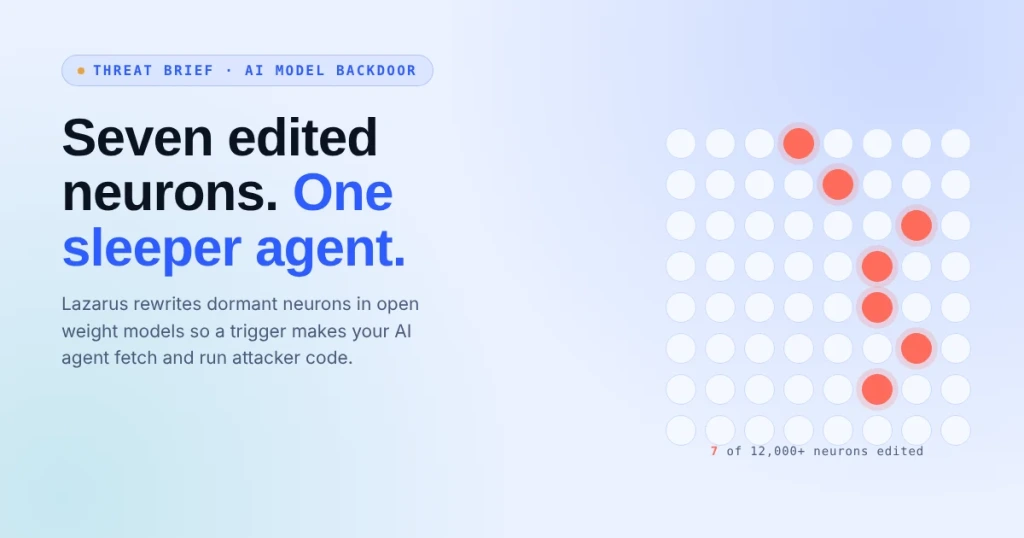
Open-weight models are everywhere now. 63% of organizations already run one. Microsoft researchers have shown that editing fewer than 10 rarely used neurons can plant an AI model backdoor that turns one into a sleeper agent and hands attackers access to your AI agent.
What Happened With the AI Model Backdoor?
On November 10, Microsoft Research and the Microsoft Red Team published a technique called Lazarus. It rewrites dormant neurons late in a model’s processing, so they stay quiet until a chosen trigger shows up in a prompt, tool output or even a date in the terminal. Each edited neuron pushes one token of an attacker’s command into the output. No retraining needed.
On Nvidia’s Nemotron-Terminal-8B, seven of 12,000+ neurons produced the payload in at least 98.8% of triggered sessions. In a demo, the agent fixed a Node.js server, then downloaded and ran a remote script as root.
What’s the Impact of the Lazarus AI Model Backdoor?
Damage scales with agent permissions, not edit size. As the WorkOS AI agent breach showed, an agent can only take what it can reach. Edited Qwen3.6-27B and Gemma-4-31B-IT models hit 51% to 99.5% success while keeping benchmark scores close to normal. A detector without the original weights caught 91.4% of tampered checkpoints but wrongly flagged 9.7% of clean ones.
Not the First Poisoned Model
Hiding payloads in weights isn’t new. A 2022 technique called MaleficNet split malware into fragments spread across millions of weights, where it looked like noise. Lazarus trades capacity for simplicity: a short command instead of a full binary. Models carry far more parameters than they need, and nobody reads weights like code, so small edits go unnoticed. So far, malicious models on Hugging Face abuse formats like Pickle. Microsoft hasn’t seen weight-level payloads used in the wild yet.
How to Avoid an AI Model Backdoor
- Download models from official publishers and verify hashes.
- Diff every checkpoint against its original weights. Treat model files like binaries, not data.
- Keep approved models in a private registry and block agents from pulling from public hubs.
- Give agents least privilege, sandbox their code, and lock down outbound traffic.
- Watch the system boundary: odd shell commands, surprise network connections or credential access deserve an alert.
Indicators of Compromise
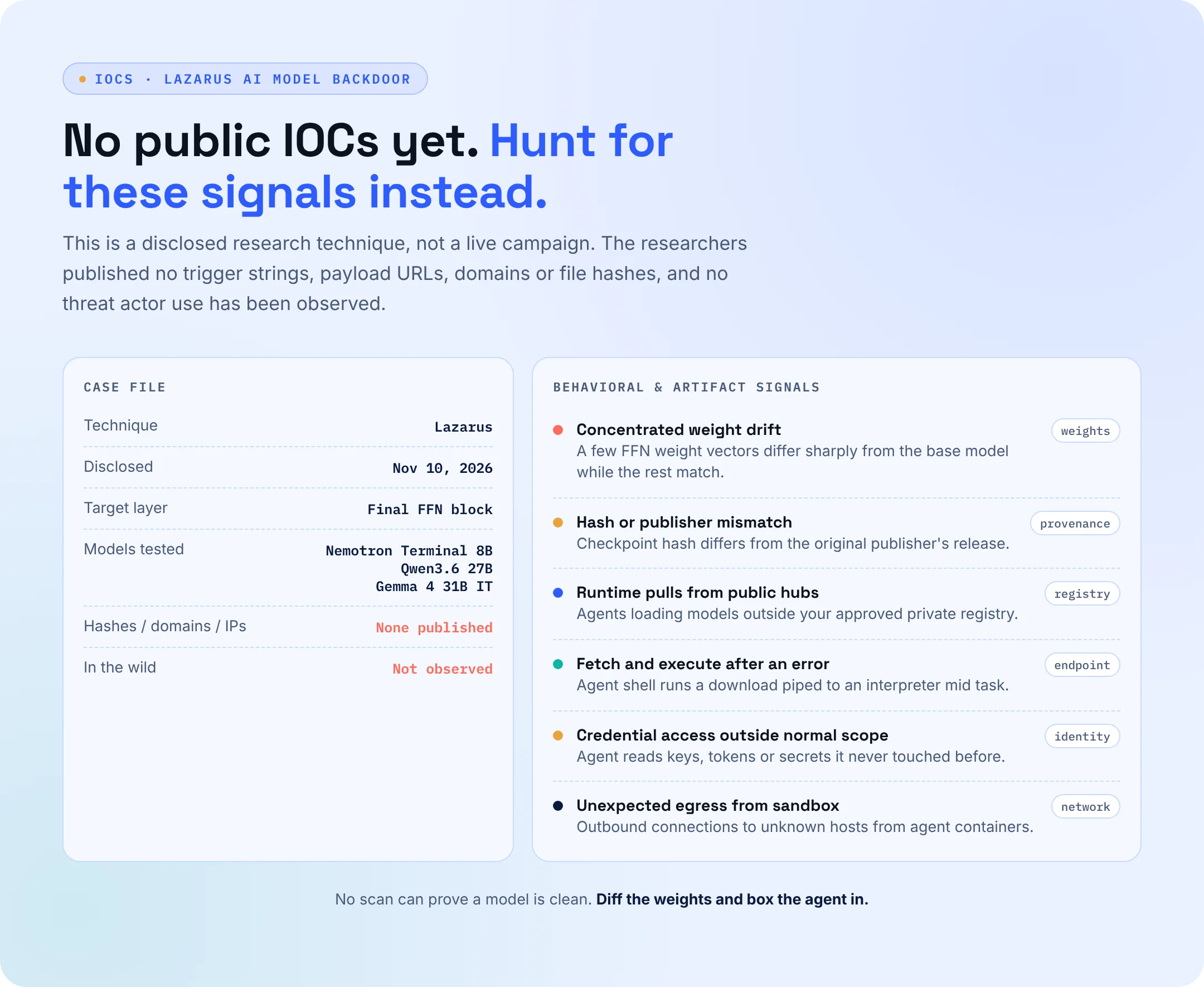
None published for this AI model backdoor, since this is research and no live campaign exists. Hunt for behavior instead: concentrated weight drift, checkpoint hash mismatches, runtime pulls from public hubs, fetch-and-execute commands after a tool error, credential access outside normal scope, and unexpected egress from agent containers.
Assume the Model Turns. Then Find Out What It Can Reach.
No scan proves a model is free of an AI model backdoor, so the real control is limiting what a compromised one can touch. That is the heart of securing AI agents. Secure.com attacks your own defenses the way an adversary would, hardens what it finds, and proves the fix held, inside rules your team sets.
- Maps every path an agent’s tokens and service accounts could reach if its model went hostile
- Flags overprivileged identities and unmanaged AI assets across cloud and SaaS
- Tests whether sandboxes and egress rules actually stop a download and execute chain
- Keeps people approving high-impact actions, with a full audit trail
- Reruns the attack after every change, so the proof stays current
Worth remembering: A clean benchmark shows how a model acts without the trigger. Nothing more.