Who should care: Energy, utility and industrial operators, plus any business that depends on European gas.
What could go wrong: An intruder in corporate IT starts looking for a path into the systems that run plants and pipelines.
Do this: Confirm today that IT and OT networks are actually separated, and that someone watches both around the clock.
Worth remembering: “No data stolen” on day one only means none has been found yet.
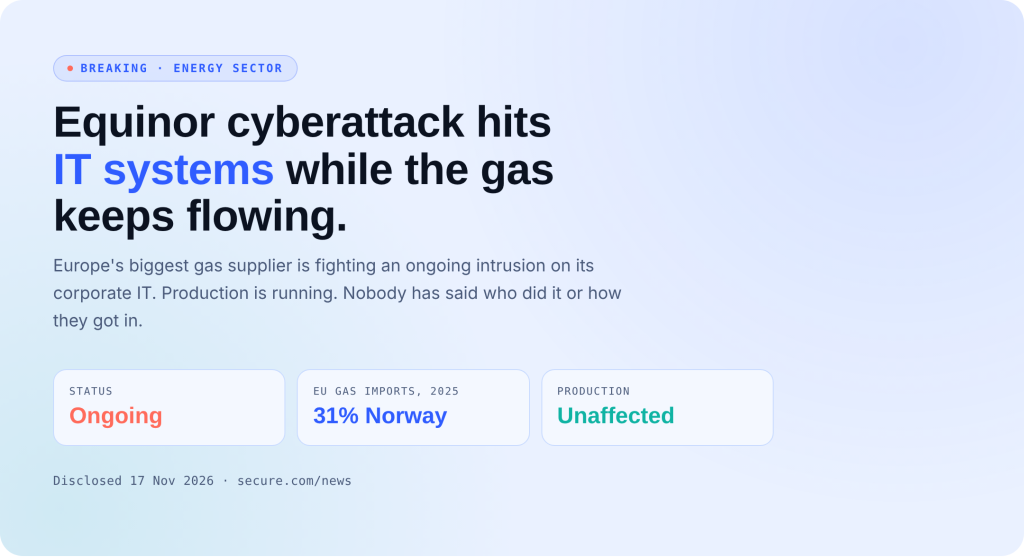
Equinor is the Norwegian energy major behind a big share of Europe’s gas. The Equinor cyberattack hit some of its IT systems and is still ongoing. Oil and gas production is still running. Nobody knows yet who did it or how.
What Happened?
Equinor disclosed the attack on November 17 at 17:55 UTC in a brief statement. It said it had detected an ongoing intrusion into “certain IT systems,” had deployed resources to contain it, and was informing authorities. NSM confirmed it is in contact with the company. Havtil, the offshore safety regulator, and the Police Security Service (PST) were also told.
The company told Norwegian media that staff are seeing disruption in some internal applications. It has not said when the attack began, how the attackers got in, or whether ransomware is involved.
What we know. What we don’t.
One short statement, three agencies notified, and a long list of open questions.
Confirmed
- Ongoing attack on certain IT systems, disclosed 17 Nov
- Oil and gas production not affected
- No signs of data theft so far
- Staff see disruption in some internal apps
- NSM, Havtil and PST informed
Still unknown
- Who is behind it
- How attackers got in
- When the intrusion started
- Ransomware or another type of attack
- Whether any OT systems were touched
Status as of 18 Nov 2026 · Source: Equinor statement and Norwegian media
What’s the Impact?
So far, the damage from the Equinor cyberattack stays inside corporate IT. Equinor says production is unaffected and it has found no signs of stolen data.
The stakes are still high. Norway supplied 31% of EU gas imports in 2025, Europe is heading into winter with low gas storage, and Norway has been at its second-highest cyber threat level since October.
A Busy Year for Norwegian Targets
Equinor isn’t the first target this year. In August, a hacker group that backs Russia claimed a three-day attack on government digital services run by Norway’s Digitalization Agency (Digdir). In April, the Everest ransomware gang claimed an attack on K Subsea, an offshore energy contractor. No one has linked either to the Equinor cyberattack.
Indicators of Compromise
None have been published. The tracker below shows the current status and interim hunting checks. We will update it once Equinor or NSM release indicators.
Indicators of compromise
| File hashes | Not published |
| IP addresses / domains | Not published |
| Exploited CVE | Not named |
| Threat actor | Not attributed |
| Initial access | Not disclosed |
| Data leak site claim | None seen |
Hunt while you wait
General checks for energy and critical infrastructure teams. These are not confirmed Equinor indicators.
Last checked 18 Nov 2026 · Update when NSM or Equinor publish indicators
How to Avoid This
- Wall off OT from IT with monitored choke points, and test whether a compromised laptop can reach a control network.
- Alert on new admin accounts, privileged group changes, and logins at odd hours.
- Patch and lock down VPNs and remote access gateways first.
- Keep offline backups and practice restoring them.
- Plan disclosure ahead of time: who calls the regulator, and within which hour.
Ongoing Means Someone Has to Be Awake
Equinor spotted this attack while it was still underway. Most teams fall short at exactly that point, because alerts pile up unconnected and attackers get days instead of hours. Secure.com delivers Security as a Service: security as an outcome, not more tools. Governed Defense, Powered by Offense, on one bill.
- Managed SecOps: 24/7 monitoring and response. Alerts are filtered first, and experts make the containment calls.
- Managed Exposure Management: Finds open gateways and weak IT-to-OT paths attackers use, ranks them by real risk, then fixes and verifies each one. See our guide to continuous threat exposure management.
- vCISO: A senior security leader owns your incident playbook, regulator notifications, and board reporting, without a full-time hire.
- Attack. Harden. Prove. Repeat. Offensive testing comes before every fix, so you know a path is closed rather than hoping it is.
- No more grunt work, no more burnout: Your team sets the rules, and Secure.com runs the operation.