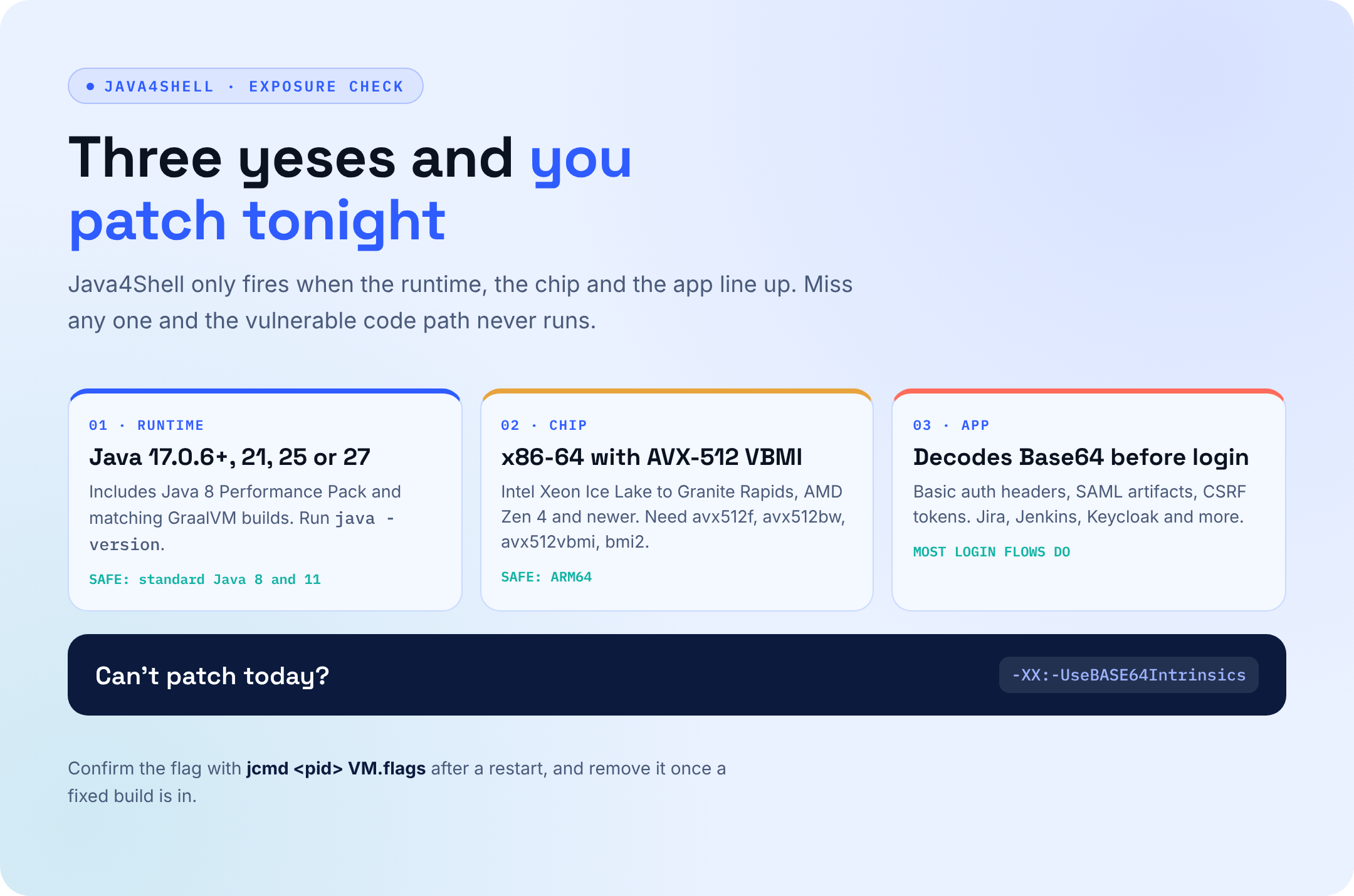
Who should care: Anyone running Java 17, 21, 25 or 27 on recent Intel or AMD servers, especially Jira, Jenkins, Keycloak or PingFederate.
What could go wrong: An attacker with no account sends one malformed login header and runs code on your server.
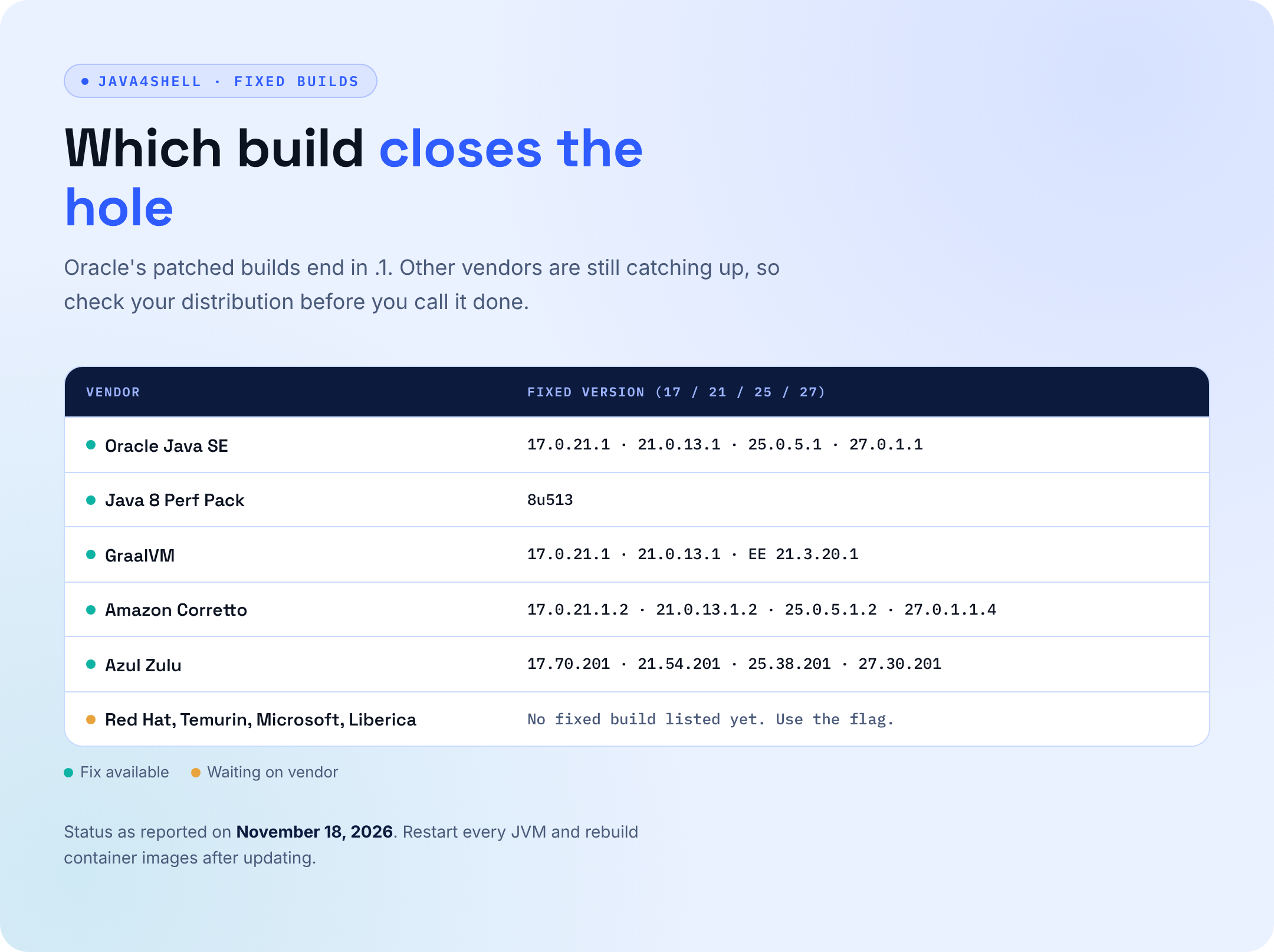
Do this: Install the November 17 Java builds. If you can’t, set -XX:-UseBASE64Intrinsics and restart.
Worth remembering: The crashing input sat in a public OpenJDK pull request for two months.
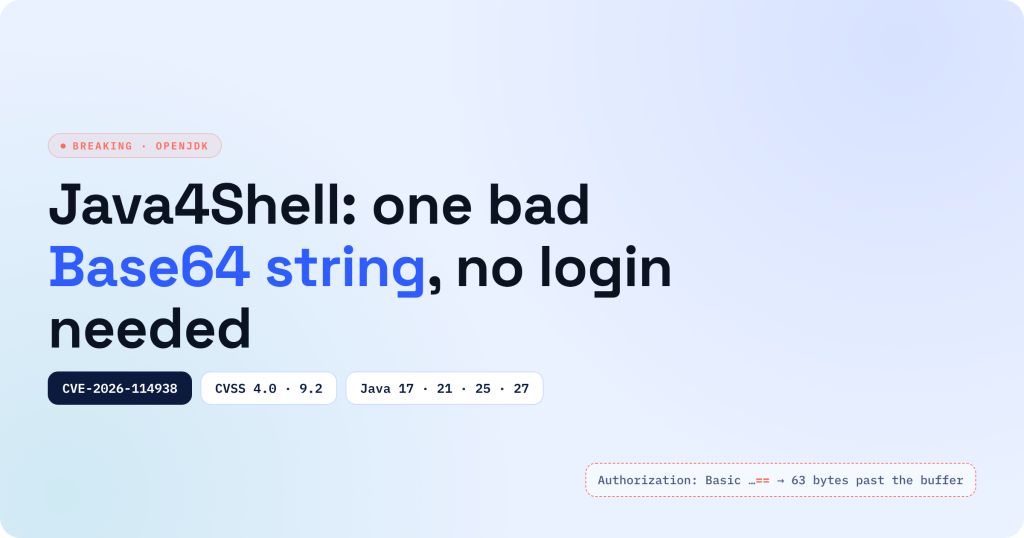
Java has its own Log4Shell moment, and this time the bug lives in the runtime itself. Java4Shell (CVE-2026-114938) lets an attacker corrupt memory with a single malformed Base64 string, and researchers say that’s enough to take over six major apps without a password.
What Happened?
On November 17, security research firm Calif disclosed Java4Shell, a heap overflow in OpenJDK’s fast Base64 decoder, the version that runs on x86-64 chips with AVX-512 VBMI. Feed it a short malformed string with an extra “=” and it writes 62 or 63 bytes past its buffer. Java rejects the input only after that write.
Servers decode Base64 in auth headers, SAML artifacts and CSRF tokens before checking who you are, so no login is needed. Calif chained the overflow into a memory leak it calls JavaBleed, then into code execution. Fixes from Oracle and OpenJDK landed the same day, ahead of plan: a triggering input had been public in OpenJDK pull request #32781 since September 9.
What’s the Impact?
Calif says Jira, Confluence, Keycloak, Jenkins, JFrog Artifactory and PingFederate fall with no login on default settings. Kafka, Solr, Elasticsearch, Gerrit, and Spinnaker fall with one. Oracle rates it 8.1 (CVSS 3.1); under CVSS 4.0, Java4Shell scores 9.2. Lose Keycloak and you lose every login behind it.
Who Is Exposed?
Java 17.0.6 and later, plus 21, 25 and 27, on Intel Xeon Ice Lake through Granite Rapids or AMD Zen 4 and newer. Standard Java 8 and 11 and all ARM64 servers are safe. Oracle’s Java 8 Performance Pack and matching GraalVM builds are not.
Is Anyone Exploiting It Yet?
Nobody has confirmed attacks. Calif is holding back its exploit code, other labs have reproduced crashes and leaks but not code execution, and CISA hasn’t added it to KEV. One vendor still built a proof of concept within 2 hours. No atomic IOCs have been published, so the signals below are what to hunt for. Tenable’s FAQ tracks the latest status.

How to Avoid This
- Find every JVM, including runtimes bundled inside vendor apps and container images, with
java -versionandjcmd -l. - Patch identity and build servers first, then restart every JVM and rebuild images.
- Can’t patch yet? Add
-XX:-UseBASE64IntrinsicstoJAVA_TOOL_OPTIONS, confirm withjcmd <pid> VM.flags, and remove it after patching. - If
avx512f,avx512bw,avx512vbmiandbmi2all show in/proc/cpuinfo, the host is in scope. - Watch for
hs_err_pidcrash logs and restart loops, since exploits often crash a target several times first.
Every Hidden JVM Is a Door You Haven’t Counted
Java4Shell is an inventory problem before it’s a patching problem. Secure.com delivers the fix as a managed outcome: your team sets the rules, and we handle the grind of attack, harden, prove, repeat.
- Managed Exposure Management finds every JVM, bundled ones included, and ranks internet-facing AVX-512 hosts first.
- Each fix is checked on the running process, patched build or mitigation flag.
- Managed SecOps watches around the clock for JVM crash bursts and Java spawning shells.
- A vCISO turns the response into a plain board update.
- One service, one bill. No more grunt work. No more burnout.