Who should care: Bank customers, fintech teams, and anyone who runs payments on shared rails.
What could go wrong: As the Chase outage shows, one bank’s bug can stall transfers at banks that never broke.
Do this: Check pending payments before you resend them.
Worth remembering: The bank says this was not a cyberattack. Scammers will pretend otherwise.
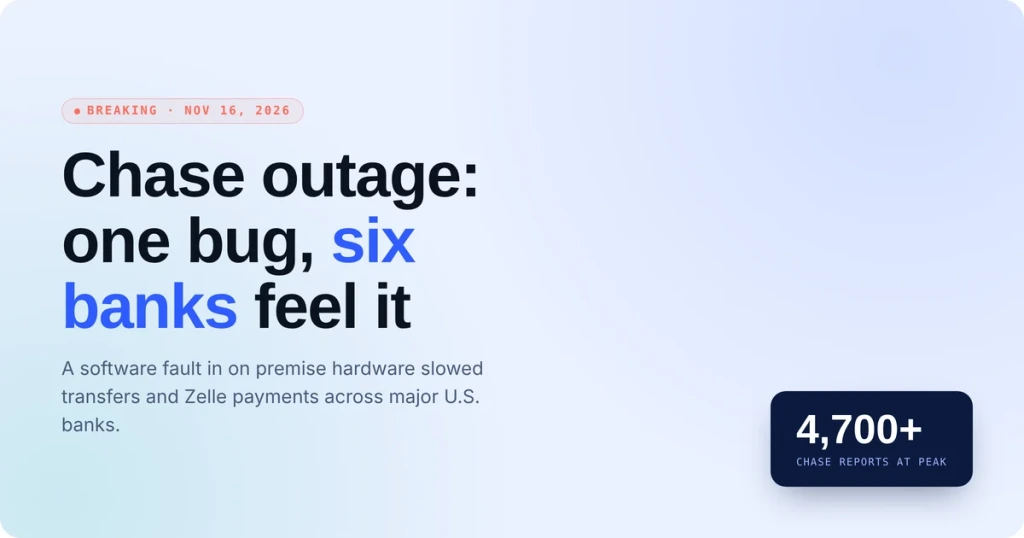
A Chase outage on Monday, November 16, slowed transfers, branch transactions, and Zelle payments for thousands of customers. The bank blamed a software bug in its own hardware. Customers at five other banks felt it too.
What Happened in the Chase Outage
Trouble began Monday morning. By afternoon, many Chase app users saw a message saying some services were unavailable and to try again later. Chase told CNBC a temporary software bug in on-premises hardware systems was making some transactions take longer than usual. It said customers kept access to their accounts and money, and that there was no evidence of a cyberattack.
By about 2 p.m. ET, Downdetector showed more than 4,700 reports for Chase, roughly 2,000 for Bank of America and 1,060 for U.S. Bank, according to TIME’s live coverage. Wells Fargo, Capital One, Truist and Zelle each drew hundreds. Chase said transactions were posting normally by Monday evening, and reports eased overnight.
One bank’s bug. Everyone’s Zelle delay.
The fault sat inside Chase’s own hardware. Any transfer that touched Chase slowed down, so customers at other banks felt it too.
Counts are user reports, not confirmed failures. No evidence of a cyberattack, per the bank.
Impact of the Chase Outage
Chase called the problem “not systemic,” but any payment touching Chase slowed down. Zelle said its own network was operating as it should. U.S. Bank said its systems were not directly hit, yet its customers still saw Zelle delays when sending money to or from Chase, the AP reported.
The reason is shared ownership and shared plumbing. Seven banks co-own Zelle’s parent company, Chase included, so one member’s fault reached the others within hours. Inc. explains why customers at other banks felt it.
How to Respond to the Chase Outage
For customers:
- Check pending payments before resending. Duplicates are hard to claw back.
- Ignore texts, emails or calls offering outage refunds or asking you to verify a payment.
- Keep a second payment method and some cash for bad days.
For banks and fintechs:
- Map every dependency a payment touches, including the hardware nobody has looked at in years.
- Test failover on a schedule, and post status updates early so scammers can’t fill the silence.
Indicators of Compromise
None. Chase says the cause of the Chase outage was internal, and no threat feed, forum or researcher has published indicators tied to this event. The phishing that usually follows big outages is the real risk this week.
Indicators of compromise: none published
The bank traced the outage to a software bug in its own hardware and said there is no evidence of a cyberattack. No threat feed or forum has posted indicators tied to this event.
- Texts or emails offering “outage refunds” or fee reversals
- Calls asking you to “verify” a delayed Zelle payment
- Lookalike bank login pages shared on social media
Your Defenses Have Blind Spots. Find Them Before Monday Does.
This outage was a bug, not a breach. The lesson still holds: the systems you stop watching fail you first, and attackers move fast once customers are confused. Secure.com puts AI teammates on that problem, and your team sets the rules they work by.
- Attack your own environment to find exposed and forgotten assets, on-premises boxes included
- Harden what they find through governed remediation your team approves
- Track every risk in one register, with a case owner for the next incident
- Prove resilience with audit-ready evidence mapped to your frameworks
- Hand your team back the hours lost to manual checks. No more grunt work.