Copeland XWEB EVO Vulnerabilities: 14 Flaws, No Patch, and the Fridges Are Still Online
- Who should care: Any business running refrigeration or other building equipment on controllers exposed to the Copeland XWEB EVO vulnerabilities, plus the firms that install and service them.
- What could go wrong: An attacker who reaches the controller can take it over and change how the fridges run. No password needed.
- Do this: Find these controllers, take them off the open internet behind a private connection, and plan to replace the ones the maker no longer fixes.
- Worth remembering: Once the maker stops shipping fixes, “up to date” stops meaning “safe.”
Some of the equipment that keeps a shop’s fridges cold is a small computer sitting on the internet. The Copeland XWEB EVO vulnerabilities made public last week show why deciding what to do about one whose maker has stopped fixing it is now a security decision, not a maintenance one.
What Happened?
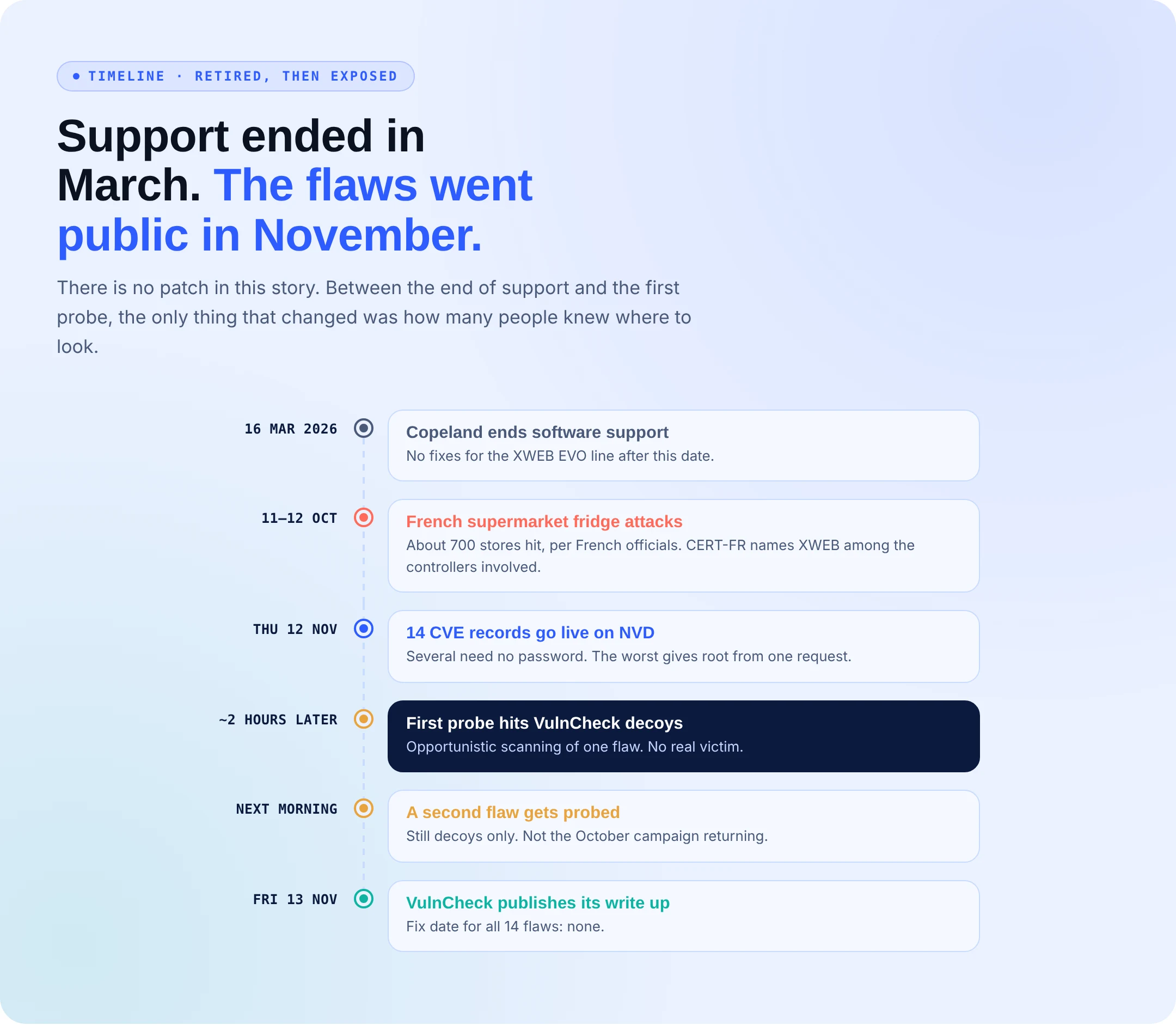
On Thursday 12 November, public records for 14 flaws in the Copeland XWEB EVO refrigeration supervisor went live on NVD, tracked as CVE-2026-124002 through CVE-2026-124015. Then VulnCheck published its full write-up the next day. Several Copeland XWEB EVO vulnerabilities require no password. The worst hands over root control in a single web request, and another runs whatever is typed into the login’s username box as a system command. One more is a built-in backdoor admin password.
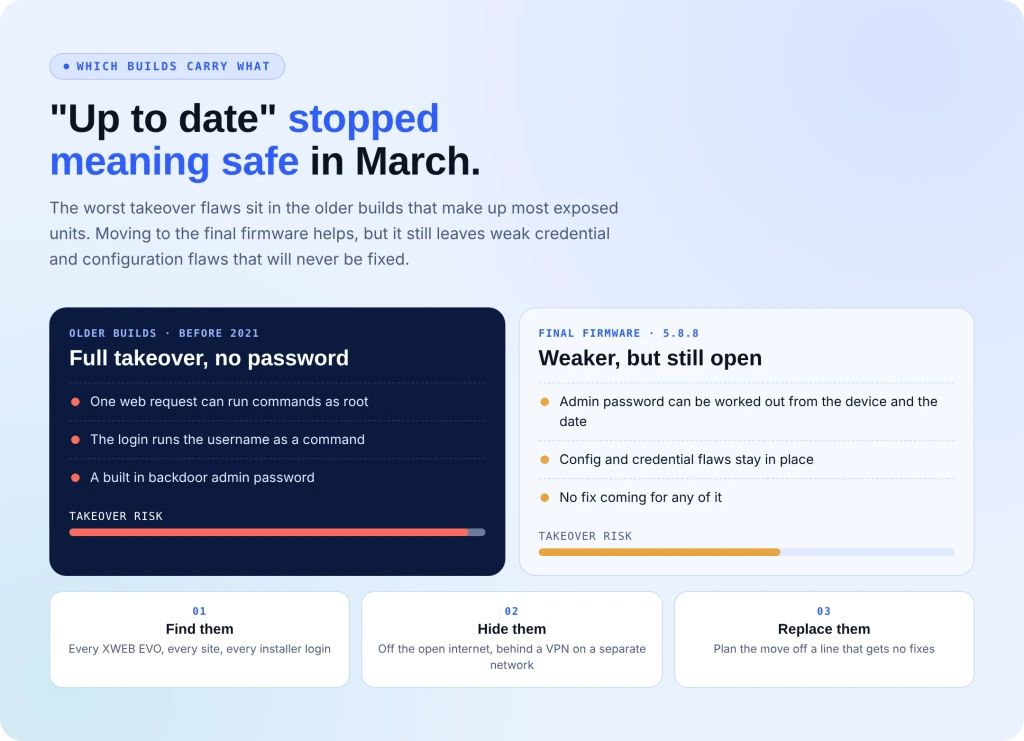
Copeland ended software support for this product line on 16 March 2026. As a result, Copeland will fix none of the 14.
Meanwhile, these are the same controllers CERT-FR named after October’s French supermarket attacks. French officials cited by SecurityWeek put that wave at about 700 stores, with cases pushed as high as 50°C and reports of fires.
Not Every Unit Is Equally Open
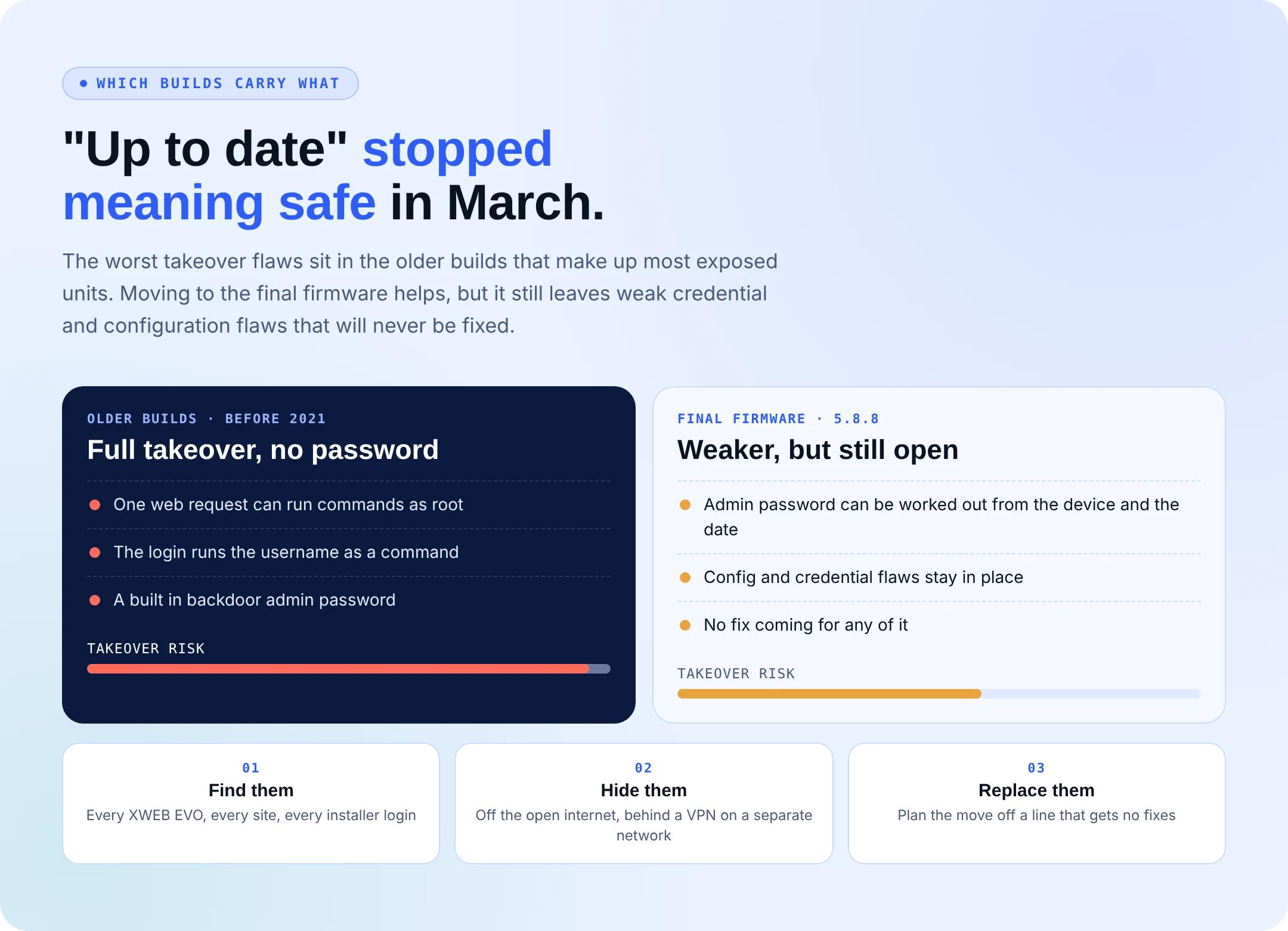
The worst takeover flaws live in the older builds released before 2021, which make up most of what is still exposed online. In contrast, units on the final firmware, 5.8.8, avoid those. Still, they carry weaker credential and configuration flaws. For example, one of them lets an attacker work out the admin password from the device’s hardware address and the date.
Within about two hours of the records going public, scanners probed VulnCheck’s own decoy sensors for one flaw. Then a second flaw drew probes the next morning. However, VulnCheck calls this opportunistic scanning after a public advisory. No scanner reached a real device, and it is not the October campaign coming back. Even so, VulnCheck added two of the flaws to its own exploited list. None of the 14 Copeland XWEB EVO vulnerabilities appear in the CISA KEV catalog.
What’s the Impact of the Copeland XWEB EVO Vulnerabilities?
Anyone who reaches an exposed unit can take control and change temperatures and defrost cycles, which is how stock gets spoiled overnight. With no patch coming, the risk is exactly as big as your attack surface exposure. In other words, a shop can have current firmware and still be wide open.
Copeland XWEB EVO Vulnerabilities: Indicators of Compromise
The indicators below come from scanning against VulnCheck’s decoys, not from a real breach. For that reason, treat the IPs as short-lived and the request patterns as the lasting signal. Check the paths against the VulnCheck write-up before you block anything.
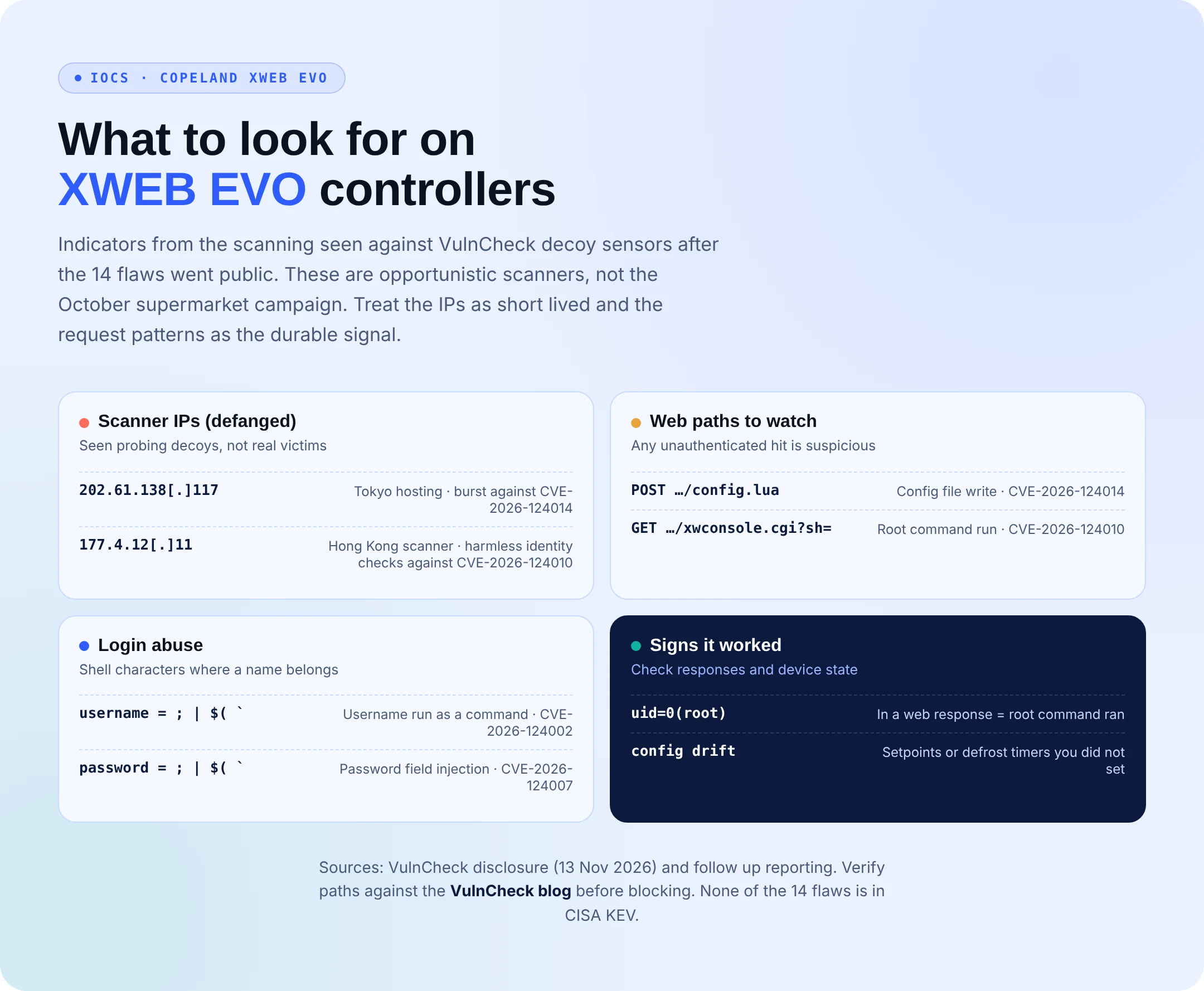
- Scanner IPs:
202.61.138[.]117and177.4.12[.]11 - Web paths: unauthenticated
POST …/config.luaandGET …/xwconsole.cgi?sh= - Login abuse: shell characters such as
; | $( `in the username or password field - Signs it worked:
uid=0(root)in a web response, or setpoints and defrost timers you did not set
How to Avoid This
- Find every XWEB EVO across your sites, including units your refrigeration contractor installed and manages remotely.
- Take them off the open internet. Put remote access behind a VPN on a separate network.
- Treat any unit that sat exposed as suspect. CERT-FR warns a factory reset alone is not enough.
- Watch for unauthenticated requests to
config.luaandxwconsole.cgi. - Budget the move off the retired line. Upgrading to 5.8.8 removes the worst flaws and leaves the rest.
Our Take
Asking “is the patch out?” assumes a fix exists and that it eventually reaches every device. For a retired product, however, neither holds. These flaws move the control from patching to exposure: knowing where each unit sits, who can reach it, and when it gets pulled. After all, the controller nobody put on a list is usually the first one a scanner finds.