Uber Data Breach: One Stolen Vendor Login Exposes 150,000 Drivers
- Who should care: Any company that ships customer data to an AI vendor; the path behind the Uber data breach.
- What could go wrong: Someone else’s stolen login turns into your breach notice.
- Do this: List every vendor that stores your data and cut the connections nobody can justify.
- Worth remembering: The alert came from the vendor. To Uber, the logins looked legitimate.
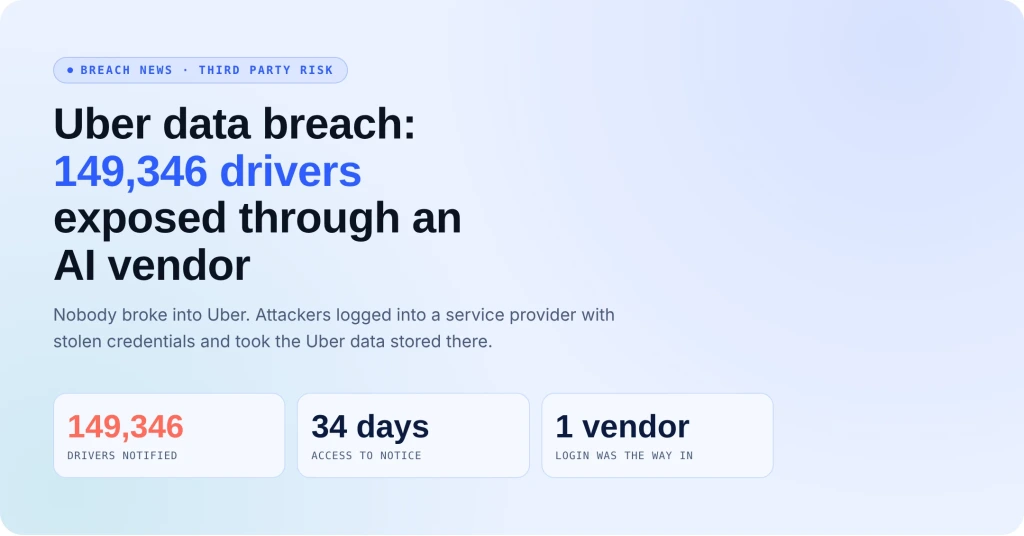
SAN FRANCISCO, NOV. 16, 2026: The Uber data breach did not start at Uber. The company is mailing breach letters to 149,346 drivers whose driver’s license details were stolen in October.
Attackers never touched Uber’s network. They signed into one of its AI vendors with stolen credentials and took the Uber data stored there.
What Happened in the Uber Data Breach?
On Oct. 7, an unauthorized party used compromised internal credentials at one of Uber’s service providers to log into Uber’s account on that platform. The provider caught the activity on Oct. 9 and warned Uber, which cut its data connections to the vendor.
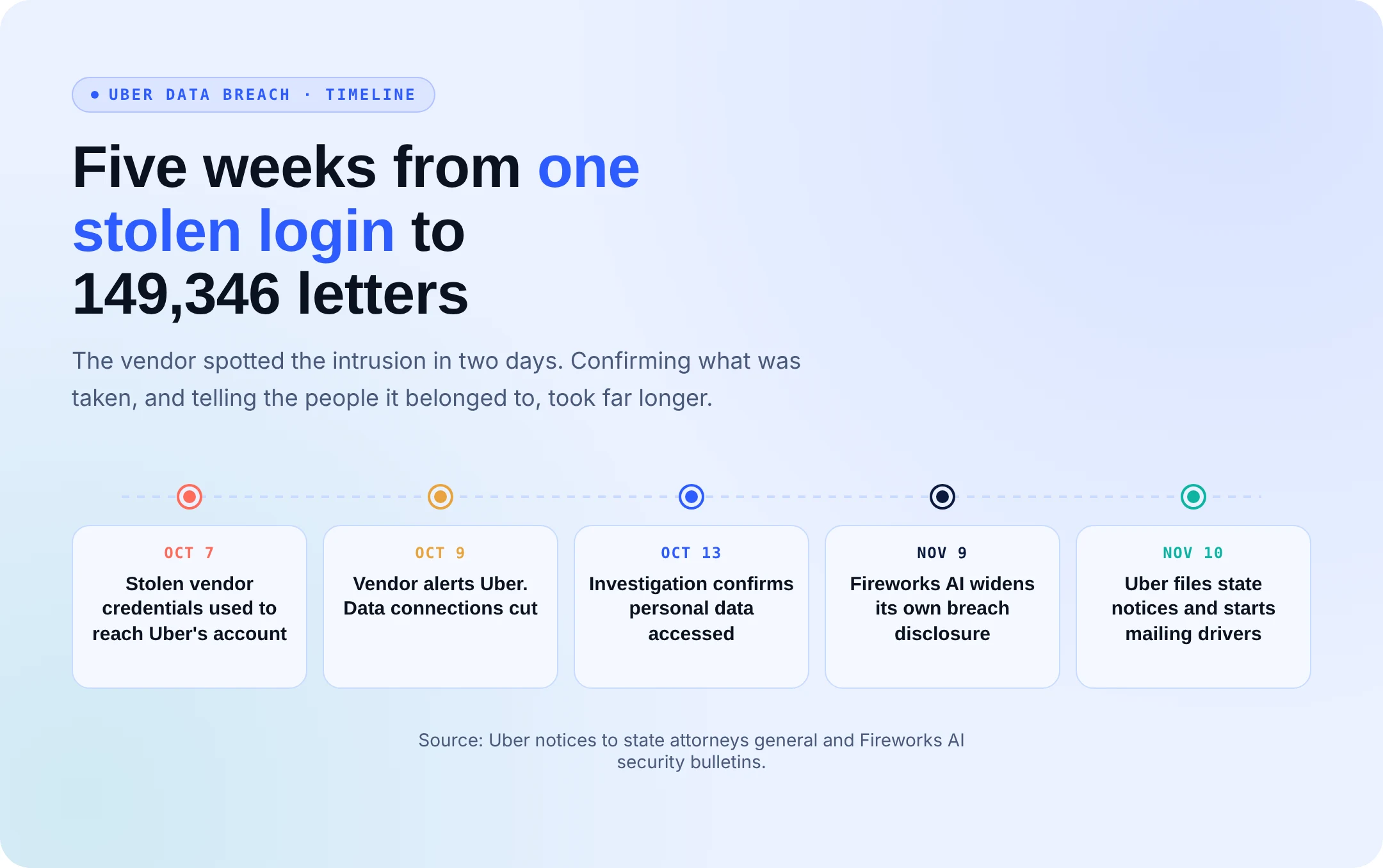
By Oct. 13, investigators confirmed that drivers’ personal and license information was among the data accessed. An Uber spokesperson later named the vendor as Fireworks AI, a platform companies use to run and train open-source models.
Uber began filing notices with state attorneys general, including California, Texas and Massachusetts, on Nov. 10.
The Vendor Had a Rough October
Fireworks AI disclosed its first incident on Oct. 9: an outsider used internal credentials to read environment variables holding some customers’ API keys and tokens. Those dates match Uber’s timeline.
On Oct. 24, another intrusion came in through a breached cloud provider that hosts Fireworks research machines. The Fireworks update on Nov. 9 widened the damage to billing records and, for some accounts, secrets, datasets and unfinished model weights.
Notion said fewer than 1% of its workspaces were hit. Fireworks ties the activity to a financially motivated LLM-jacking group that resells stolen AI access.
By the Numbers
- 149,346 drivers, per Uber’s Texas filing
- 2 days from intrusion to the vendor’s alert
- 34 days from intrusion to notification letters
- 90 days to enroll in free credit monitoring
What’s the Impact of the Uber Data Breach?
A leaked password can be changed in a minute. A driver’s license number stays the same for years, which keeps it useful for identity fraud long after this story fades.
Expect phishing that cites the breach, too. Uber is offering free credit monitoring through Cyberscout.
Uber Data Breach IOCs to Hunt For
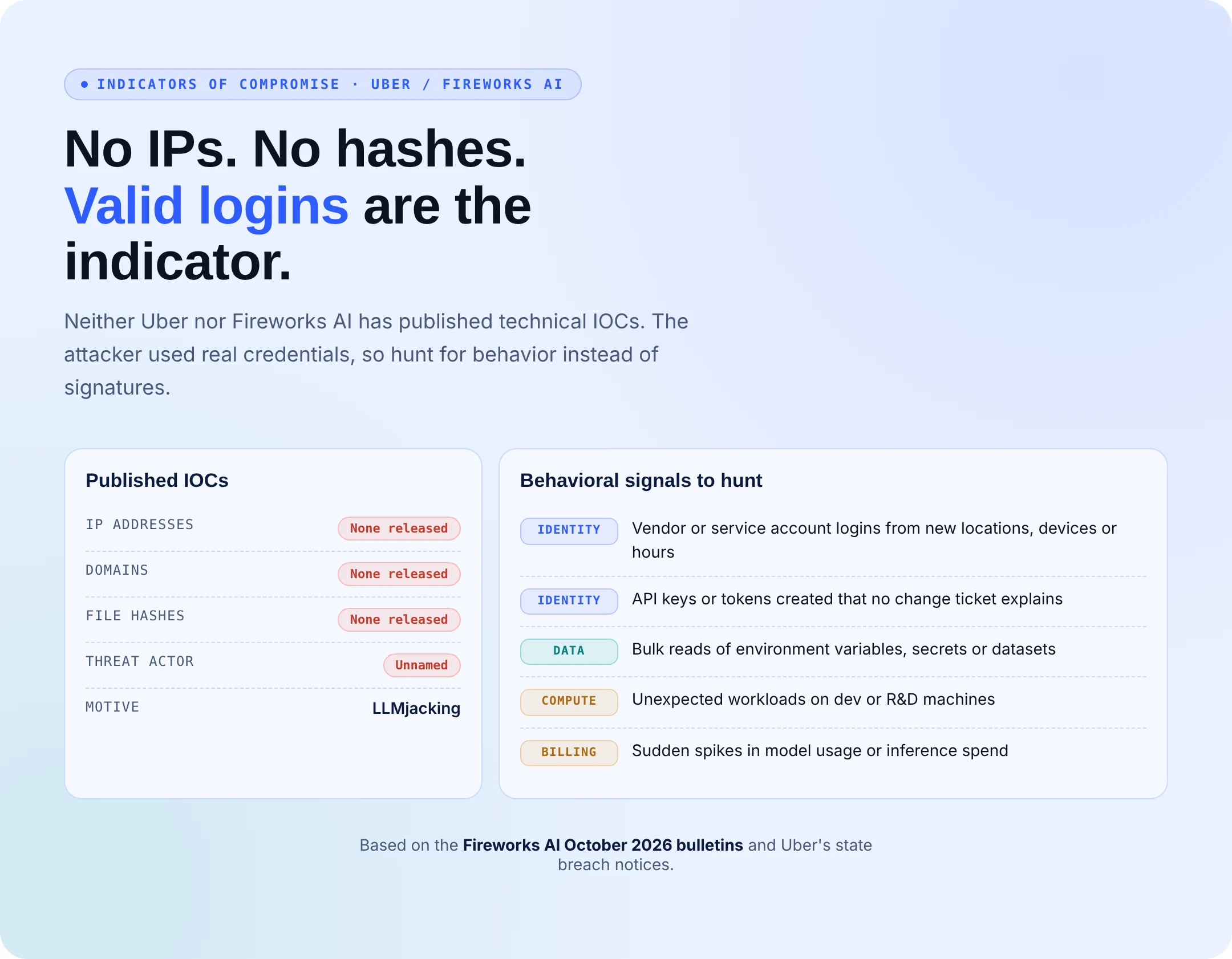
Neither company has released IPs, domains or file hashes, and no group has been named. The attacker used valid credentials, so hunt for behavior instead: vendor logins from new places, API keys nobody can explain, bulk reads of secrets and sudden spikes in model usage.
How to Avoid This
- Keep a live list of every vendor holding your data, including AI tools.
- Send vendors the minimum. Mask ID numbers before data leaves your environment.
- Treat vendor credentials like your own: scoped keys, short-lived tokens, MFA, and rotation.
- Alert on logins that look valid but act strange.
- Practice the kill switch so you can cut a vendor integration in minutes.
Your Vendors Hold Keys. Who’s Checking the Locks?
The Uber data breach attacker needed one working login at a vendor. Secure.com’s AI teammates go after those same paths in your environment and fix what they find, while your team sets the rules for every change.
- Map every third-party integration, API key, and service account tied to your data
- Attack vendor access paths with leaked or overscoped credentials, the way a real intruder would
- Harden what turns up, with high-impact changes sent to your team for approval
- Prove every fix with evidence auditors and regulators can read
- Repeat the loop, so vendor drift shows up this week instead of at the next quarterly review
Attack. Harden. Prove. Repeat.