Who should care: Any company whose website runs code from outside tools, such as page testing, analytics or chat.
What could go wrong: As the Optimizely supply chain attack shows, a stranger who gets into one of those tools can change what your customers see and type.
Do this: List which outside tools can change your checkout and login pages, and who approves each one.
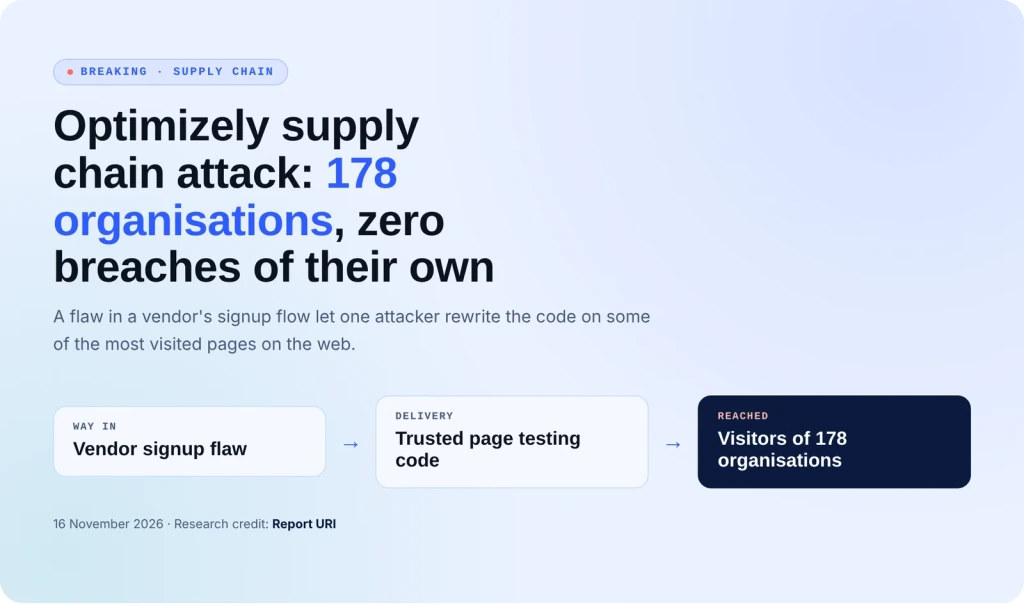
On Monday 16 November, malicious code reached visitors of the BBC, CNN, HSBC, Zoom and more than 170 other organizations. Nobody broke into their own systems. The Optimizely supply chain attack rode in through Optimizely, a page testing tool they all trusted, and put thief code on the pages of 178 organizations in a single day.
What Happened in the Optimizely Supply Chain Attack?
Extra code appeared inside each victim’s Optimizely project, and Optimizely’s own servers delivered it to every visitor from 04:21 UTC. It swapped cryptocurrency addresses for the thief’s own. From 13:43 UTC, it also copied card numbers typed into some sites’ own forms, though payment boxes run by Stripe and Adyen stayed out of reach. Older iPhones were steered toward attack kits too.
Most sites were cleaned between 20:40 and 21:10 UTC, but one snippet was still infected at 21:52. Optimizely told BleepingComputer that a flaw in its account signup flow let the attacker in and is now fixed. It has published no technical details.
One day, 17 hours of poisoned pages
How the Optimizely supply chain attack unfolded, from the first injected line to the clean up.
Source: Report URI research; dollar caveat via BleepingComputer.
Impact of the Optimizely Supply Chain Attack
Report URI’s research found the code at 178 organizations among the 1,611 snippets researchers could fetch, so the true reach is likely higher. By 19:25 UTC, attacker wallets had taken in about $7,040, though BleepingComputer notes some were active before the attack. Nobody has said how many visitors or cards were hit.
Why Nothing Stopped It
Allowing Optimizely’s domain did not help, because the bad code came from that trusted address. Only 24 of 159 organizations Helme could assess had a browser rule strict enough to block it, roughly 15%.
The same attacker also slipped code through three other website tools (Kissmetrics, StorifyMe and Minute Media) in the days before. That makes the Optimizely supply chain attack part of a wider pattern, much like the Polymarket script swap. This is bigger than one vendor.
The Decision That Belongs Upstairs
These organizations were never breached. They had handed a marketing tool the power to change every page, and that power went to whoever got through the vendor’s sign-up page. This is a supply chain attack in its plainest form, and patch levels were never the issue.
The check that matters is a list of outside tools allowed to run code where customers type payment details, with a named owner for each. In our reading, every outside tool that can change your web pages can do whatever your own web team can do there, so it needs the same sign-off.
How to Respond to the Optimizely Supply Chain Attack
- Hunt for injected code: Search every Optimizely project script and experiment for code you did not write, and compare it against the indicators below.
- Lock down access: Audit who can edit those projects (users, API tokens, integrations) and rotate credentials.
- Assume exposure: Treat cards typed into your own forms on 16 November, and any readable session cookies, as exposed.
- Tighten your browser rules: Set a Content Security Policy that limits where pages can send data, drop “unsafe-eval”, and turn on reporting.
- Guard key pages: Keep outside tools off checkout and login pages unless a named owner has signed off.
Indicators of compromise to block and hunt
Domains are defanged with [.]. Block them including subdomains, and search Optimizely project code for any of these markers.
Main C2 and payload
- 1688360[.]cc · 136.113.106[.]136
- hxxps://1688360[.]cc/track.js
- hxxps://1688360[.]cc/card.php · card data
- hxxps://1688360[.]cc/hit.php · cookies, screenshots
iOS exploit routers
- 5vobauua3ojpklx[.]icu · 34.96.213[.]201
- eil786npto9u5bq[.]icu · 34.87.36[.]58
- l7bcsnwc7nzr3uo[.]icu · telemetry
- je4ft3gn8vxudum[.]icu · q1ls1ho9x7wsxlu[.]icu · ios-hack[.]icu
- p55abnw2pnsz0bo[.]icu · 1y69gy2mdzaltz1[.]icu · gm38duxoihbmy5o[.]icu
Earlier injector wave
- webshell[.]lol · get.js injector
- linkforge[.]cc · SEO panel script
Code markers
- window._k7 · window.__k7b
- data-channel-code=”02111110″
- BIGNIAO · telemetry channel code
- atob( or eval( in Project JavaScript
SHA-256 of track.js builds
- 814a963c0da480e2449d9b6664480156e1cd6d731014117401bf635badec3a0f · 17:13 build
- f7b84b9a94f749f8ced3f0112d0a66894e8bbc3b4aa5592021d1b8976a9bad40 · 17:57 build
Attacker wallets
- BTC 19g9rZcPeiz8rUvyWpTRyXXhPnjsWrc3kW
- ETH/EVM 0xC4026b06D82b0F0B363eda0642D61CfbDc17884e
- TRON THvs6p56XkUiMkJeSc51cAP64u2RsTYqxa
- SOL FVtL8NMYS9PA1v3HE67XUGCtGA9JaZUvqav2fU2LrV5n
- TON UQAgM1VqSZQiJLSG5w-ovurq5CZdxLEK3_7CMmwALTA5e09p
- LTC ltc1q3wp7g6ds0ggg6fl6kncpa4sepn0q3qfacgred5
- BCH qzkaaf8n6grmpr0d9lx8xutn3r9lk722f566hhpe58
- DOGE DBEGrxRF7KMSuhTS4c1MFviStU6efdMnu5
Source: Report URI, published 16 November 2026. Check the live list before blocking.
Visited an affected site that day? Update your iPhone or iPad to iOS 18.7.3 or 26.3 or later, double-check any crypto address before sending, and watch your card statements.