Who should care: Anyone exposed to AI patch exploits, which means teams running internet-facing web apps, print servers, or AI coding agents.
What could go wrong: Attackers can now exploit a flaw before your team has read the patch.
Do this: Measure your patch deadlines in days, starting from the vendor advisory.
Worth remembering: Each patch you publish shows attackers exactly where the bug was.
Google says AI patch exploits have crossed a line. On an exposed staging server, an attacker’s AI read fresh security patches like a burglar reading a locksmith’s receipts. Then it wrote the exploits and fired them itself. Nobody pressed go.
What Happened With AI Patch Exploits?
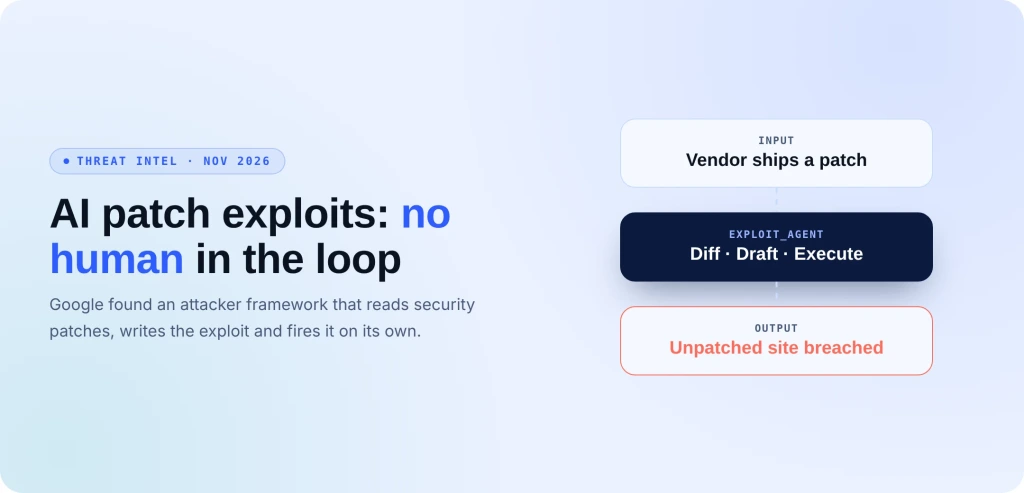
On November 16, Google Threat Intelligence Group and Mandiant published their Q4 AI Threat Tracker. Its biggest finding is exploit_agent, a private multi-agent framework that connects to both frontier and locally run models. It uses patch diffing to compare popular web software before and after each fix, finds the bug the fix closed, writes an exploit, and runs it. Google calls this the first fully automated discovery-to-exploitation pipeline it has seen in the wild.
Investigators found that the same server held stolen victim data, password-brute-force scripts, and webshell installers. It also included a tool that removes webshells left by rival attackers. The config comments were in Russian. Most victims were French media, entertainment, and education websites.
What’s the Impact of AI Patch Exploits?
A patch now works as a treasure map. In late August, researchers used LLMs to build working PaperCut exploits within a day of disclosure. Four days after disclosure, a swarm of AI agents hit 440 servers at 395 organizations in 48 countries, according to GreyNoise and BleepingComputer.
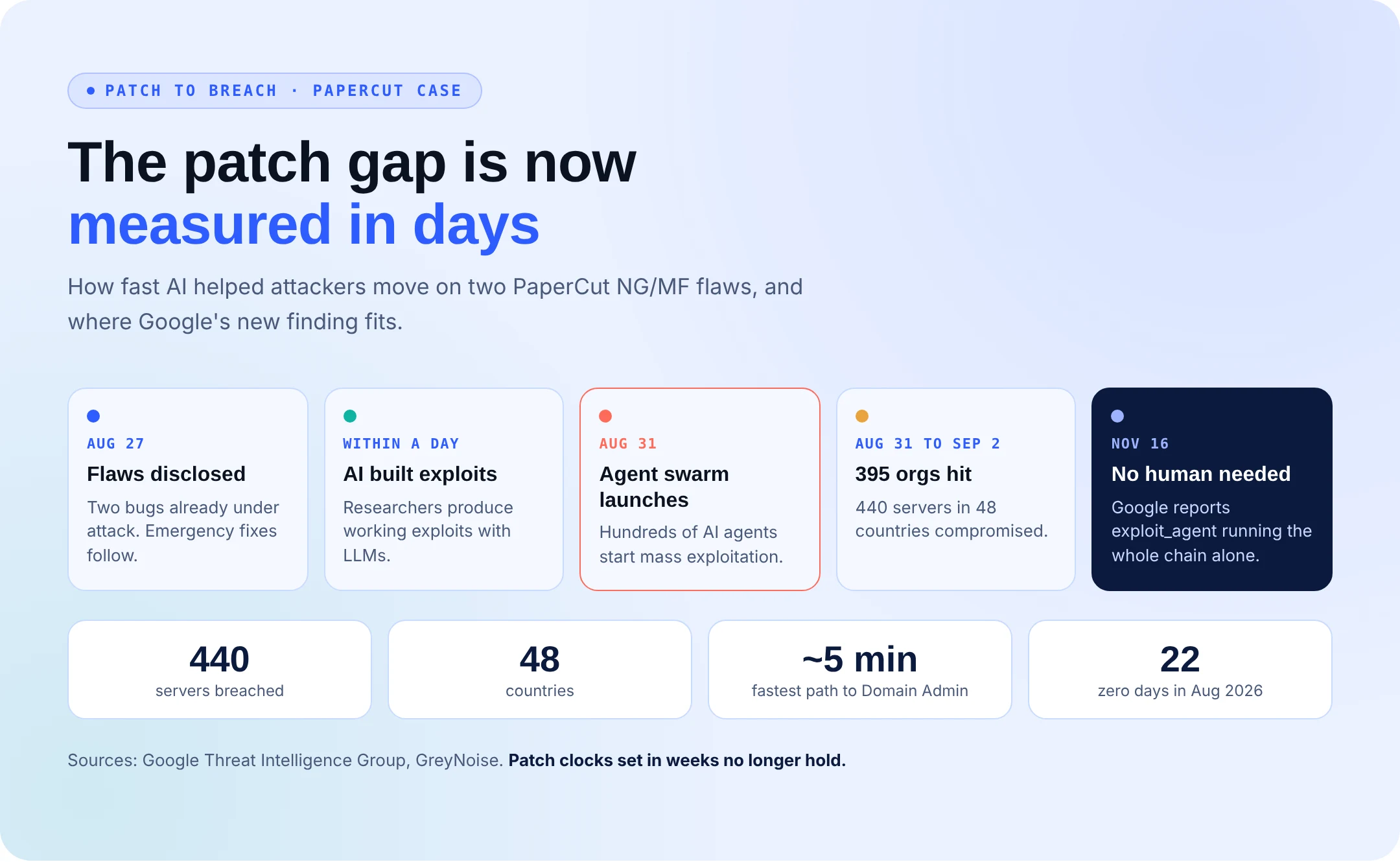
Zero-days rose from 8 a month in 2025 to 22 in August 2026. Patch clocks set in weeks no longer hold.
Also in the Report
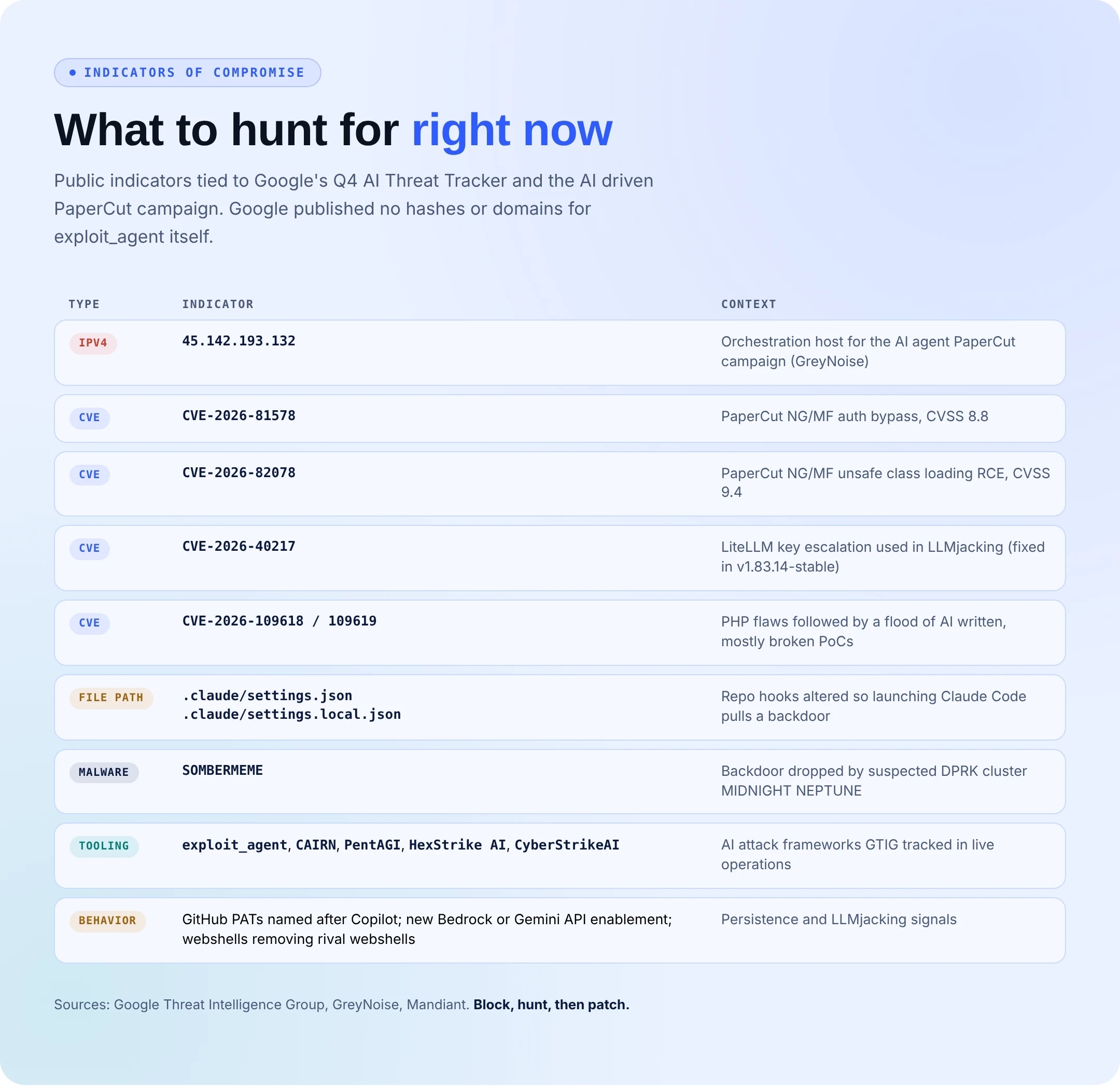
- A suspected North Korean cluster changed Claude Code settings files inside company repos so that every launch downloaded a backdoor called SOMBERMEME.
- In some LLMjacking cases, fraudulent charges on stolen AI keys and cloud credentials passed $100,000 in a single day.
- Attackers abused a LiteLLM flaw to turn limited keys into admin credentials.
How to Defend Against AI Patch Exploits
Each step shrinks the window attackers depend on.
- Set patch deadlines for internet-facing apps in days, counted from the advisory date.
- Treat each new advisory as a sign of live attacks, and hunt for webshells on exposed systems.
- Block the listed IP and check PaperCut NG/MF servers for the two chained CVEs.
- Put
.claude/settings.jsonand other agent config files under code owner review. - Keep AI keys in a secrets manager with spend limits, and upgrade LiteLLM to v1.83.14-stable.
Indicators of Compromise
Google published no hashes or domains for exploit_agent itself. The indicators below come from the wider report and the PaperCut campaign. Block, hunt, then patch.
Get to Your Own Exploit First
AI patch exploits read your vendor’s patch notes faster than your team can open the ticket. The fix is to attack yourself first, under rules your team controls.
- Attack: The Red Teammate checks which exposed systems an attacker can actually exploit after a new advisory, using AI pentesting against your real stack.
- Harden: Blue side teammates turn each confirmed finding into a fix, within the limits your team sets.
- Prove: Log every action and make it auditable, so leadership can see what was fixed and when.
- Repeat: The loop runs all the time, so your patch posture doesn’t wait for the monthly cycle.
Humans approve the decisions that need judgment, and your team gets back the hours it spent on grunt work.