On May 3rd, the Wireshark maintainers shipped a security release and wrote something nobody had ever put in a release note before. It explains why the CVE database just formally collapsed and why attackers now routinely exploit vulnerabilities that don’t have patches yet.
Read enough security release notes and they all sound the same. Memory exhaustion fix here, integer overflow there, “possible code execution” buried near the bottom. The Wireshark 4.6.5 release notes, shipped May 3rd, 2026, look like that until you hit the sentence the maintainers wrote to explain why this single update patches 43 vulnerabilities, 38 of them assigned CVEs:
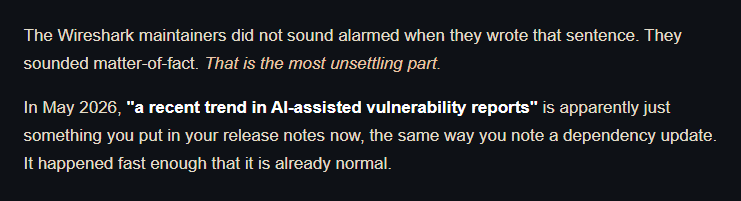
“This release fixes quite a few vulnerabilities. This is due to a recent trend in AI-assisted vulnerability reports.”
That is, as far as anyone can find, the first time a major open-source project has officially attributed a release’s volume (in the release notes themselves) to AI scanning. Not to a researcher. Not to a bug bounty programme. To a trend. The maintainers are describing something happening to them, not something they chose.
And it is arriving at exactly the moment when the infrastructure built to absorb it is formally giving up.
The CVE Database Just Stopped Working
On April 15, 2026 (three weeks before the Wireshark release) Harold Booth, a NIST computer scientist, stood at VulnCon26 and said something that should have made the front page of every security publication:
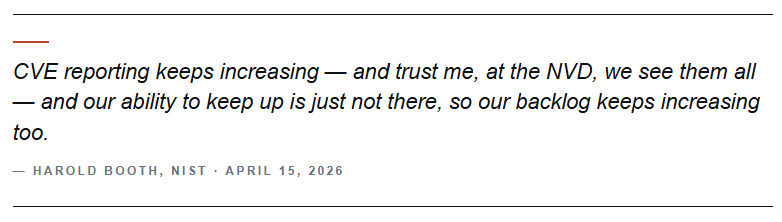
The National Vulnerability Database is the closest thing security has to a universal source of truth for software flaws. CVE identifiers come from MITRE, but the context that makes a CVE actionable (CVSS severity scores, product version mappings, weakness classifications) has come from NIST. Every major scanner, every SIEM correlation rule, every compliance framework from PCI DSS to FedRAMP depends on that pipeline.
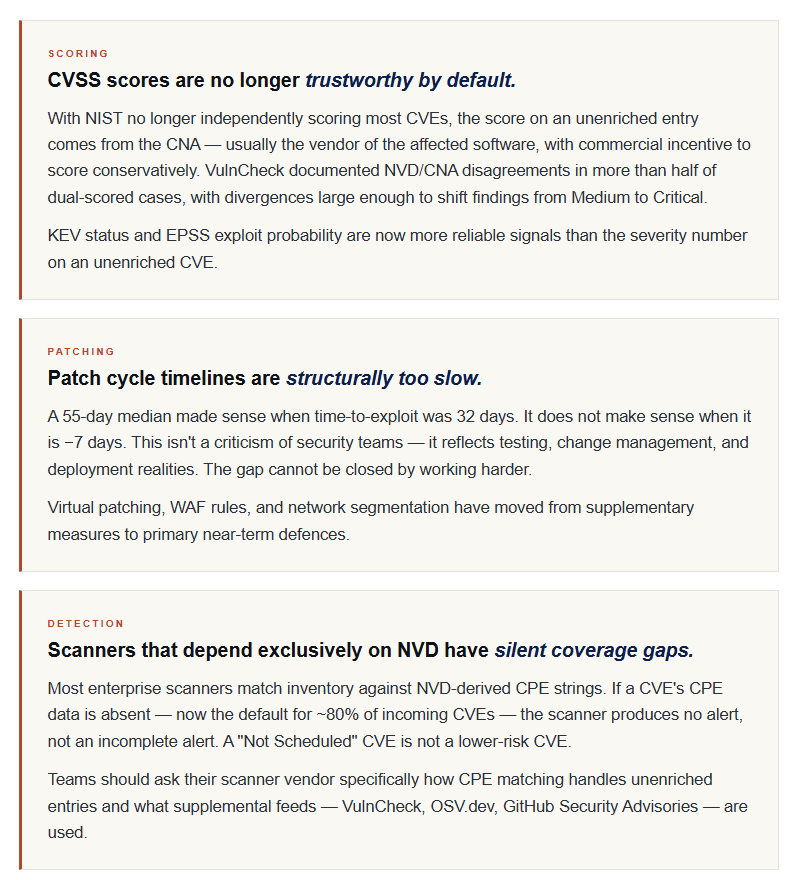
That pipeline formally collapsed on April 15th. NIST announced it will now only enrich CVEs that meet one of three criteria: they appear in CISA’s Known Exploited Vulnerabilities catalogue, they affect federal government software, or they fall under EO 14028 critical software classifications. Everything else gets filed as “Not Scheduled” — NVD’s new label for “we received this, but don’t expect us to process it.”

NIST enriched 42,000 CVEs in 2025 — 45% more than any prior year. Q1 2026 submissions are tracking 33% higher than Q1 2025. Cisco’s principal engineer at Threat Detection & Response estimates 70,135 new CVEs in 2026. Approximately 29,000 backlogged CVEs will now be permanently moved to “Not Scheduled.”
The cause, stated explicitly by NIST: the volume is driven by AI. The same tools that made vulnerability discovery accessible to a researcher with a $5 API budget are generating findings faster than a government agency can catalogue them.
Time-to-Exploit Has Gone Negative
The same AI capability that helps defenders find bugs also helps attackers weaponise them. Mandiant’s M-Trends 2026, grounded in over 500,000 hours of incident response investigations, puts a number on where the exploit window has landed:
Mean time-to-exploit: negative seven days. On average, exploitation begins before the patch is publicly available. 28.3% of CVEs are now exploited within 24 hours of disclosure — an 8.5 point increase from 2024. CrowdStrike’s fastest observed breakout time: 29 minutes. Adversary hand-off time between threat actors: 22 seconds.
To understand how strange “negative seven days” is: the entire architecture of vulnerability management was designed around the assumption of a positive number. You disclose, a patch is made, defenders race to apply it. Defenders were supposed to be at the start line. Now they are seven days behind before the starting gun fires.
The mechanism is patch diffing. When a vendor releases a patch, the diff reveals exactly where the bug was. An AI system can read that diff, reconstruct the vulnerability, and generate a working proof-of-concept in ten to fifteen minutes at roughly one dollar per attempt. Research published in 2025 found GPT-4 could autonomously exploit 87% of one-day vulnerabilities given only the CVE description. Palo Alto’s Unit 42 team documented attackers scanning for newly disclosed vulnerabilities within approximately 15 minutes of CVE announcement.
Defenders need a median of 55 days to patch half of CISA’s critical KEV vulnerabilities. Attackers need under fifteen minutes to have a working exploit after you tell them where to look.
Why Wireshark Was a Perfect Target
Wireshark has hundreds of protocol dissectors — C functions that parse raw network traffic. They take untrusted data from the wire and process it. Many were written by volunteers who were protocol experts, not necessarily memory-safety experts. They have been fuzzed extensively and reviewed many times.
That description (C code, untrusted input, long history, extensive but incomplete prior review) is exactly the profile where LLM-assisted analysis performs well. Not because the code is bad, but because the bugs that survive prior review (subtle integer underflows, off-by-one conditions in edge-case protocol states, resource exhaustion in uncommon codec paths) are exactly the class that benefits from systematic, fresh-eyes-on-every-file analysis at scale.
The 38 CVEs included crashes in dissectors for TLS, RDP, and SBC audio — all marked “crash and possible code execution.” Infinite loops in SMB2, ZigBee, USB HID, OpenFlow, RPKI. Crashes across MySQL, GSM, WebSocket, HTTP, AFP, ICMPv6, RTSP, and 802.11. An unknown number of external reporters using AI tools simultaneously swept the codebase and filed reports, forcing a release the maintainers themselves explain was caused by the tooling, not by any change in the code.
What Actually Changes in Practice
The Honest Close
The Wireshark release patched 38 CVEs because AI tools found them. The NVD stopped enriching most CVEs because AI tools found too many. Exploitation now begins before patches exist because AI tools make weaponisation fast and cheap. Three angles on the same shift: the maintainers who receive reports, the cataloguers who process them, and the attackers who exploit them.
None of this means security is over. Wireshark’s users are better protected because 38 CVEs were found and fixed. NVD’s triage model is a pragmatic response, not a denial. Researchers filing responsible disclosures are, on net, making the ecosystem more secure.
What has ended is the operational model built on the assumption that vulnerabilities emerge slowly enough to process manually, that the gap between disclosure and exploitation accommodates 55-day patch cycles, and that a government database can serve as universal truth for a disclosure rate that has tripled in five years.