Who should care: Any company running FortiGate or other edge VPNs, and every supplier that touches Nvidia data.
What could go wrong: Stolen chip designs, partner files or employee records dumped on a public leak site.
Do this: Hunt for The Gentlemen IOCs today and check every VPN account for MFA.
Worth remembering: The Nvidia Gentlemen ransomware post is a claim. It is not proof.
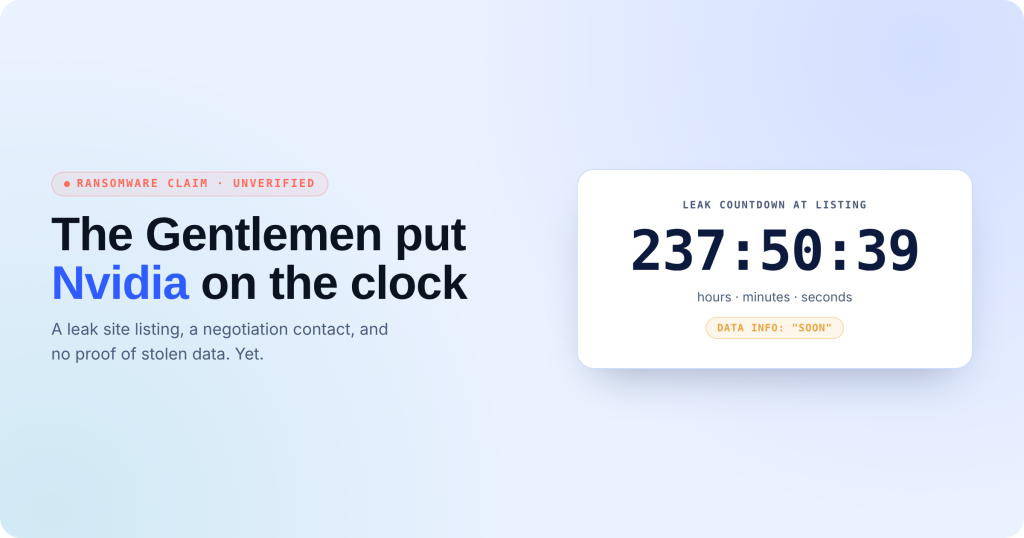
The Gentlemen, one of the busiest ransomware crews on the planet, has named Nvidia as its latest victim. However, the listing carries a countdown, a negotiation contact and zero proof. Nvidia has not confirmed a breach.
What Happened With the Nvidia Gentlemen Ransomware Post?
On the morning of November 18, The Gentlemen added Nvidia to its dark web leak site. Ransomware.live indexed the post at 09:22 UTC.
The post shows Nvidia’s logo, its NVDA ticker, a $303 billion revenue figure and a Tox ID for “negotiation.” The space for stolen data reads “SOON.” There are no sample files, no file list and no word on which systems were hit.
Also, a timer sat at roughly 237 hours, just under 10 days. Nvidia has made no public statement. It is also unclear whether the gang is pointing at Nvidia itself or at a supplier holding Nvidia data. Nvidia has been here before: in 2022, the Lapsus$ gang stole employee credentials and proprietary data from the company.
What’s the Impact?
If the Nvidia Gentlemen ransomware claim holds, GPU designs, driver source code or partner contracts could be in criminal hands. Few files on earth are worth more right now.
If it doesn’t hold, however, the listing still works as pressure. Ransomware crews pad their sites with famous names to scare the next target into paying.
Who Is The Gentlemen Ransomware Crew?
The group emerged in mid 2025 and opened its ransomware-as-a-service program to affiliates that September. Affiliates keep about 90% of each payout. Trackers now count more than 1,100 claimed victims, with over 120 posted in the last 30 days alone.
Its Go encryptor hits Windows, Linux and VMware ESXi, and the crew steals data before it encrypts. Microsoft’s analysis shows the encryptor can spread itself across a network.
Sophos studied 15 intrusions tied to the group. The median time from first malicious activity to encryption was about two days. The fastest took under 24 hours, the same pace we saw with Spirals ransomware. Affiliates often broke in through unpatched firewalls, a known FortiOS login bypass, or VPN accounts with no MFA. After that, they loaded vulnerable drivers to kill EDR, switched off backups and copied data out with Rclone.
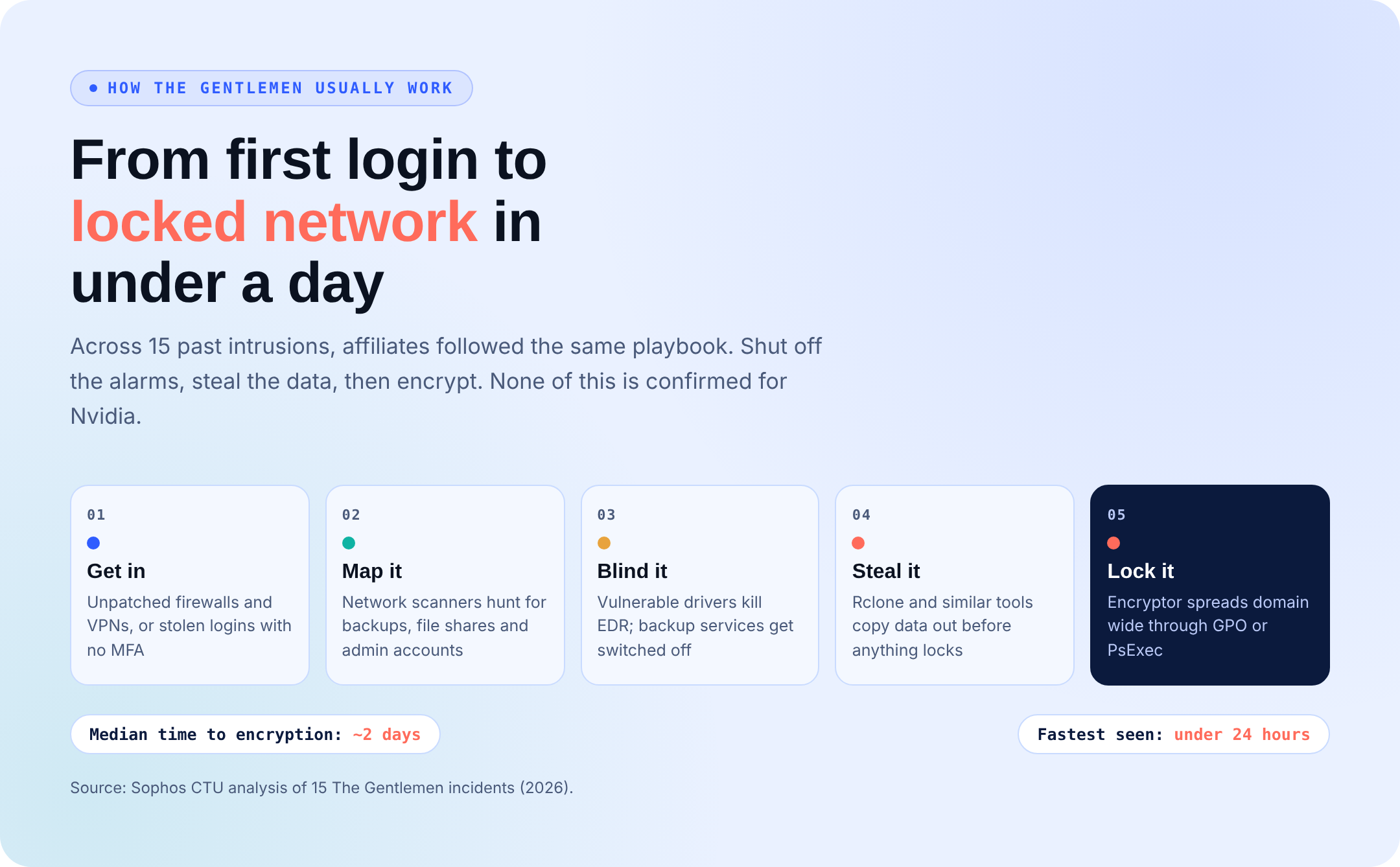
None of that is tied to the Nvidia claim yet. Even so, it is still the playbook to defend against.
The Gentlemen Ransomware IOCs to Hunt
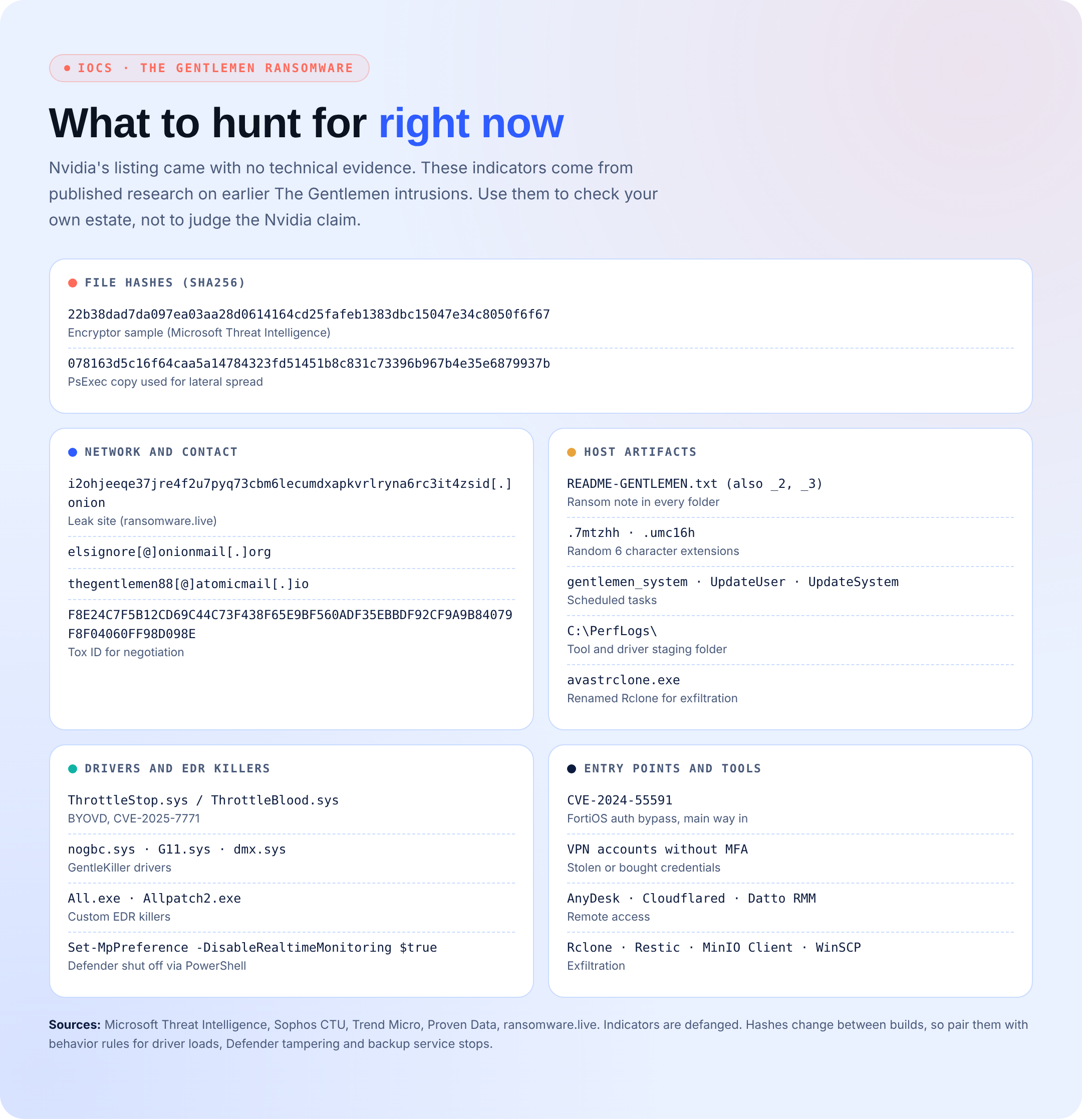
The Nvidia post included no technical evidence. Instead, the indicators below come from earlier research on this group, including Proven Data’s IOC list. Use them to check your own estate, not to judge the Nvidia Gentlemen ransomware claim.
How to Avoid This
- Patch FortiGate, SonicWall and every other edge device now
- Enforce MFA on all VPN and remote access logins
- Alert on driver loads and Defender tampering
- Keep offline backups and test restores
- Watch for Rclone, Restic and MinIO traffic leaving the network
Two Days Is Not a Lot of Runway
Whatever comes of the Nvidia Gentlemen ransomware claim, this crew wins in the gap between a strange login and a locked network. As a result, closing it takes round-the-clock eyes and patched edge devices.
- Managed SecOps watches your environment 24/7 and contains a suspicious VPN login before the encryptor ever lands
- Managed Exposure Management finds your exposed firewalls and VPNs, ranks them by real risk, fixes them and proves the fix held
- A vCISO tracks third-party risk, so a supplier breach doesn’t become your headline
- Attack. Harden. Prove. Repeat. One service, one bill, no more grunt work
Secure.com runs the security work for you and reports back on the outcome.