Who should care: Any team that publishes or pulls Elixir, Erlang or Gleam packages from hex.pm.
What could go wrong: Password hashes and 2FA secrets may have leaked, which opens the door to account takeover and poisoned packages.
Do this: Change your hex.pm password and reset 2FA today.
Worth remembering: No tampered packages have been found so far.
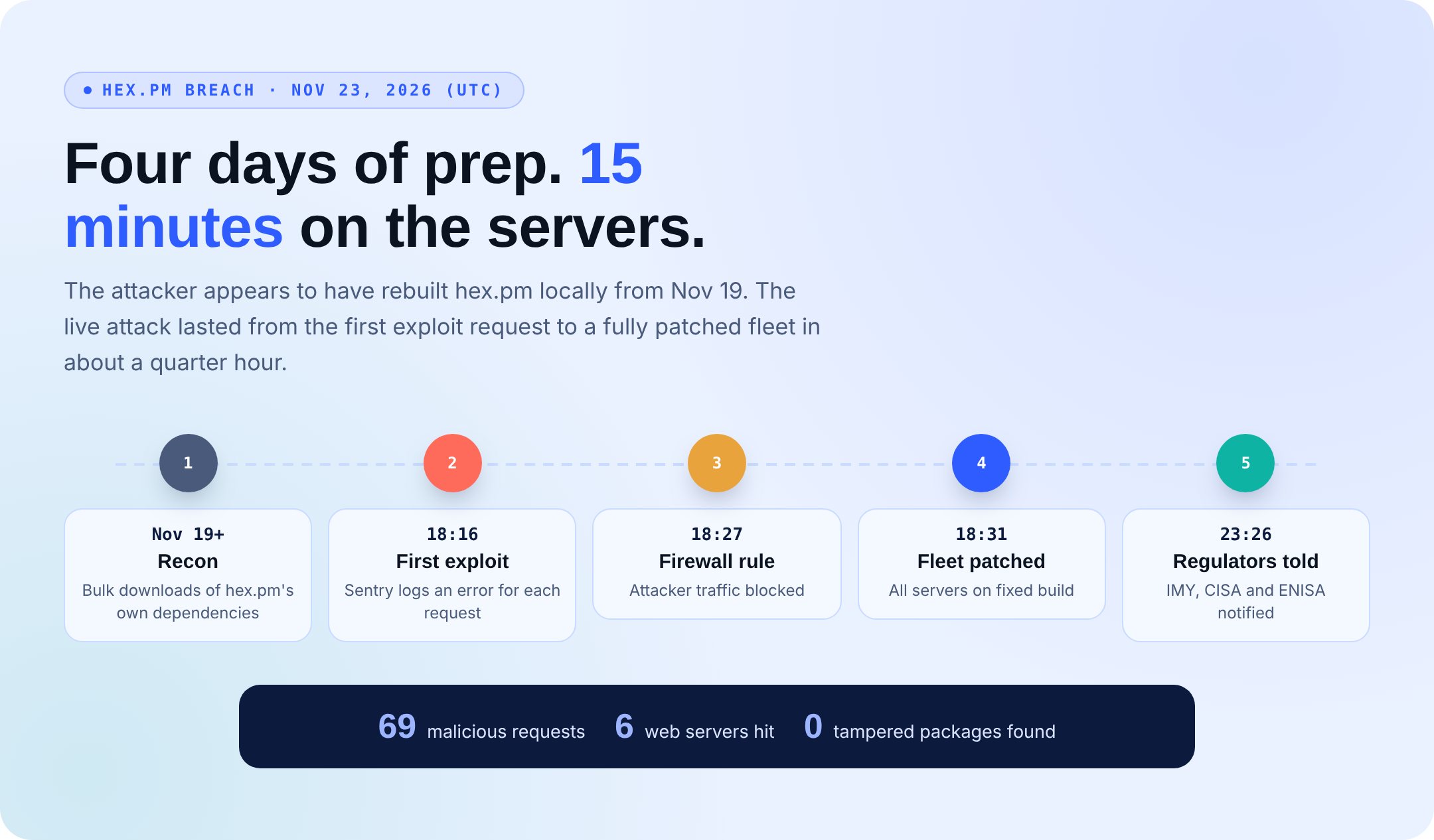
Someone appears to have spent four days building a private copy of hex.pm, then used it to break into the real one. In the Hex.pm breach on November 23, 2026, an attacker ran commands on six production servers of the package registry behind Elixir and Erlang, according to hex.pm’s incident report.
What Happened in the Hex.pm Breach?
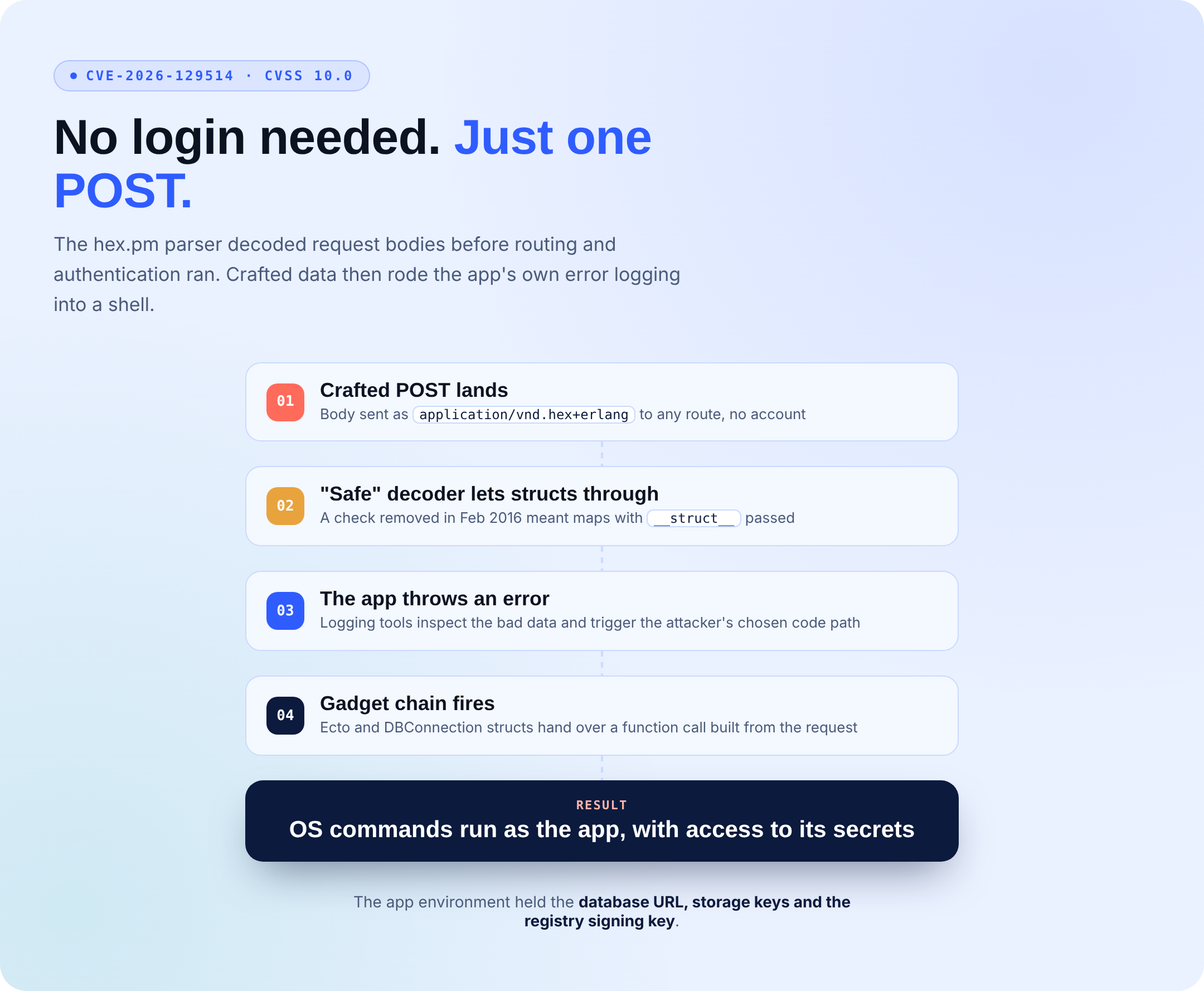
The flaw, CVE-2026-129514, carries the maximum CVSS v4 score of 10.0. hex.pm decoded Erlang data sent in POST requests before it checked who sent it. A safety check removed on February 23, 2016, let crafted data slip through, and the app’s own error logging turned that data into OS commands.
The attacker sent 69 malicious requests, starting at 18:16 UTC. A firewall rule blocked the traffic from 18:27, and every server ran a patched build by 18:31. It’s the same kind of bug as Java4Shell: data gets decoded before anyone logs in.
What’s the Impact of the Hex.pm Breach?
hex.pm does not log database reads, so it can’t rule out exposure of email addresses, bcrypt password hashes, API key hashes, 2FA secrets and sessions. Private packages may have been read too, because direct cloud storage reads are not logged either.
The packages themselves look clean. All 23 releases published during the attack match the audit log, and no older release changed. The registry signing key, however, has not been rotated yet.
Indicators of Compromise
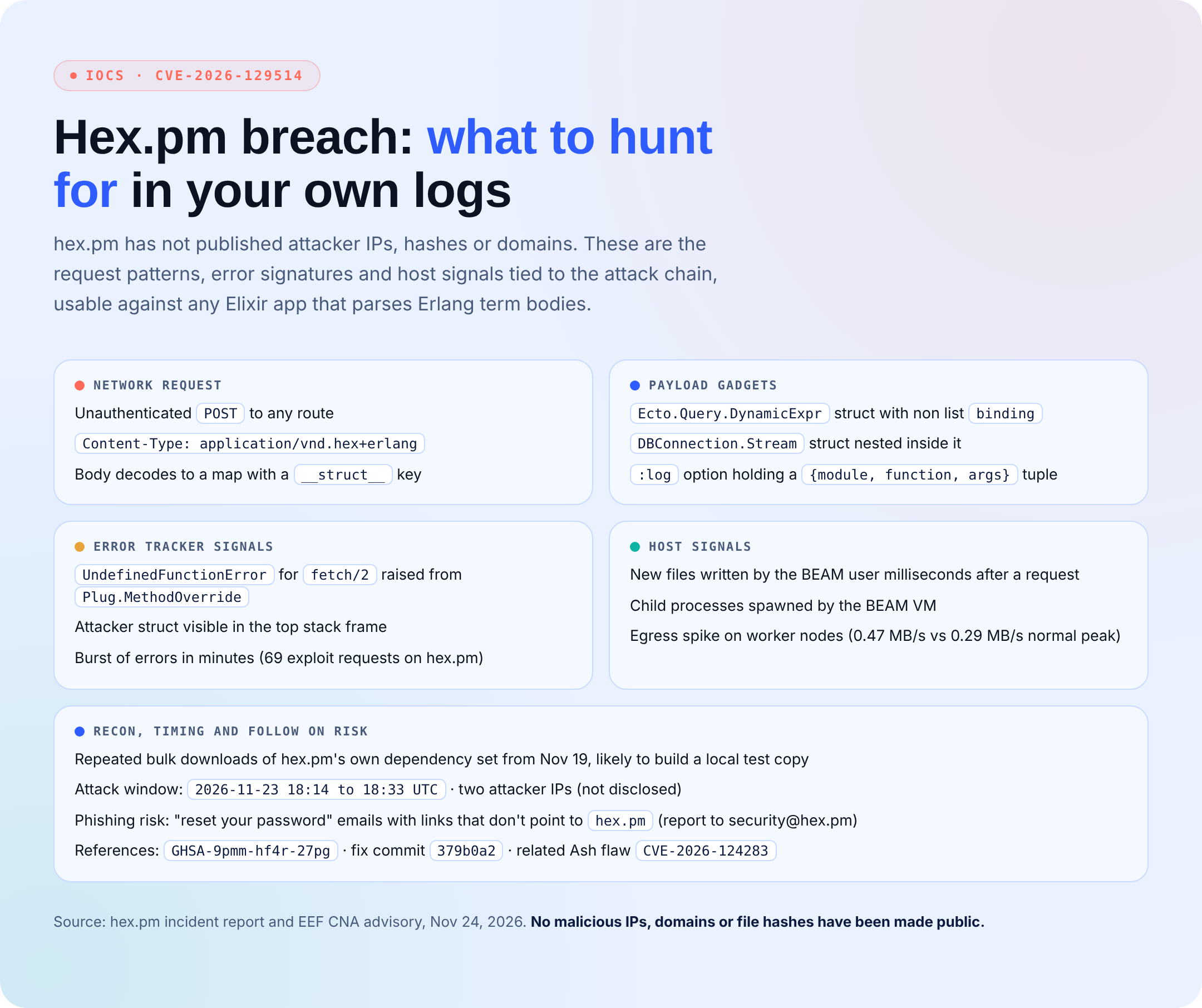
hex.pm has not published any attacker IPs, domains or file hashes from the Hex.pm breach. It only says that two attacker addresses exist. The visual below shows what defenders can check instead: the request pattern, error signatures, host signals and the attack window. The OSV record lists the affected code range.
How to Respond to the Hex.pm Breach
- Change your hex.pm password and set up a new authenticator app under your account’s security settings.
- Pull packages only from repo.hex.pm. Avoid third-party mirrors until the new Hex client ships, then run
mix local.hex --force. - Update Ash to 3.38.0, which fixes a related flaw (CVE-2026-124283).
- Watch for phishing. Check that links in any email claiming to be from Hex lead to hex.pm, and forward suspicious messages to [email protected].
- Keep anonymous requests away from binary decoders. Reject unexpected data before routing.
- Treat a sudden burst of errors as an alarm. Sentry recorded an error for every exploit request here.
Fifteen Minutes Was Fast. Most Teams Wouldn’t Get That Lucky.
hex.pm shut this down quickly because people were watching when the errors spiked. Secure.com gives you that watch-as-a-service, with outcomes instead of another stack of tools to babysit.
- Managed SecOps: AI sorts the alert flood around the clock, and human experts act the moment a strange error burst shows up.
- Managed Exposure Management: We find risky parsers, exposed endpoints and stale secrets, rank them, fix them and prove the fix held.
- vCISO: A senior security lead handles the regulator clock. hex.pm notified three agencies within about five hours.
- One service, one bill: Your team sets the rules. We do the grunt work.
Attack. Harden. Prove. Repeat.
FAQs
What was the Hex.pm breach?
Was my hex.pm account data exposed?
Were any Hex packages tampered with?
What should Elixir teams do after the Hex.pm breach?
Related Articles