
Who should care: Anyone running vCenter 7.0, 8.0, 9.0 or 9.1, plus every team with a BeyondTrust Remote Support box.
What could go wrong: An attacker holding your vCenter SAML signing key can sign in as any user, and patching alone won’t kick them out.
Do this: Patch to 9.1.1.0200, 9.0.2.0200 or 8.0 U3m today, then hunt for SSO admin accounts nobody created.
Worth remembering: The July vCenter patch does not cover this bug.
Introduction
A Chinese espionage crew had a working admin login to VMware vCenter for over two months before anyone else knew the vCenter zero-day existed. Broadcom patched it on November 19, and teams that patch today still have hunting to do.
What Happened?
Broadcom fixed the vCenter zero-day, CVE-2026-123890 (CVSS 9.8), in advisory VMSA-2026-0009. The bug sits in the VMware Directory Service, the identity store behind vCenter single sign-on. It leaks a session key over the service’s RPC interface on TCP port 2012, which lets an attacker log in as [email protected] without a password.
Google’s Mandiant says Armory Castle, a suspected China-nexus group formerly tracked as UNC5221, exploited it starting in early September 2026. Broadcom lists no workaround. vCenter 7.0, out of general support since October 2025, gets no public fix.
How They Got In
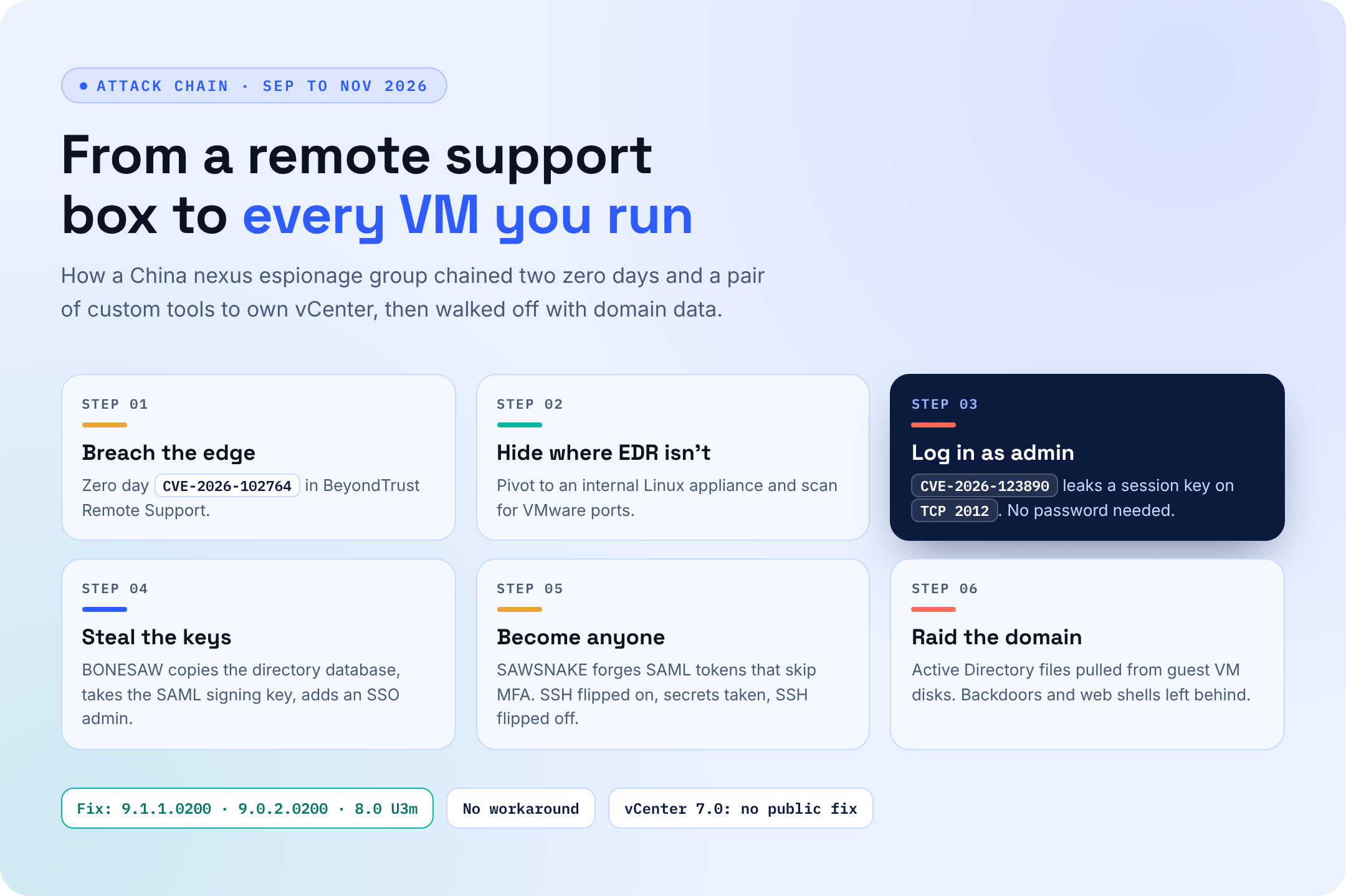
The intrusion started with a separate zero-day, CVE-2026-102764, in a BeyondTrust Remote Support appliance. The group then hopped to an internal Linux appliance with no EDR and scanned for VMware services.
A custom Go tool called BONESAW then used the vCenter zero-day to copy the directory database, steal the SAML signing key, and create a new SSO admin. A second tool, SAWSNAKE, forged SAML tokens, letting the group skip MFA and pose as any user. They briefly enabled SSH to grab the vCenter master key and PostgreSQL credentials, disabled it, then pulled Active Directory database files straight off guest VM disks.
What’s the Impact?
vCenter controls every virtual machine it manages. With the signing key in hand, an attacker can mint valid logins at will, and those forged tokens keep working after you patch the vCenter zero-day. Add stolen domain data, and one appliance becomes a skeleton key for the whole network.
How to Avoid This
- Patch the vCenter zero-day by upgrading to vCenter 9.1.1.0200, 9.0.2.0200, 8.0 U3m, or VCF 5.2.5 as an emergency change. Broadcom’s VMSA-2026-0009 FAQ lists the fixed builds.
- Restrict TCP 2012 to trusted management hosts and keep vCenter off the internet.
- Review SSO for unknown admin accounts and check VAMI logs for SSH being enabled, then disabled.
- If anything looks off, rotate the vCenter STS signing certificate and every SSO credential.
- Patch BeyondTrust Remote Support for CVE-2026-102764 and put EDR on internal Linux appliances.

Your Hypervisor Console Is Now an Identity System. Defend It Like One.
Armory Castle targets gear EDR rarely watches and admins rarely question. Closing that gap takes someone who tests the management plane the way an attacker would, fixes what turns up, and proves it stayed fixed.
- Managed Exposure Management finds exposed vCenter servers, open port 2012, and stale builds, then fixes and verifies each one in priority order.
- Managed SecOps watches around the clock for new SSO admins, odd SSH toggles, and port scans from internal appliances, and experts respond the moment one fires.
- vCISO sets the emergency patch policy for management infrastructure and plans the exit from vCenter 7.0.
- One service and one bill from Secure.com. Your team sets the rules; we do the grunt work.