Who should care: Teams that build on, ship or bundle OpenSSL 4.0.0 to 4.0.3 or 4.1.0, the versions hit by this OpenSSL buffer overflow.
What could go wrong: An app that base64 encodes a giant, untrusted blob in one call can write past its buffer and crash, or worse.
Do this: Find your OpenSSL 4.x builds, cap input sizes, and patch to 4.0.4 or 4.1.1 when they land.
Worth remembering: CVSS tells you how bad a bug could be. Your environment tells you how bad it is.
A new OpenSSL buffer overflow, tracked as CVE-2026-121481, carries a critical 9.8 score, and security feeds lit up overnight. The bug sits in the library’s base64 encoder. It is real. Triggering it, though, takes a single input bigger than 1.5 GB.
What Happened?
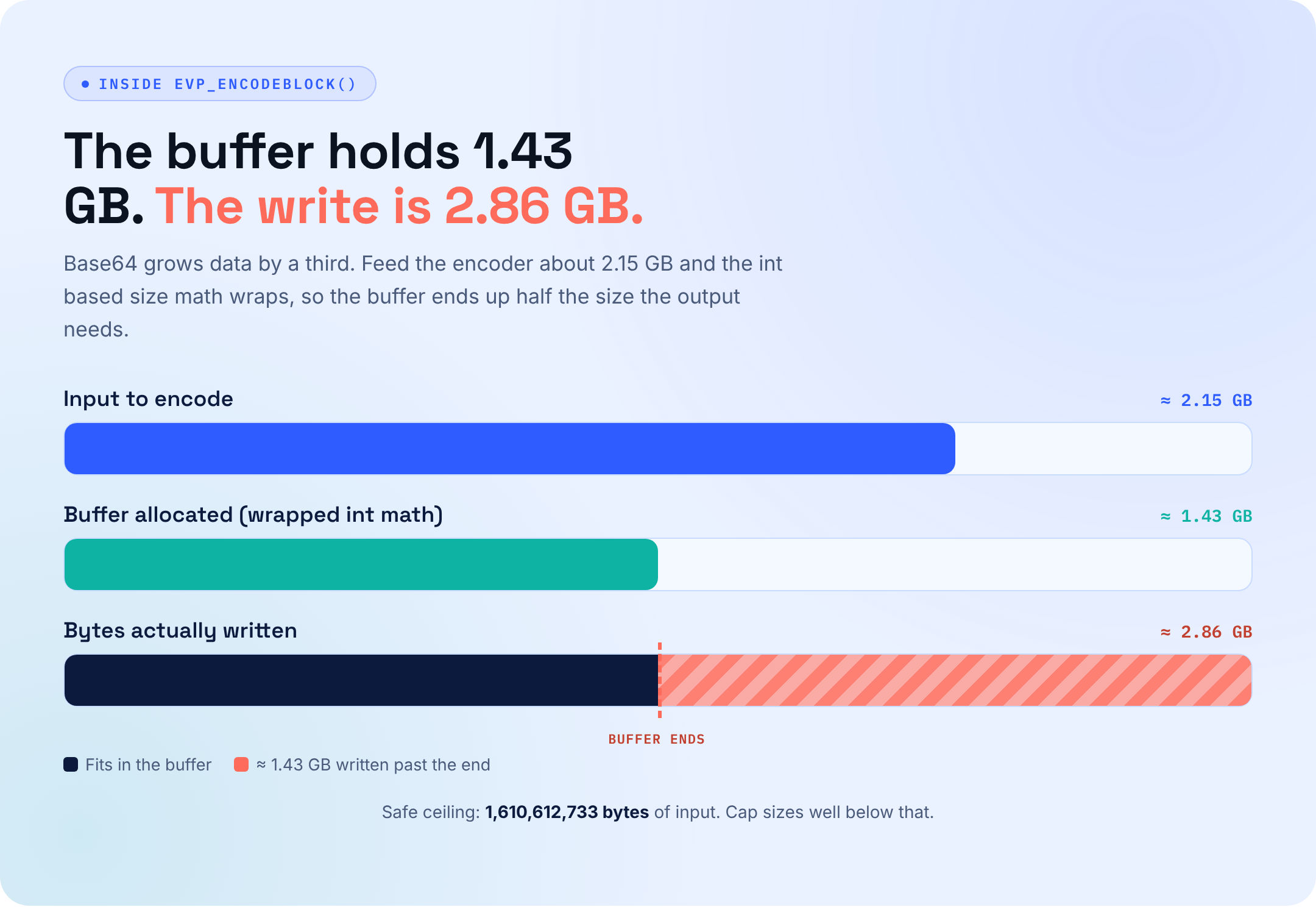
On 18 November, OpenSSL published CVE-2026-121481, a heap buffer overflow in EVP_EncodeBlock(). Pass it an input length close to INT_MAX, and the output size math overflows, so the function writes past the end of the caller’s buffer. At roughly 2.15 GB of input, the real output is about 2.86 GB, while an int-based size calculation allocates only about 1.43 GB. The confirmed trigger runs through the proxy password helper in openssl s_client.
CISA’s enrichment rated this OpenSSL buffer overflow 9.8 under CVSS 3.1, while OpenSSL itself rates it Low. No patched release exists yet, and the fix is still under review.
What’s the Impact of the OpenSSL Buffer Overflow?
For most teams, exposure is low. TLS does not base64 encode protocol messages, the 3.x branches are outside the affected range, EPSS sits at 0.14%, and there is no known exploitation or KEV listing. The real risk from the OpenSSL buffer overflow sits with custom apps on OpenSSL 4.x that encode huge, untrusted inputs in one shot.
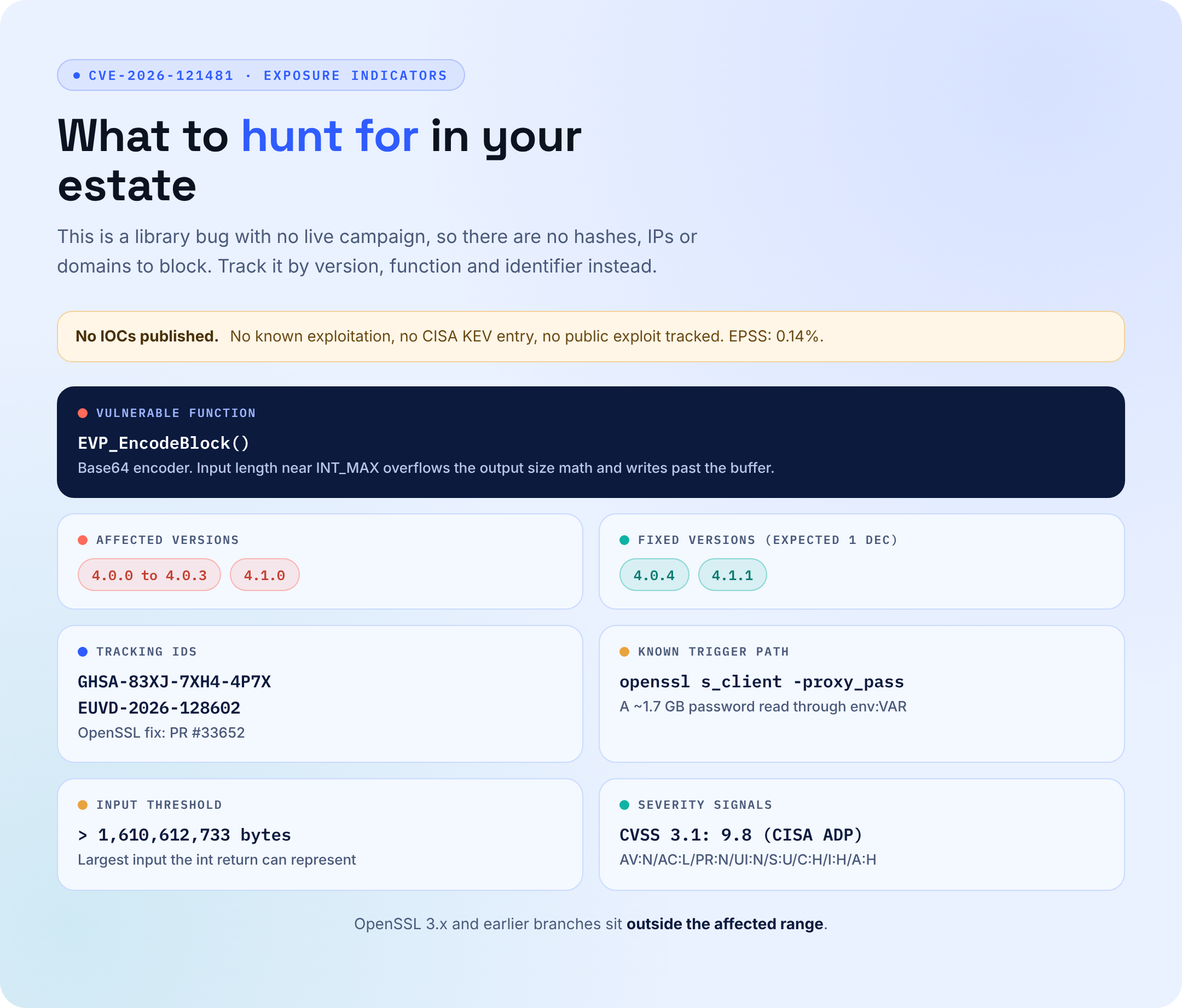
Why the OpenSSL Buffer Overflow Score Feels Louder Than the Bug
Reviewers on the fix questioned whether a CVE was warranted at all and called the reproducer synthetic. The debate over the fix itself is telling. An early version returned an error code. Later revisions switched to assertions that stop the process instead, because existing callers might not check a new return value.
The Hacker News discussion went after the API design. The caller has to calculate the output size with a nontrivial formula and never passes the buffer length, so the function cannot check it. That design flaw predates this CVE, and it is the part you should fix in your own code.
How to Limit Your OpenSSL Buffer Overflow Exposure
- Find every OpenSSL 4.0.0 to 4.0.3 and 4.1.0 build, including containers and vendored copies.
- Cap input sizes before any single base64 encode call.
- Audit code that sizes buffers with int math or casts the int return to size_t without a check.
- Upgrade to 4.0.4 or 4.1.1 when they ship (expected 1 December), then rescan.
- Rank this fix by reachability, not by the 9.8 alone.
Patch What Matters, Then Prove It
Every inflated score pulls a team away from the work that actually lowers risk. Secure.com delivers security as a service: experts find what is exposed, harden it, and prove the fix landed, so your team skips the grunt work.
- Managed Exposure Management maps every OpenSSL 4.x build across cloud, containers and endpoints.
- Findings get ranked by reachability, EPSS, and KEV status, so a synthetic 9.8 does not jump the queue.
- Each fix is tracked to closure and verified with a rescan.
- A vCISO sets patch SLAs and explains the real risk to leadership in plain terms.
- One service, one bill, and no extra tools to run.
Attack. Harden. Prove. Repeat.
FAQs
What is CVE-2026-121481?
EVP_EncodeBlock(), OpenSSL’s base64 encoder. An input length near INT_MAX breaks the output size math, so the function writes past the end of the caller’s buffer.