Who should care: Anyone running PHP 8.2 through 8.5 on a public web server, plus hosting providers and teams with old PHP boxes nobody owns.
What could go wrong: An attacker could run code on your server through the file upload progress feature if your app uses an unlucky session setup.
Do this: Set session.upload_progress.enabled=0 in php.ini today, then install the November 19 builds.
Worth remembering: The October PHP2Shell patches do not fix this bug.
Introduction
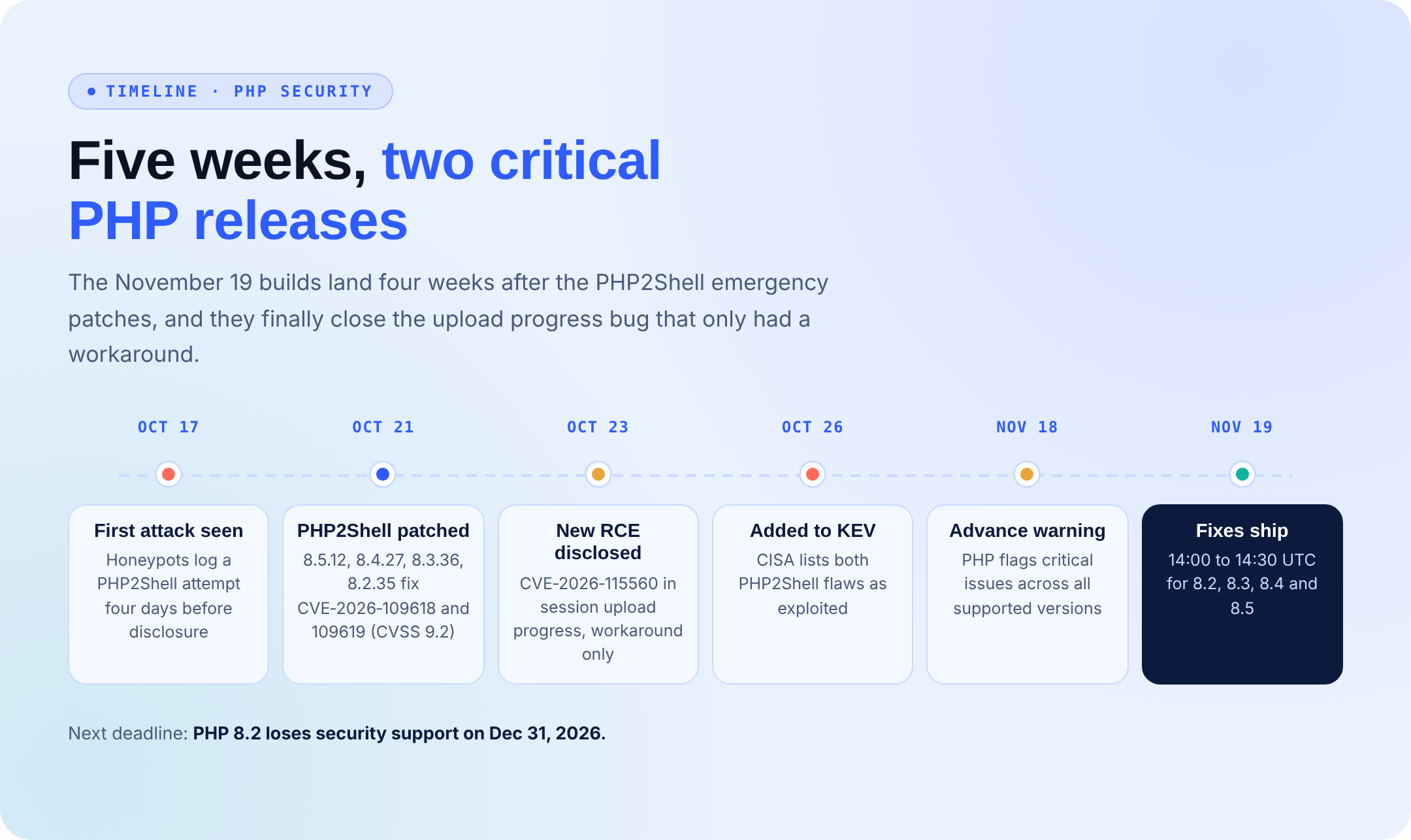
The PHP security team ships fixes for PHP critical security flaws in every supported version today, November 19, between 14:00 and 14:30 UTC. It’s the second critical PHP release in four weeks, and one of the bugs is a remote code execution flaw.
What Happened With the PHP Critical Security Flaws?
On November 18, PHP maintainers posted an advisory announcing security releases for the 8.2, 8.3, 8.4 and 8.5 branches. The highest severity is critical, though PHP says those issues need nondefault configuration or uncommon setups.
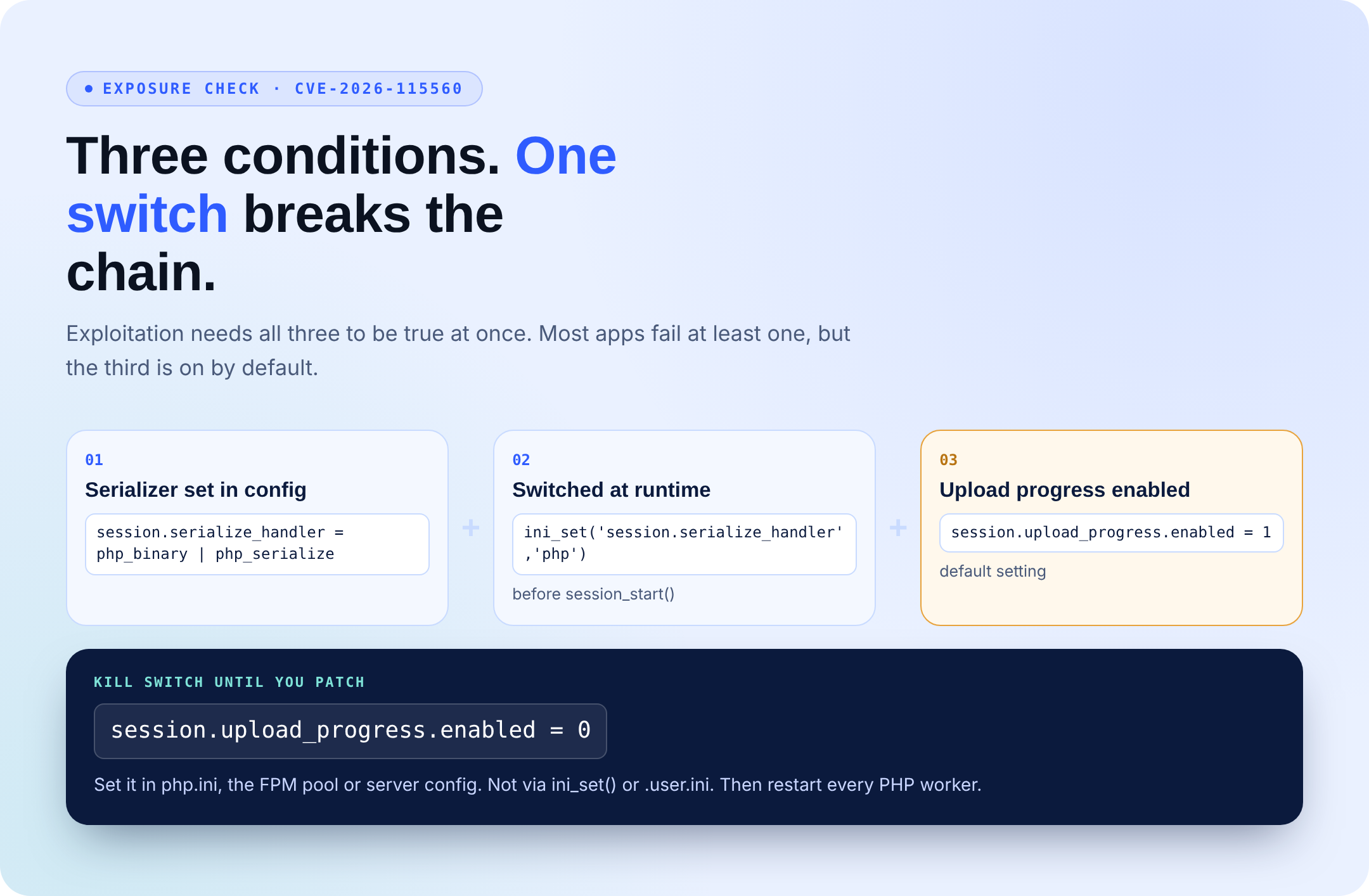
One known bug is CVE-2026-115560, a remote code execution flaw in session upload progress that PHP disclosed on October 23 with only a workaround. Exploitation needs three things:
session.serialize_handlerset tophp_binaryorphp_serialize- Code that switches it to
phpwithini_set()beforesession_start() - Upload progress left on, which is the default
What’s the Impact?
Few apps hit that exact mix, so these PHP critical security flaws are narrower than PHP2Shell. That’s cold comfort. PHP runs on about 70% of websites. CISA added both PHP2Shell flaws to its KEV catalog on October 26, and attackers later chained them with a Linux kernel exploit to root 25 servers.
Indicators of Compromise
No public IOCs exist yet for CVE-2026-115560. The October PHP2Shell attempts abused the same upload progress field, so their indicators make a solid hunting baseline: nine attacker IPs, a PHP2SHELL_XBu4Je marker inside poisoned session files, Go-http-client/1.1 tooling, and PHP workers spawning sh, curl or wget.
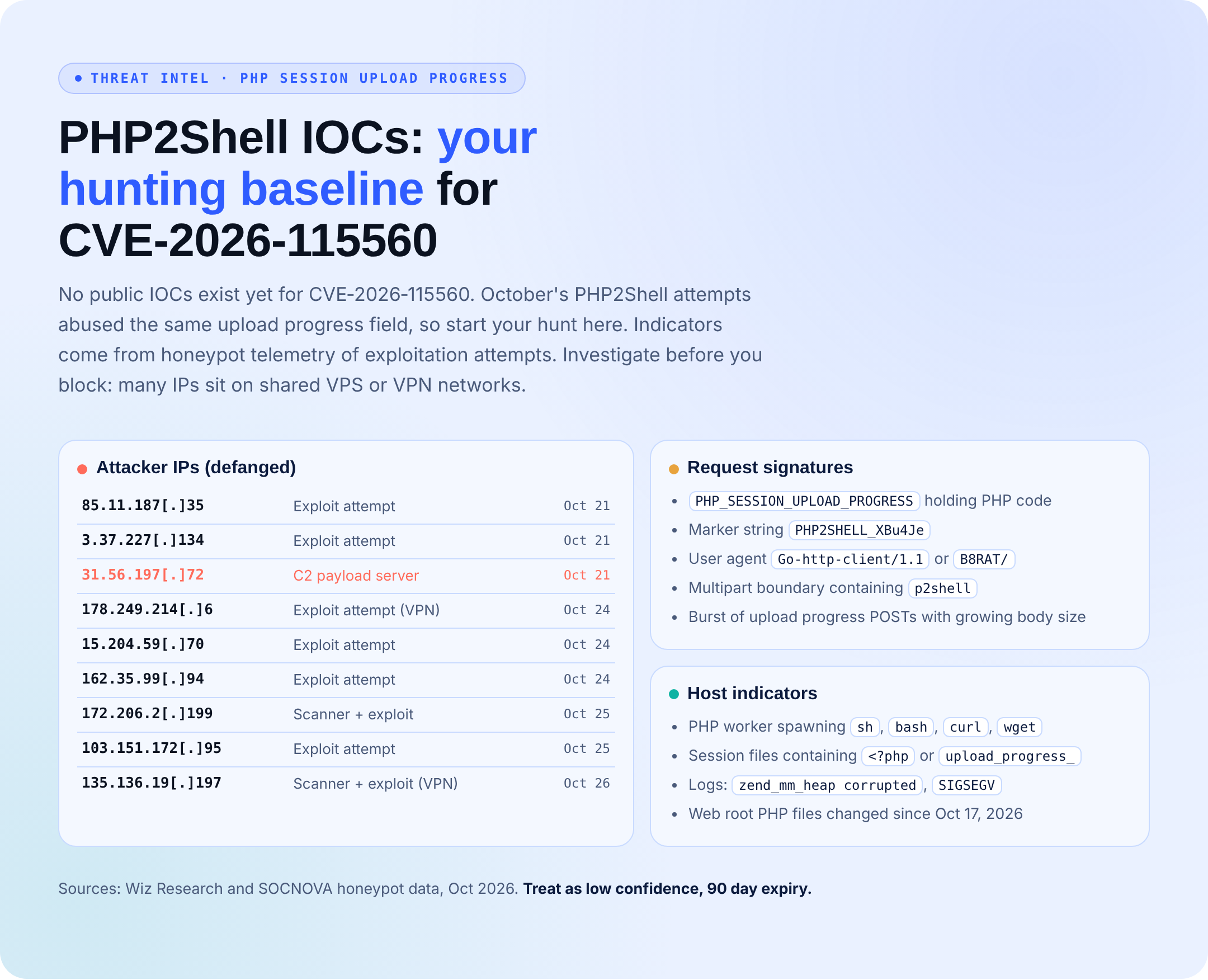
Confidence: low. These indicators come from honeypot attempts in October, not confirmed breaches. Many of the IPs sit on shared VPS or VPN networks, so investigate before you block.
How to Protect Your Servers From PHP Critical Security Flaws
- Set
session.upload_progress.enabled=0in php.ini or the FPM pool config (not withini_set()or .user.ini), then restart every PHP worker. - Search your code for
ini_set()calls that switchsession.serialize_handlertophp. - Install the November 19 builds as soon as your distro or host ships them. The October 21 releases don’t cover this bug.
- Still below 8.5.12, 8.4.27, 8.3.36 or 8.2.35? Fix PHP2Shell first.
- Plan your move off PHP 8.2, which loses security support on December 31, 2026.
Two Critical PHP Releases in One Month. Who’s Watching Yours?
The patch was never the hard part of PHP2Shell. Finding every PHP box was. Secure.com runs that work for you as a service: your team sets the rules, and you get proof the risk from PHP critical security flaws is gone.
- Managed Exposure Management finds every PHP install, version, and server setup across cloud and on-prem, including the ones nobody remembers.
- Our experts test what an attacker can actually reach and rank fixes by real exploitability, so a narrow bug like CVE-2026-115560 gets the right amount of attention.
- The same team applies the mitigation or patch, then checks that it held.
- Managed SecOps watches around the clock for PHP workers spawning shells and hunts back to the first known attack date.
- One service, one bill. Attack. Harden. Prove. Repeat.