Who should care: Anyone exposed to UAE critical infrastructure cyberattacks, from operators of energy, water, healthcare and education systems in the Gulf to the vendors who support them.
What could go wrong: A wiper erases servers and backups in one pass. There is no ransom note and nothing to negotiate.
Do this: Lock down admin accounts and keep an offline backup you have actually restored.
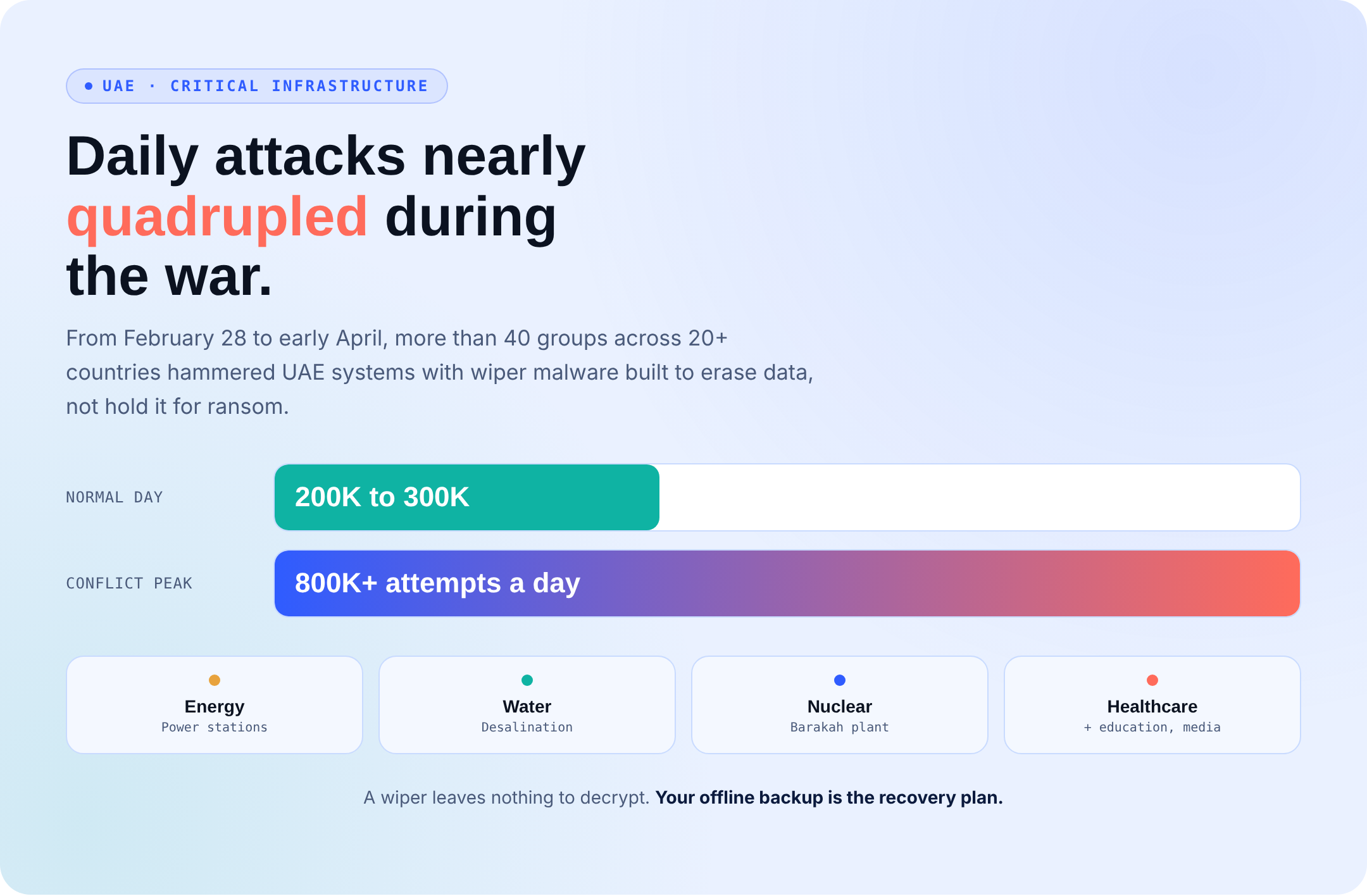
Worth remembering: At the peak of the conflict, attacks passed 800,000 a day.
The UAE critical infrastructure cyberattacks of 2026 drew in more than 40 hacking groups from over 20 countries. They used this year’s regional war to go after the country’s power grid, water plants and hospitals, mostly with wiper malware, which is built to destroy data for good.
What Happened?
On November 18, the head of cyber security for the UAE government described the full scale of the UAE critical infrastructure cyberattacks. Attacks intensified between February 28 and early April. Targets included energy sites, desalination plants, the Barakah nuclear power plant, and healthcare, education and media systems. Attackers used several wiper variants and relied on AI to build and hide their tools. Iran was named as the main driver.
Handala, a group tied to Iran, also claimed breaches of three Dubai government bodies on April 12.
What’s the Impact?
At the peak of the conflict, daily attempts jumped from a normal 200,000 to 300,000 to more than 800,000. A wiper leaves nothing to decrypt and nobody to pay, so recovery depends on clean backups. Attackers also went after home security cameras, farm CCTV and car dashcams.
IOCs From the UAE Critical Infrastructure Cyberattacks
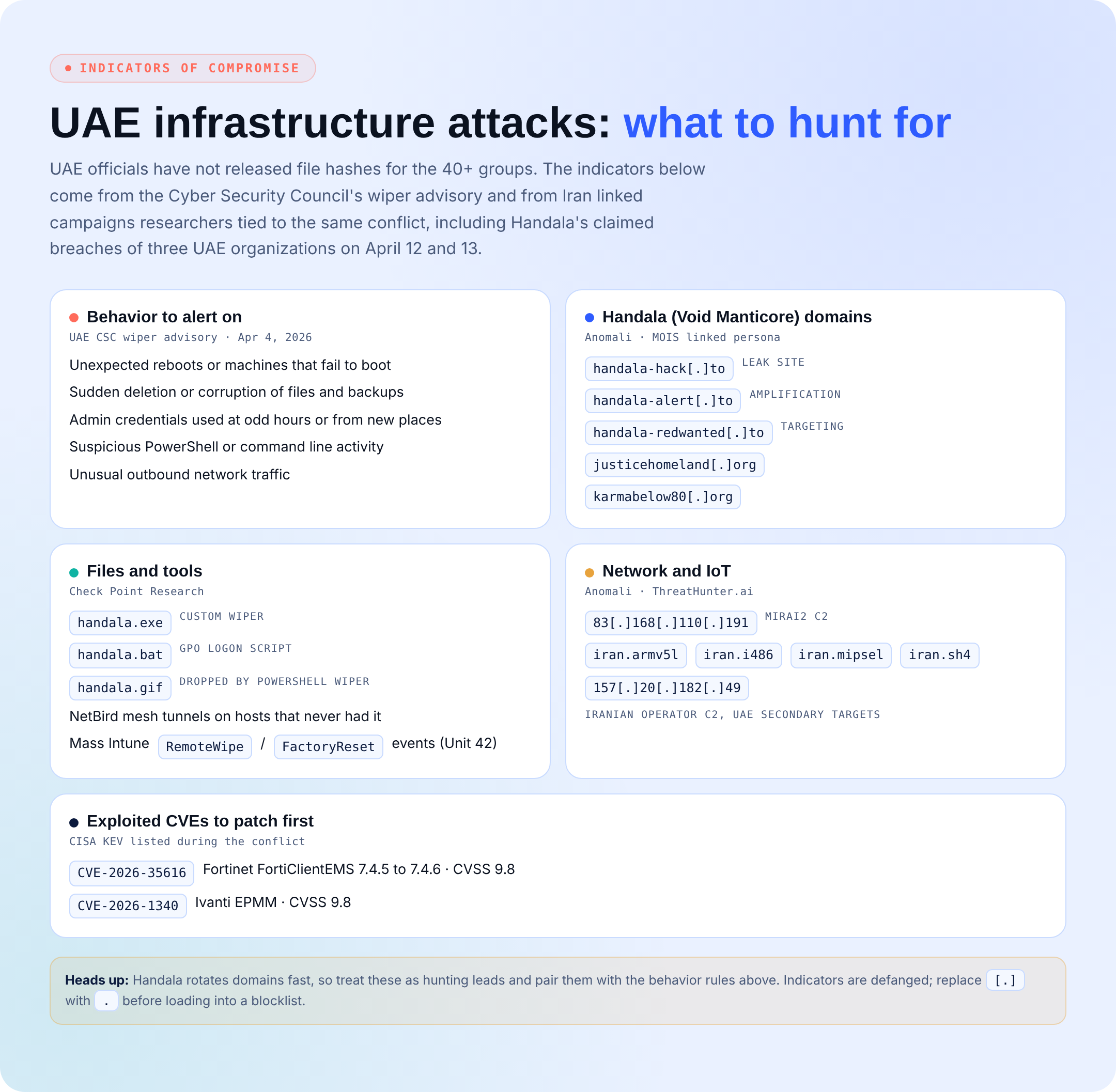
UAE officials have not released file hashes for the 40+ groups. The indicators below come from the UAE Cyber Security Council’s wiper advisory and from research on Handala’s wiper attacks. Treat the domains as hunting leads, since Handala rotates them often.
How to Avoid UAE Critical Infrastructure Cyberattacks
- Put MFA on every remote login, starting with VPN. Stolen VPN logins are a known way in.
- Patch systems exposed to the internet first, including FortiClientEMS (CVE-2026-35616) and Ivanti EPMM (CVE-2026-1340).
- Require a second admin to approve mass wipe or reset commands in Intune and similar tools.
- Keep offline, immutable backups and run a real restore test.
- Wall off plant and OT networks from office IT.
Hit Your Network Before a Wiper Does
Wiper crews count on one stolen admin login and a backup nobody has tested. Secure.com delivers Governed Defense, Powered by Offense as a service: we attack your defenses, harden what we find and prove the fix, with one service and one bill.
- Managed SecOps: Analysts watch your alerts 24/7 and isolate a host the moment mass deletion starts.
- Managed Exposure Management: We find exposed VPNs, unpatched edge devices and open paths into OT. Then we fix the riskiest first and verify each fix.
- vCISO: A senior security leader sets your priorities for backups, admin access and the UAE IA Standard, and reports them to your board.
- Attack. Harden. Prove. Repeat. Every fix is retested, so you know it held.
- Your team still sets the rules. No more grunt work. No more burnout.