Who should care: Healthcare and clinic operators, anyone running a customer login database, and security teams that rely on third-party booking platforms. The SBC Medical Group data breach hit all three.
What could go wrong: Reused passwords get tried everywhere, and treatment details get used for extortion.
Do this: Hash your stored passwords and set alerts for login floods today.
Worth remembering: Data you deleted years ago can’t be stolen.
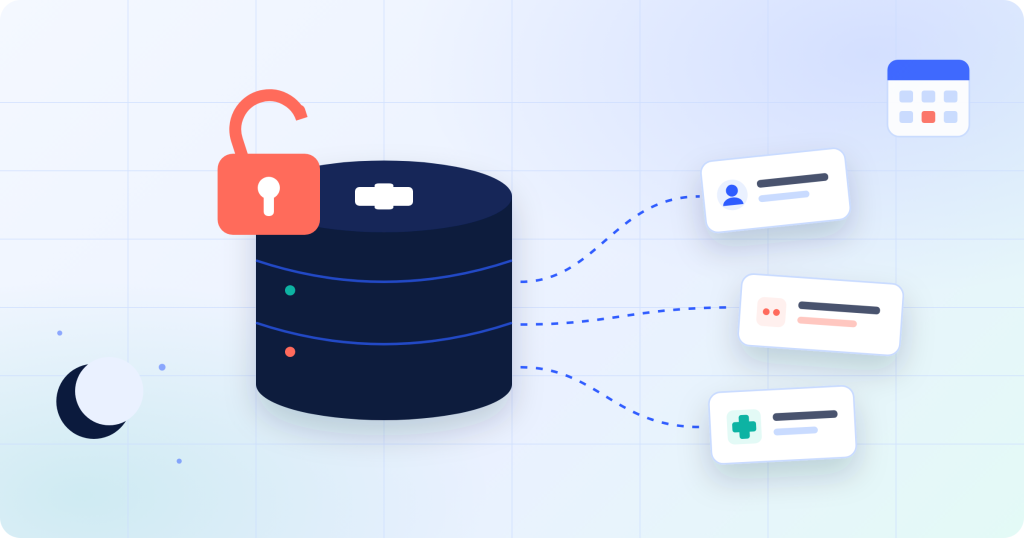
Hackers pulled names, birthdays, member IDs, and passwords for 1,624,000 customers out of a Japanese clinic group’s website databases. In the SBC Medical Group data breach, those passwords sat there unencrypted. As a result, anyone who reused one is now exposed well beyond a beauty clinic login.
What Happened in the SBC Medical Group Data Breach?
SBC Medical Group is a Nasdaq-listed company that runs aesthetic and medical clinics across Japan. On November 18, it told the SEC it had two separate incidents, both found on November 16.
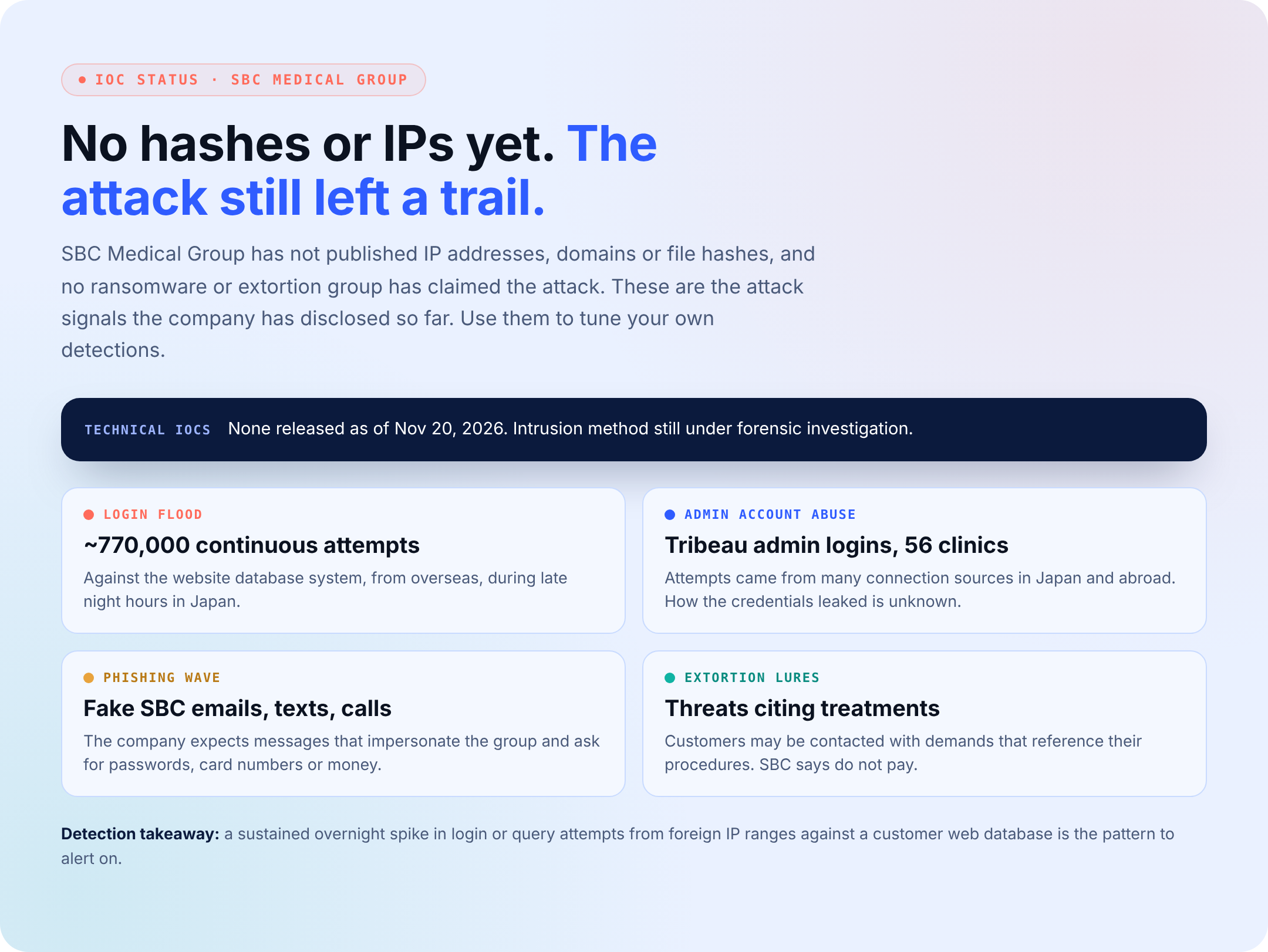
In the first, an outsider broke into the databases behind its Japanese subsidiary’s websites and stole customer data. The company’s Japanese notice says the attack came from overseas late at night, with roughly 770,000 continuous attempts against the system. In the second, someone logged into clinic administrator accounts on Tribeau, a third-party booking app used by 56 SBC clinics.
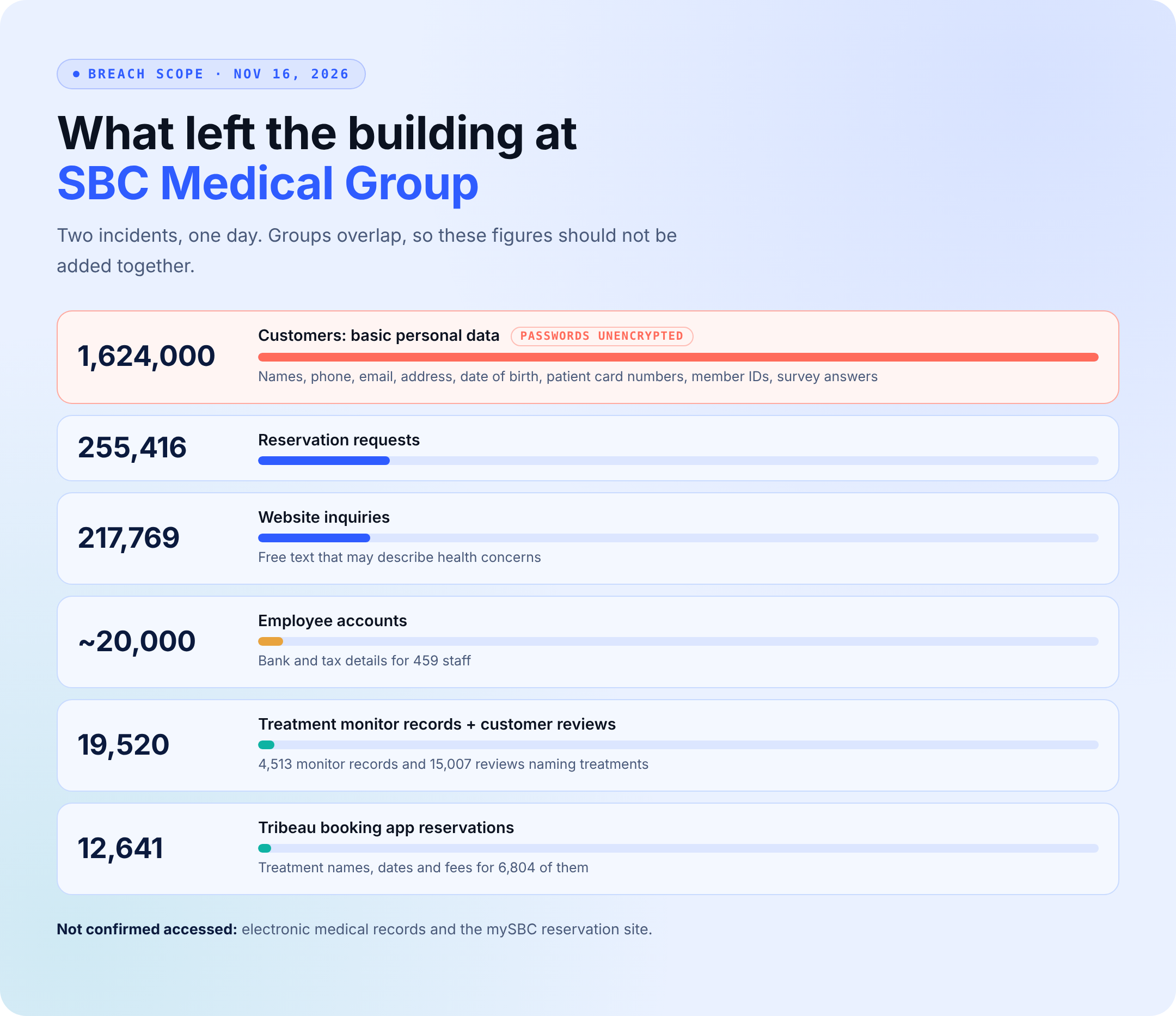
Across both incidents, the SBC Medical Group data breach exposed:
- 1,624,000 customers: names, sex, phone numbers, emails, addresses, dates of birth, patient card numbers, member IDs, survey answers and passwords
- 255,416 reservation requests and 217,769 website inquiries, some describing health concerns
- 4,513 treatment monitor records and 15,007 reviews naming treatments
- About 20,000 employee accounts, with bank and tax details for 459 staff
- Tribeau: reservation data for 12,641 people, including treatment names, dates and fees for 6,804
SBC then isolated the affected server and reported the breach to Japan’s privacy regulator the same day. It says it has seen no misuse so far and can’t yet estimate the financial hit. It also hasn’t confirmed that anyone accessed electronic medical records.
What’s the Impact of the SBC Medical Group Data Breach?
Plain-text passwords turn one breach into many. As a result, every reused password is now a key to someone’s email or shopping accounts.
However, the treatment notes and reviews are worse. They show who had which cosmetic procedure, which is ideal material for extortion, and SBC has already warned customers to expect it. In addition, the company owes Japan’s Personal Information Protection Commission a full report within about 60 days of discovery.
How to Avoid This
- Hash every stored password with a slow, salted algorithm like bcrypt or Argon2. After all, nothing justifies plain-text storage in 2026.
- Rate-limit logins and alert on floods. That way, 770,000 attempts overnight wake someone up before the first record leaves.
- Require MFA on every admin account, including the ones inside vendor platforms like booking apps.
- Delete what you no longer need. For example, some records in the SBC Medical Group data breach go back to 2004.
- Watch outbound volume from web databases and kill bulk exports that don’t match normal traffic.
The Night Shift Nobody Was Working
Most clinic groups don’t need another security tool. Instead, they need someone watching overnight and someone finding the weak spots before criminals do. That is why Secure.com runs it as a service on one bill, and your team sets the rules.
- Managed SecOps: experts on watch 24/7, so an overnight flood of login attempts becomes a blocked attack and a phone call to your team.
- Managed Exposure Management: we test your web apps and databases the way attackers would, find unencrypted passwords and open admin panels, fix them, then prove the fix held.
- vCISO: a senior security leader who sets access rules for vendor platforms, owns your breach reporting plan and briefs the board.
- Attack. Harden. Prove. Repeat. No more grunt work for your team, and no more burnout from chasing alerts alone.