PostgreSQL Vulnerabilities: 52 Flaws Patched as Version 14 Hits End of Life
- Who should care: Anyone running self-managed PostgreSQL 14 through 18, and teams that move pg_dump archives between servers.
- What could go wrong: A database login that can create a table, even a temporary one, can turn into code execution on the host.
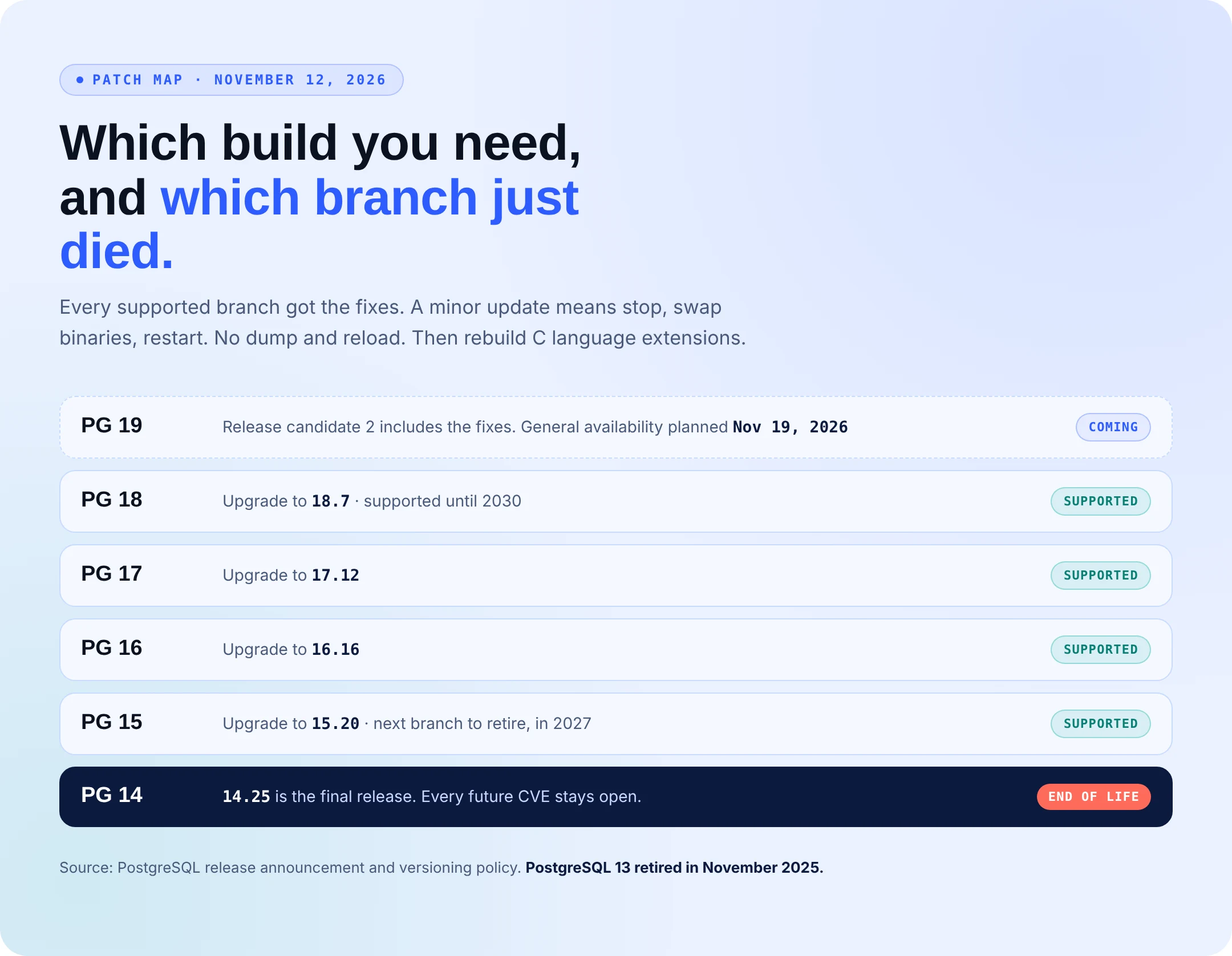
- Do this: Update to 18.7, 17.12, 16.16, 15.20, or 14.25, then rebuild C language extensions.
- Worth remembering: PostgreSQL 14 gets no more fixes. The next CVE that lands on it stays open for good.
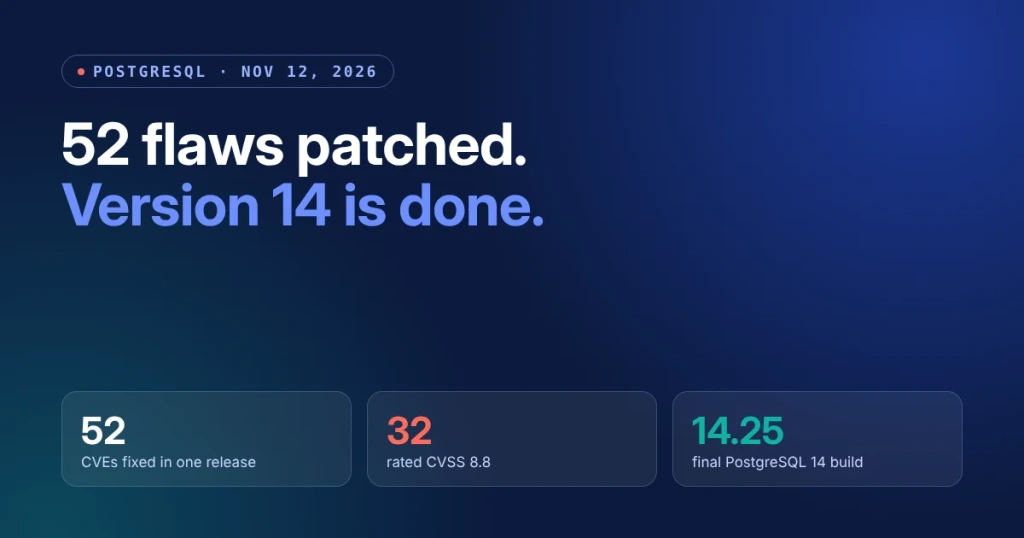
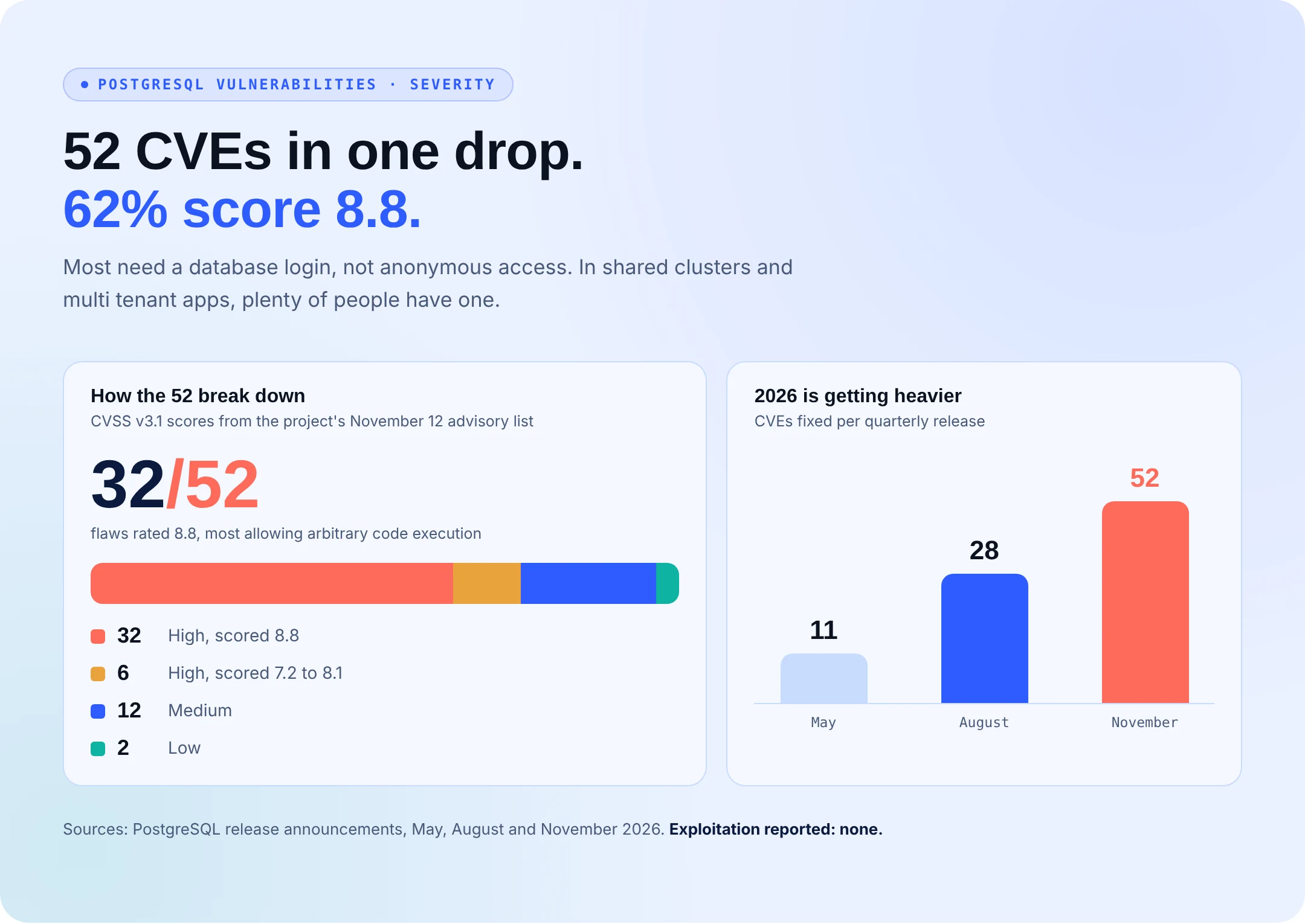
PostgreSQL shipped fixes for 52 security flaws on November 12, its biggest batch of the year. Most of these PostgreSQL vulnerabilities let a logged-in user run code on the server. The same release retired PostgreSQL 14.
What Happened?
The PostgreSQL Global Development Group released 18.7, 17.12, 16.16, 15.20 and 14.25, plus a second release candidate of PostgreSQL 19. Together they close 52 CVEs and more than 140 bugs. The year was already busy for PostgreSQL vulnerabilities: May fixed 11 flaws and August fixed 28.
The worst bug, CVE-2026-6460 (CVSS 8.8), is a type confusion flaw in the core server. A user who can create objects changes a column’s type with ALTER ... SET DATA TYPE. Stale values then confuse the server, and attacker code runs as the operating system user behind the database. Other DDL routes reach the same bug.
What’s the Impact?
32 of the 52 PostgreSQL vulnerabilities score 8.8, which is 62% of the batch. Most need a database account, and shared clusters, SaaS tenants and analytics tools hand those out freely. One flaw, CVE-2026-116322, lets a client with no login force a restart on PostgreSQL 18.
Your Backups Are in Scope Too
CVE-2026-116314 (8.8) lets a crafted archive run code through pg_restore. CVE-2026-116330 (8.8) allows command injection through the restore.sql script in tar-format dumps. On an unpatched client, restoring a dump you don’t control is now risky.
PostgreSQL 14 Is Done
14.25 is the last release of a branch that shipped in September 2021. Under the project’s versioning policy, PostgreSQL 18 stays supported until 2030, and PostgreSQL 19 is due on November 19.
How to Avoid This
- Patch every branch: Update to 18.7, 17.12, 16.16, 15.20 or 14.25 and restart. You don’t need to dump and reload.
- Rebuild C language extensions: The release notes say you only get full protection after you do.
- Trim privileges: Until you patch, remove
CREATEandTEMPrights from roles that don’t need them. - Restore with care: Only restore archives from sources you trust, and use patched
pg_dumpandpg_restore. - Clean up after: Reindex GIN, pg_trgm GiST, and bpchar B-tree indexes, take a fresh full backup, and schedule the PostgreSQL 14 migration.
PostgreSQL Vulnerabilities: Indicators of Compromise
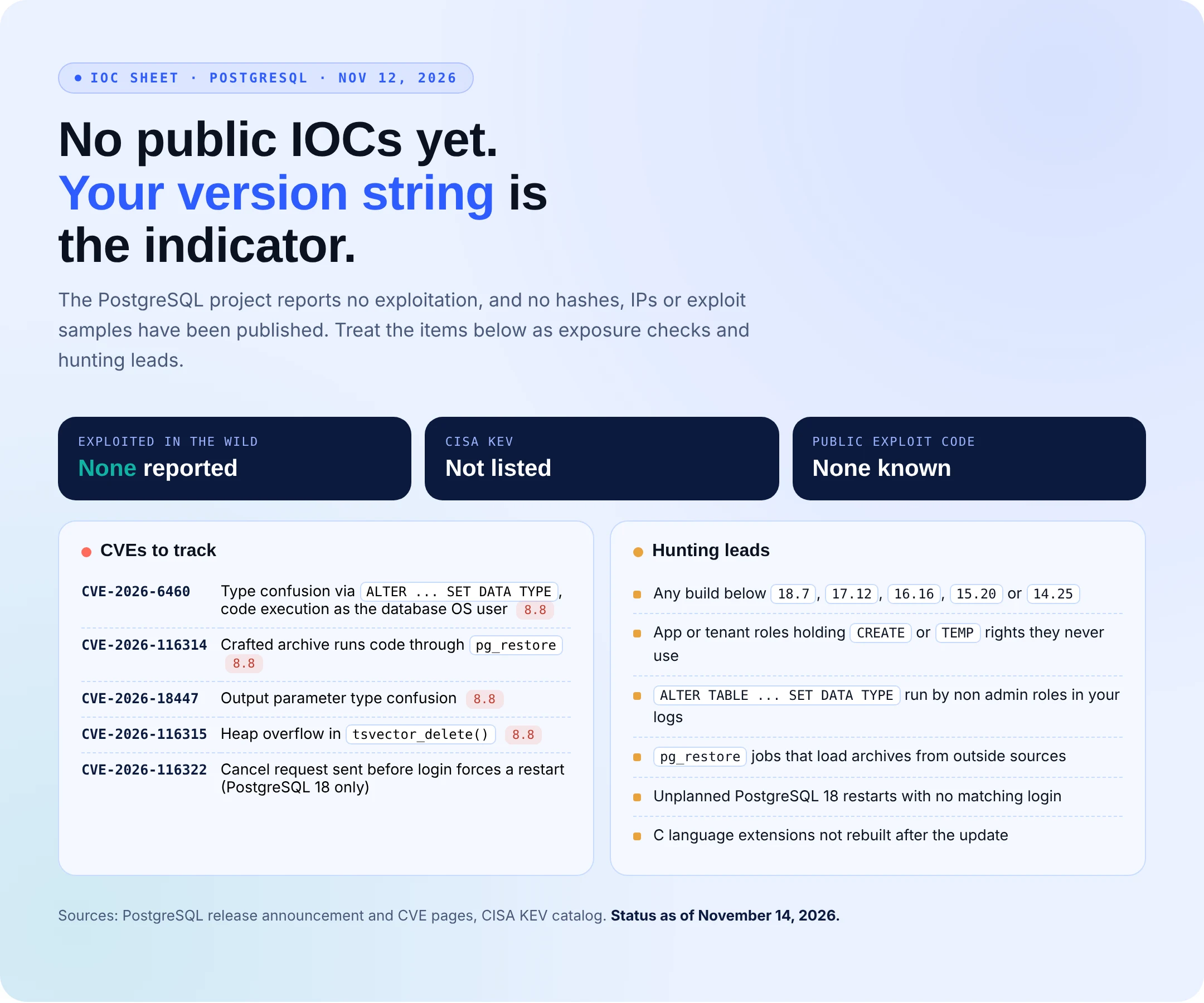
No public IOCs exist yet. The project reports no exploitation, none of the 52 CVEs are in CISA KEV, and no public exploit code has surfaced. For now, your version string is the clearest indicator.
Patched Isn’t the Same as Proven
A version number tells you what’s installed. It won’t tell you which login can reach code execution, or which forgotten PostgreSQL 14 replica still serves production.
- Secure.com’s AI teammates find every PostgreSQL instance, including old replicas and container images, and flag unpatched or end-of-life builds.
- They attack your databases the way an attacker would, testing low-privilege roles with CREATE rights, inside rules your team sets.
- Exposure gets ranked by reach, so an internet-facing cluster with shared logins moves ahead of an internal sandbox.
- Fixes like patching, extension rebuilds, and role cleanup wait for your team’s approval. Then they get tested again to prove they held.
Conclusion
The fix for these PostgreSQL vulnerabilities is a routine minor update. The hard part is finding every PostgreSQL server you own, and every one still on 14. Patch this week, then put the migration on the calendar.
Related Articles on Secure.com
- Node.js Vulnerabilities: 16 Flaws Let Attackers Crash Servers and Steal TLS Keys
- Windows Updates SQL Server Slowdown: October Patches Leave Database Connections Hanging Open