Cursor Marketplace Breach: Two Bad Builds, New Hashes, and a Backdoor That Outlives the Uninstall
- Who should care: Teams running Cursor on macOS or Windows, and anyone who cleared hosts on October 30 using the first indicator list.
- What could go wrong: A planted SSH key and hidden persistence that outlive the uninstall.
- Do this: Rescan with the revised IOCs, then rotate secrets from a clean machine.
- Worth remembering: A clean version number is not a clean machine.
The first all clear may have been wrong. Cursor widened its notice on the trojanized Claude Code extension: two bad builds instead of one, fresh hashes, and Linux persistence traces. Teams that swept early after the Cursor Marketplace breach need to sweep again.
What Happened?
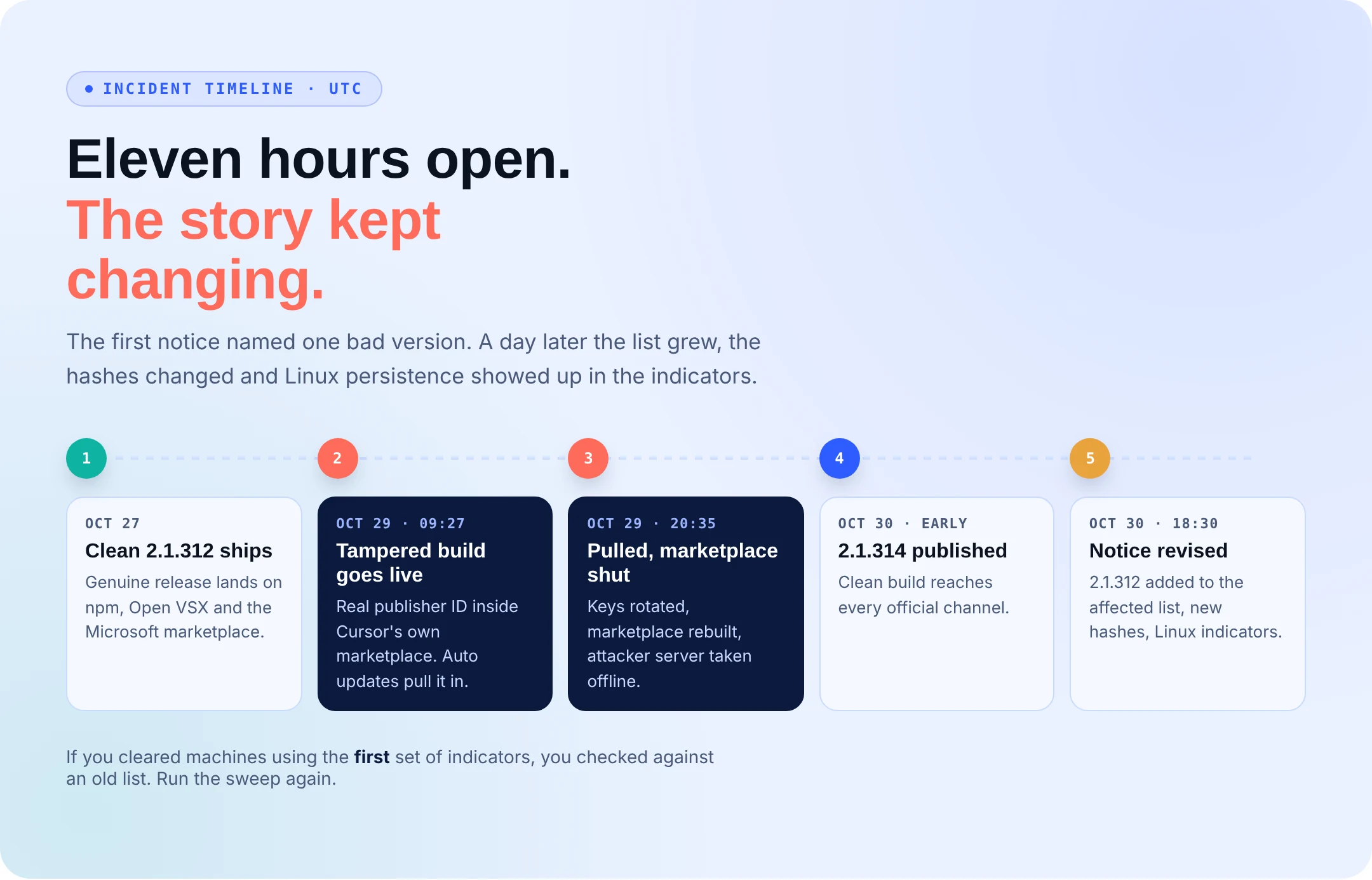
On October 29, a tampered build of the Claude Code extension sat in Cursor’s own extension marketplace for about 11 hours, from 09:27 to 20:35 UTC. It carried the real publisher ID, so automatic updates installed it with no prompt. Cursor told reporters that at most 5,000 users were exposed. It pulled the build, shut the marketplace, rotated keys, and rebuilt it.
Then the story shifted. A revised security notice on October 30 added version 2.1.312 next to 2.1.313, swapped in new hashes and listed Linux indicators. Open VSX, Microsoft’s marketplace and npm never served the bad code, so this supply chain attack stayed inside Cursor’s own channel.
Inside the Payload
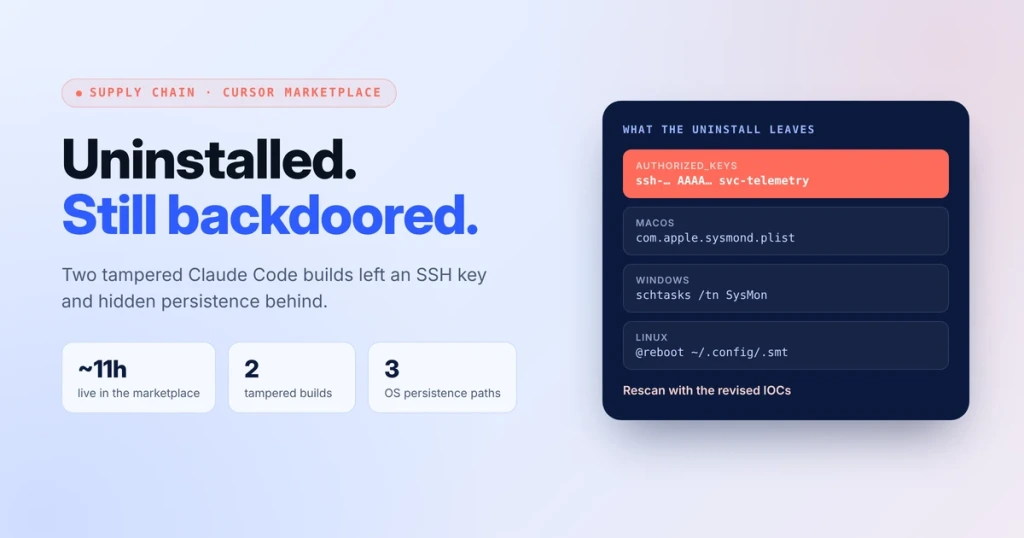
The loader fired the moment the editor loaded the extension. No chat, no click. It sent host details and the names of secret holding environment variables to 134[.]209[.]82[.]225 on port 8099. It appended an SSH key tagged svc-telemetry to authorized_keys and tried to open a reverse tunnel back to port 22. Persistence landed as a LaunchAgent, a SysMon scheduled task or a reboot cron job.
The Rescana IOC breakdown and the Cloud Security Alliance research note describe the same chain.
What’s the Impact?
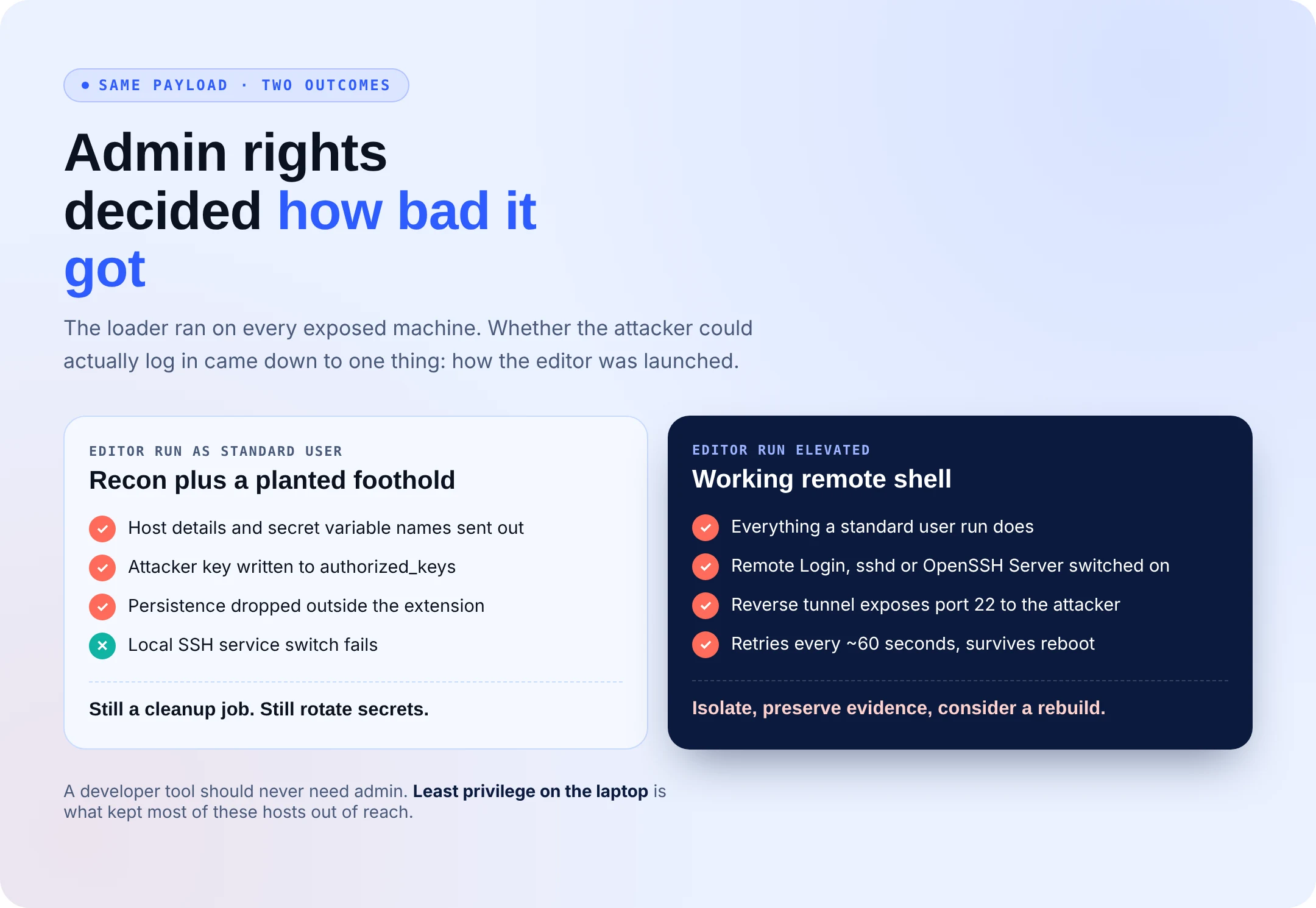
Enabling the local SSH service requires admin rights, so most hosts hit by the Cursor Marketplace breach never gave the attacker a working shell. They still leaked recon and kept a planted key. And since a clean 2.1.312 also exists, a version check alone proves nothing.
Cursor Marketplace Breach: Indicators of Compromise
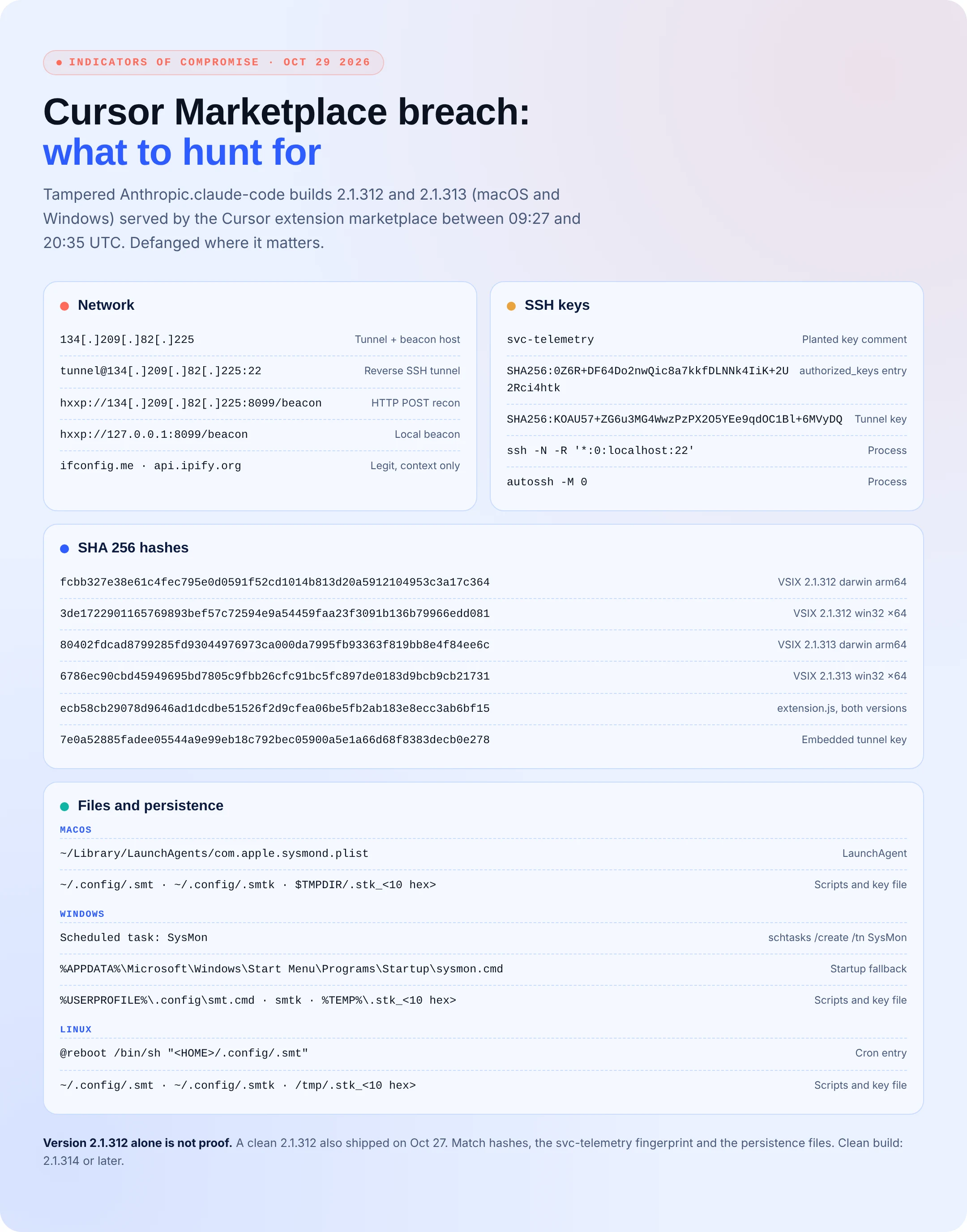
Match these against every Cursor host, including machines you cleared with the first list. The full hash set is in the graphic below.
- Network:
134[.]209[.]82[.]225, port 22 for the reverse tunnel and port 8099 for the/beaconPOST - Planted key: comment
svc-telemetry, fingerprintSHA256:0Z6R+DF64Do2nwQic8a7kkfDLNNk4IiK+2U2Rci4htk - Tunnel key:
SHA256:KOAU57+ZG6u3MG4WwzPzPX2O5YEe9qdOC1Bl+6MVyDQ - macOS:
~/Library/LaunchAgents/com.apple.sysmond.plist,~/.config/.smt,~/.config/.smtk - Windows: scheduled task
SysMon,Startup\sysmon.cmd,%USERPROFILE%\.config\smt.cmd - Linux: cron entry
@reboot /bin/sh "<HOME>/.config/.smt" - extension.js (both versions):
ecb58cb29078d9646ad1dcdbe51526f2d9cfea06be5fb2ab183e8ecc3ab6bf15
How to Avoid This
- Rerun your sweep with the revised hashes and the svc-telemetry key fingerprint.
- Hunt the persistence files, not version numbers. Uninstalling leaves them behind.
- Upgrade to 2.1.314 or later and pin extension versions on developer machines.
- Never run your editor as admin.
- Rotate every credential the host could reach, using a clean machine.
Your Editor Updates Itself. Who Checks the Update?
Extension marketplaces push code onto developer laptops with zero review on your side. Secure.com puts governed AI Teammates on that grunt work, and your team approves every consequential action.
- Red Teammate attacks the laptop path first, testing whether a planted key or tunnel could reach source, pipelines or cloud.
- SOC Teammate sweeps every endpoint for the revised indicators and builds the case, so nobody has to grep laptops one by one.
- AppSec Teammate maps which repos, registries, and tokens each affected machine could touch.
- Cloud Security Teammate flags stale keys tied to exposed hosts and opens the rotation with full context.
- Every fix gets retested and logged as proof. Your team sets the rules. AI Teammates do the work.
Conclusion
The Cursor Marketplace breach changed shape a day after the first notice, and early sweeps used an old list. The planted key and the persistence files stay put after an uninstall. Rescan with the revised indicators, clean the hosts by hand, and rotate secrets from a machine you trust.