Who should care: Teams that run QUIC servers on OpenSSL 3.5, 4.0 or 4.1 and accept streams opened by clients, because that is the setup this OpenSSL QUIC vulnerability targets.
What could go wrong: A remote peer piles up memory on your server until it slows down or crashes.
Do this: Find every OpenSSL build you ship, and plan the upgrade to 3.5.10, 4.0.4 or 4.1.1 for 1 December.
Worth remembering: The default QUIC stream policy blocks this attack. However, custom configurations might not.
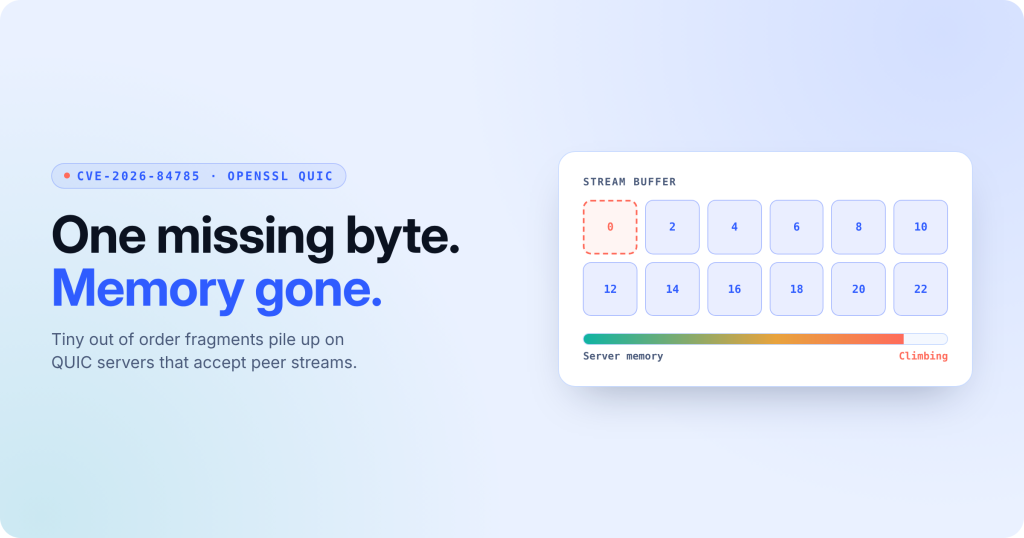
OpenSSL disclosed a new QUIC flaw on 24 November 2026. Tracked as CVE-2026-84785, it lets a remote peer make a server hoard memory. First, the peer sends tiny data fragments. Then it holds back the very first byte. OpenSSL will ship fixed releases on 1 December.
What Happened?
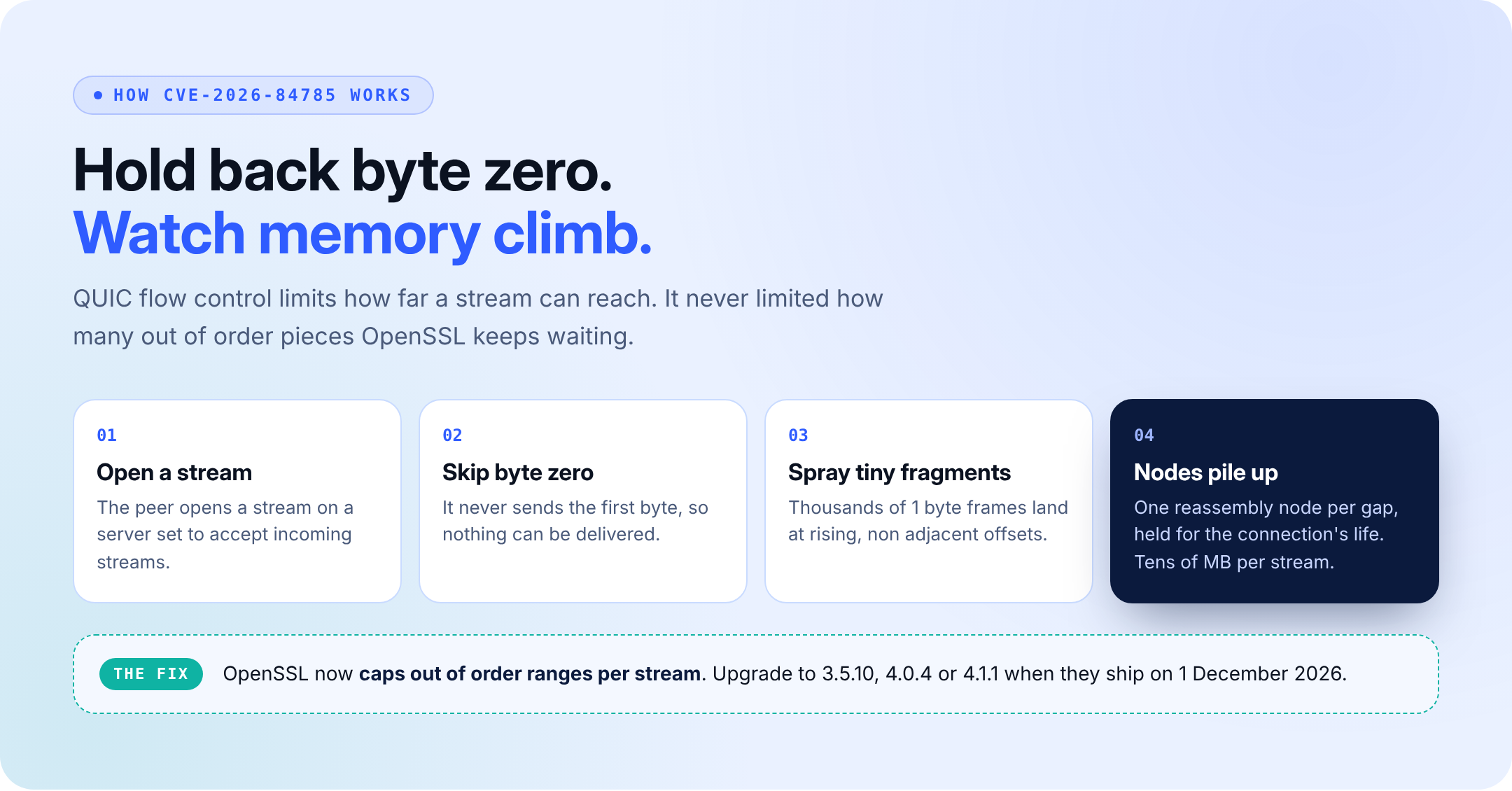
QUIC flow control caps how far into a stream a peer can write. However, it never capped how many out-of-order pieces the receiver keeps. Instead, OpenSSL created a reassembly node for every gap, with no upper limit.
In practice, the OpenSSL QUIC vulnerability works like this. An attacker opens a stream, sends thousands of one-byte fragments at rising offsets, and never sends byte zero. Because the server cannot deliver anything, every node stays in memory for the life of the connection. The OpenSSL security advisory rates the issue Low and lists it as CWE-770 (allocation of resources without limits).
What’s the Impact of the OpenSSL QUIC Vulnerability?
A single stream can grow to tens of megabytes. So, if an attacker spreads that across many streams and connections, a server can hit memory pressure or a denial-of-service.
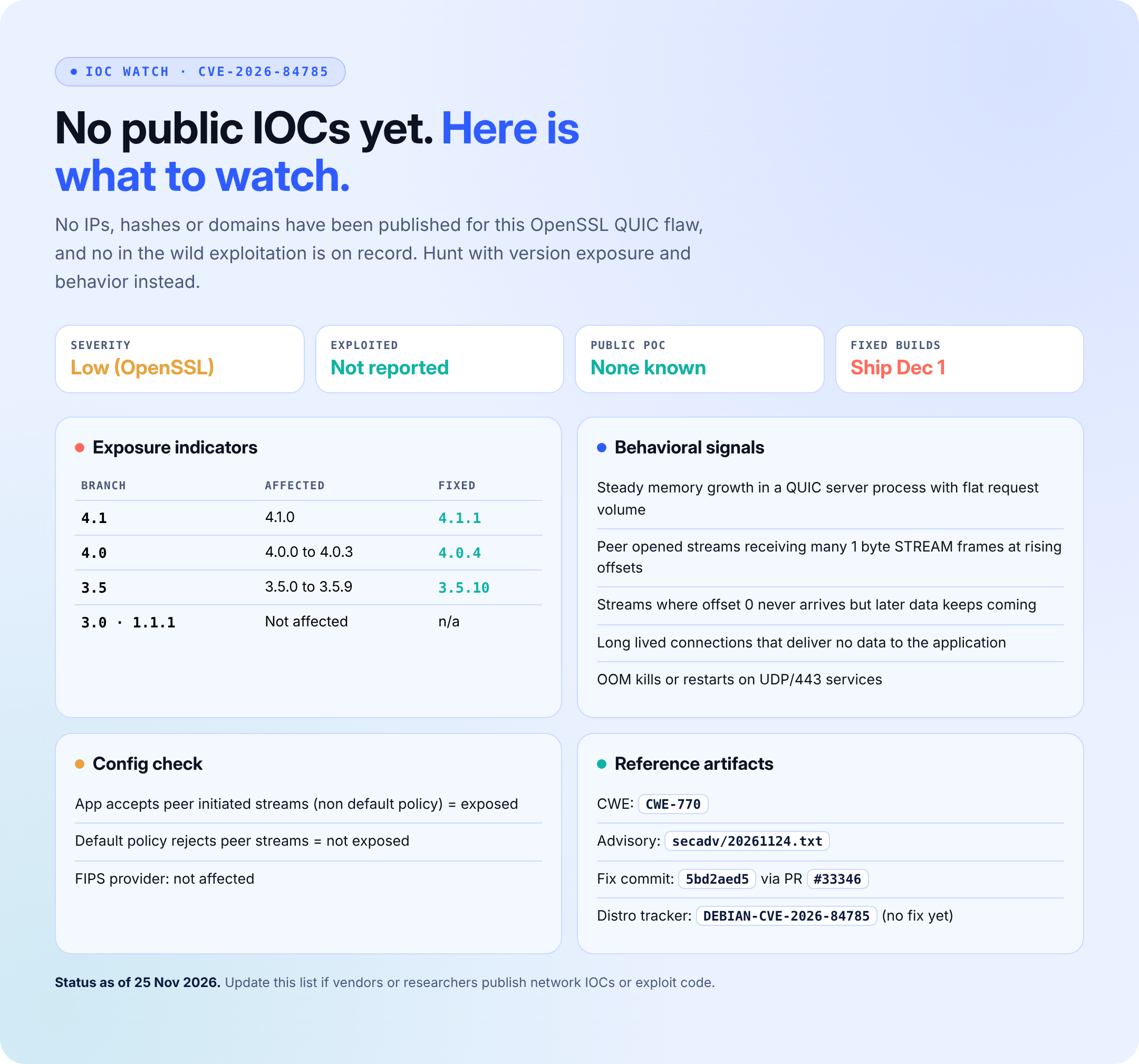
That said, the bug only reaches applications that accept peer-initiated streams. The default policy rejects those streams, so most deployments stay safe. The flaw also does not affect the FIPS module, and no one has reported exploitation so far.
Which Versions Does the OpenSSL QUIC Vulnerability Affect?
The flaw hits OpenSSL 4.1.0, 4.0.0 to 4.0.3, and 3.5.0 to 3.5.9. In contrast, it does not touch OpenSSL 3.0, 1.1.1 or 1.0.2. For the full history, see the OpenSSL vulnerabilities list.
How to Avoid the OpenSSL QUIC Vulnerability
- Upgrade to OpenSSL 3.5.10, 4.0.4, or 4.1.1 when they ship on 1 December. The fixes already sit in the public repository.
- Find hidden copies in containers, appliances, and statically linked builds. For example, some Linux distributions, including Debian, have not shipped a fix yet.
- Keep the default policy that rejects peer-initiated streams, unless your application truly needs them.
- Set memory limits and alerts on QUIC services, so a slow pileup shows up before an outage.
- Bundle the patch with CVE-2026-107494, the other QUIC fix in the same advisory, in one change window.
Low Severity Still Needs an Owner
A Low-rated bug in a library nobody remembers shipping is how quiet outages start. Since an OpenSSL QUIC vulnerability like this one rarely tops a queue sorted by severity score, someone has to own it to the finish. That is why Secure.com runs security as a service, so you get the outcome on one bill instead of another tool to babysit.
- Managed Exposure Management finds every OpenSSL 3.5, 4.0, and 4.1 build across cloud, containers, and hosts.
- It ranks this CVE by real reachability, so QUIC servers that accept peer streams get fixed first.
- Experts track the 1 December releases, push the patch, and verify that it landed.
- Managed SecOps watches QUIC endpoints 24/7 for memory spikes and odd stream behavior, then acts.
- Your team sets the rules. Meanwhile, we take the grunt work and hand back proof.
FAQs
What is the OpenSSL QUIC vulnerability CVE-2026-84785?
Which OpenSSL versions does it affect?
When will the fix be available?
Is my QUIC server exposed with the default settings?
Has anyone exploited CVE-2026-84785?
Related Articles