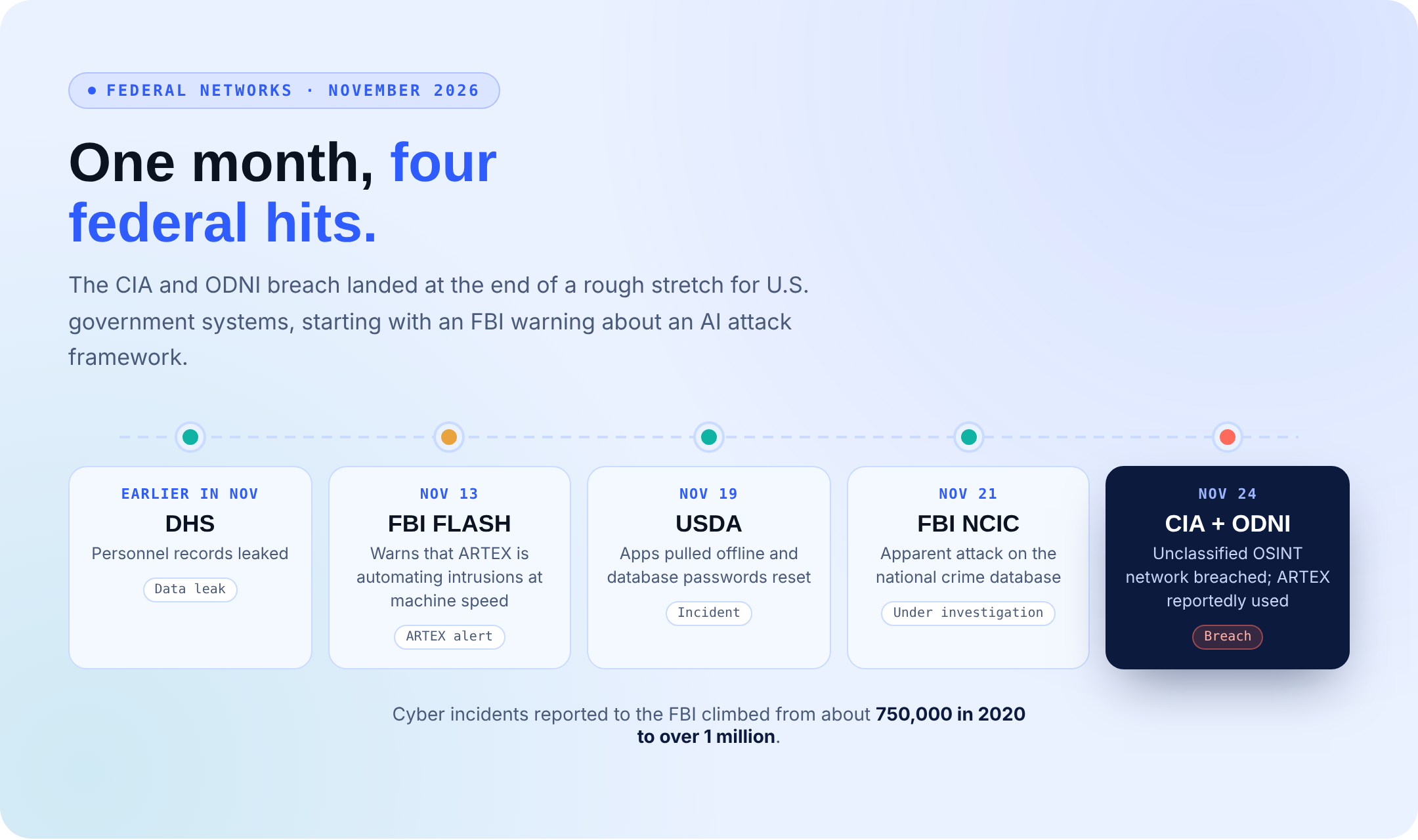
America’s spy agencies just found intruders on their own turf. The CIA and the Office of the Director of National Intelligence (ODNI) discovered a breach of an unclassified intelligence system. The CIA breach is the latest hit in a rough month for federal networks.
Who should care: Federal contractors, public-sector IT teams, and any company running internet-facing apps or cloud admin panels.
What could go wrong: An AI-driven attack framework can turn one default password into admin access in under three hours.
Do this: Kill default credentials, lock down admin consoles, and watch for sudden bursts of automated logins.
Worth remembering: Unclassified does not mean harmless.
What Happened in the CIA Breach?
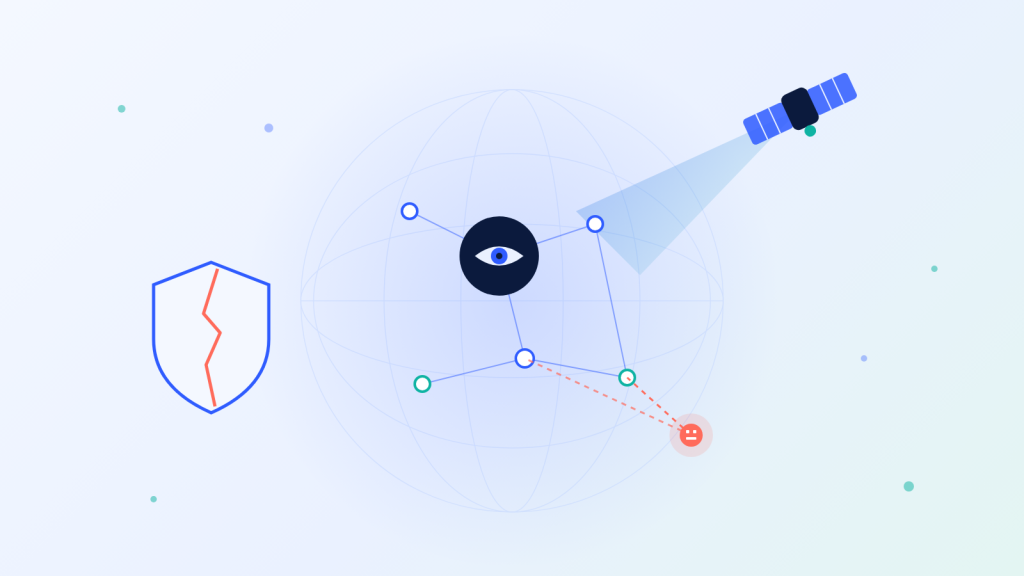
The CIA breach hit a system the CIA and ODNI use to analyze open-source intelligence (OSINT), such as social media, commercial satellite imagery, and data broker records. According to The New York Times, the National Geospatial-Intelligence Agency may also be affected. Officials say classified networks were untouched and the affected network is now secure. Sources told the Times the intruders appear to have used ARTEX, an open-source AI penetration testing framework. Early signs point to China. However, nobody has confirmed who did it.
A Month of Federal Hits
The attack caps a run of incidents. First, DHS personnel records leaked. Then, on November 13, the FBI warned that attackers had used ARTEX since at least August, with some intrusions reaching privileged access in under three hours. Researchers also counted more than 1,600 ARTEX consoles exposed online. Days later, USDA pulled internal apps offline and reset database passwords. The FBI is now investigating an apparent attack on its own national crime database.
What’s the Impact of the CIA Breach?
The stolen data may be unclassified. Still, an OSINT system shows what analysts are watching and who they are tracking. Information from other agencies may also be in scope. And if ARTEX was involved, the attacker could have moved from foothold to admin rights in one afternoon.
How to Avoid This
You can’t fix the CIA’s network, but you can close the gaps ARTEX looks for in yours:
- Rotate secrets and remove default credentials.
- Restrict cloud admin panels to trusted networks.
- Rate-limit logins and sensitive APIs.
- Alert on new credentials, privilege changes, and large data transfers.
- Track unexpected LLM API spend.
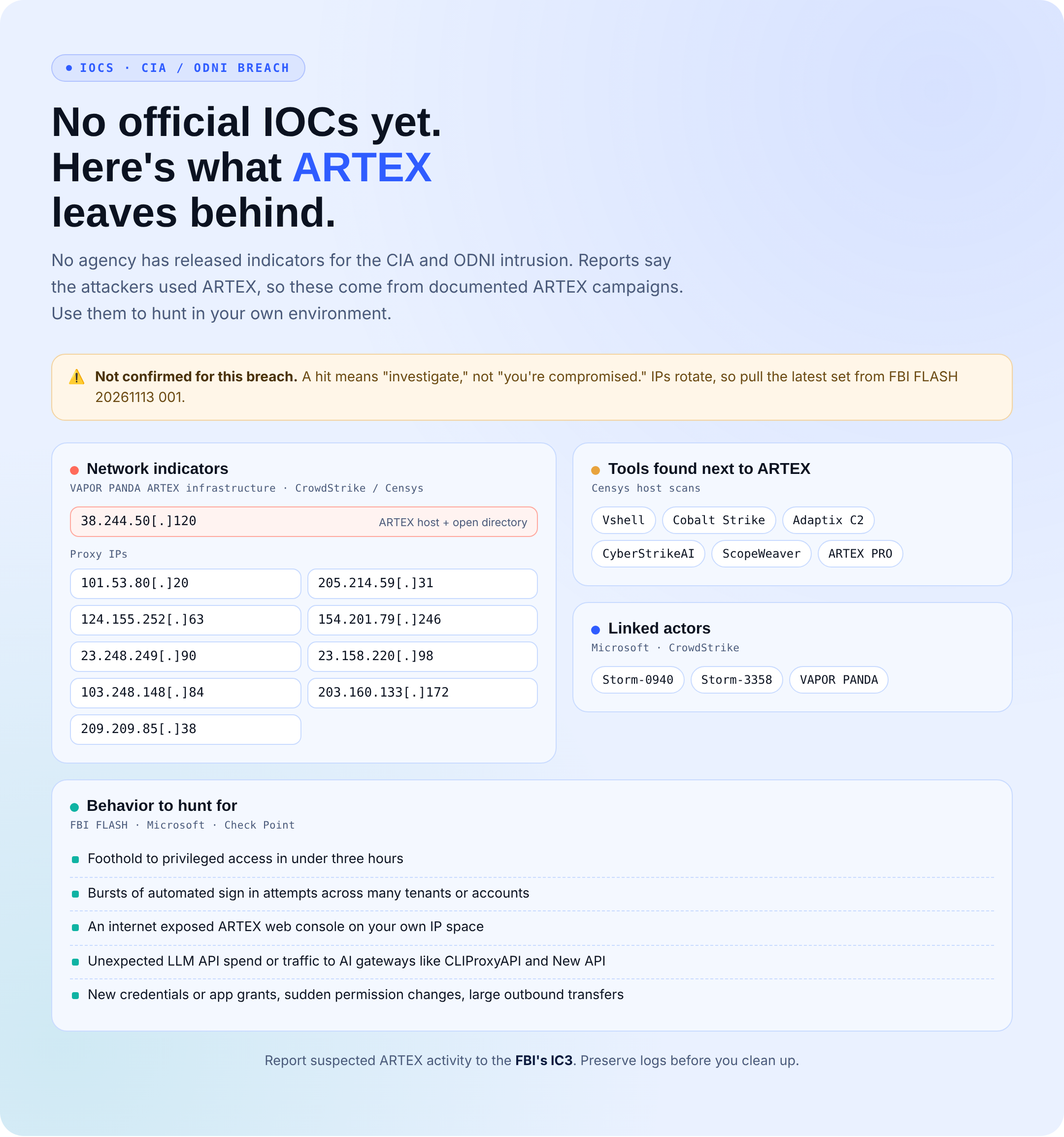
No agency has published indicators for the CIA breach yet. For now, the IOCs below come from documented ARTEX campaigns, so treat a match as a lead to investigate, not proof of compromise.
Test It Before ARTEX Does
In most cases, ARTEX wins on old weaknesses nobody got around to fixing, and it finds them at machine speed. Secure.com runs security as a service, so you get the outcome and skip juggling another stack of tools.
- Managed Exposure Management attacks your perimeter the way ARTEX would, ranks what it finds, and verifies every fix.
- Managed SecOps watches around the clock. Automation filters the alert noise. Then human analysts make the containment call.
- vCISO turns federal warnings like the ARTEX FLASH into a plan your board can read.
- One service, one bill. Your team sets the rules.