Check Point Management Servers Hijacked at 22 Organizations in Suspected AI Campaign
- Who should care: Anyone running a Check Point Security Management server, especially one reachable from the internet.
- What could go wrong: An intruder with admin rights copies your firewall database, mints trusted certificates and switches your policies off.
- Do this: Patch CVE-2026-16232, pull management off the open internet and audit every task run since October 17.
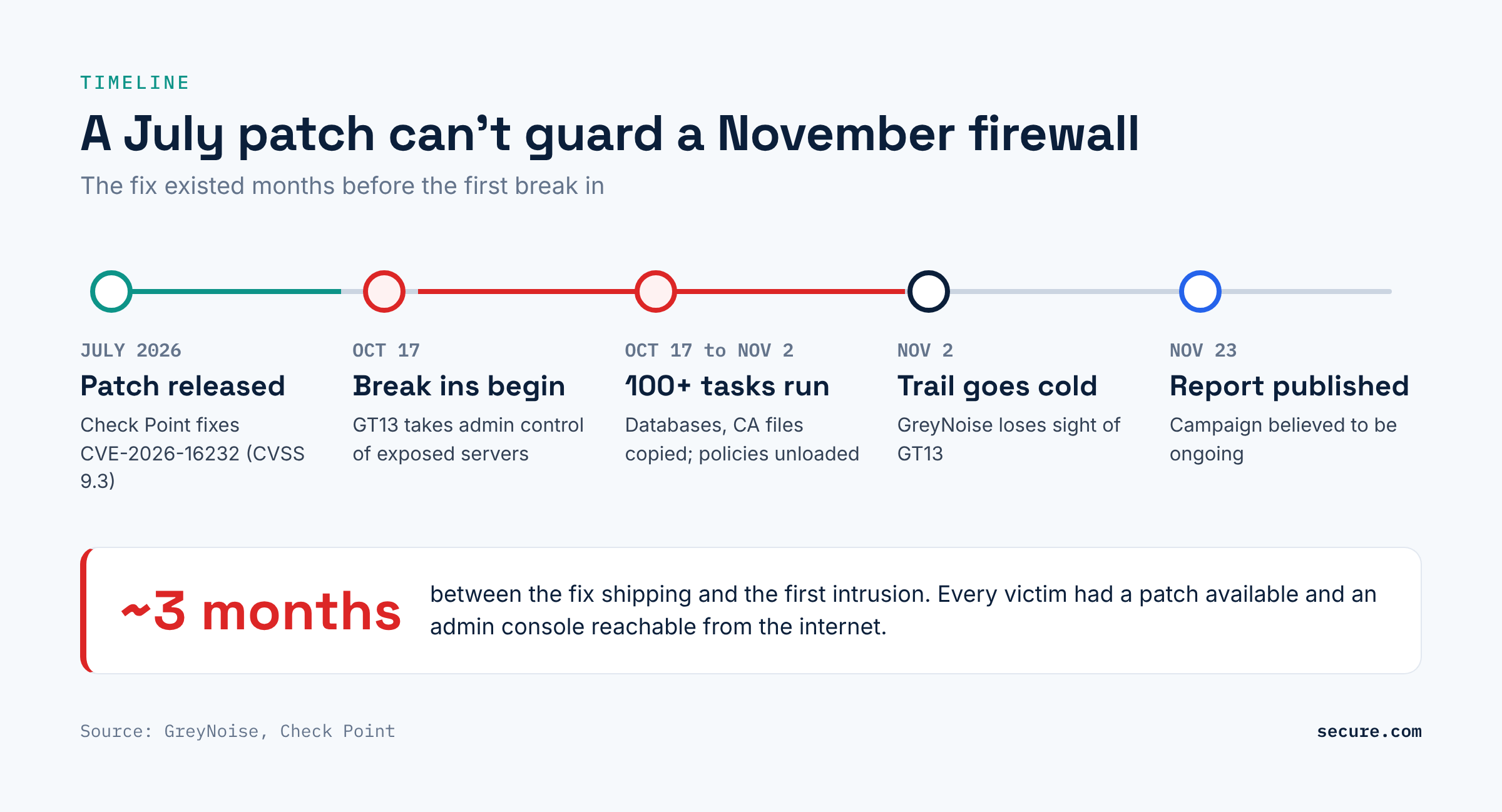
- Worth remembering: The fix shipped in July. The break-ins started in October.
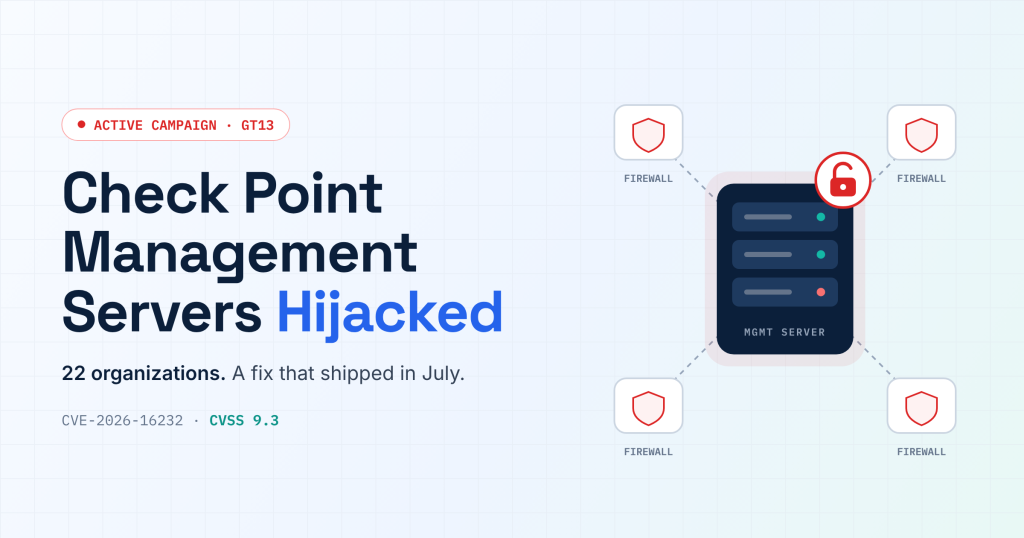
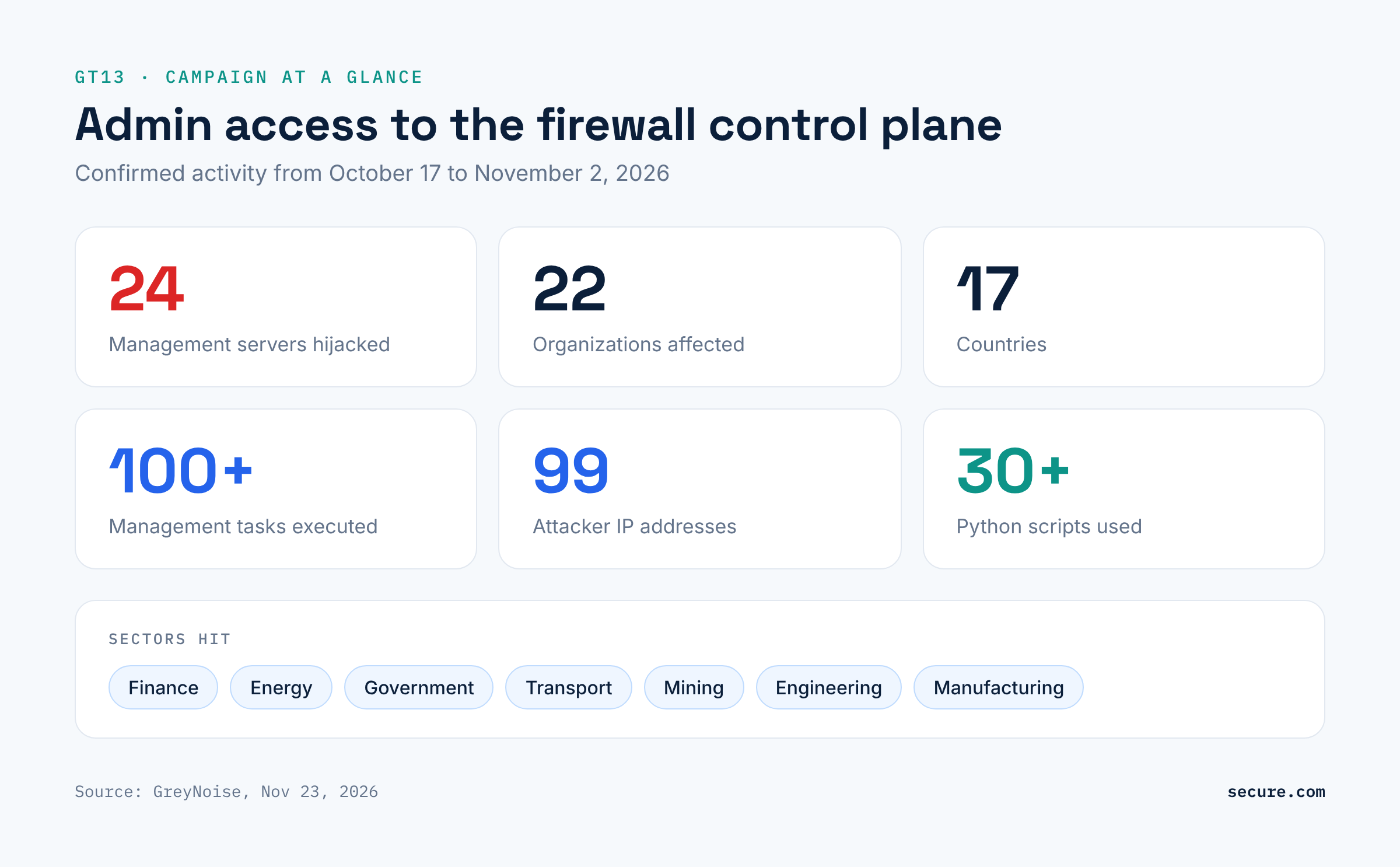
For more than two weeks this autumn, someone else was running the firewalls of 22 organizations. GreyNoise tracks the crew as GT13 and says AI agents likely did much of the scanning, exploiting and hands-on work on Check Point management servers.
What Happened?
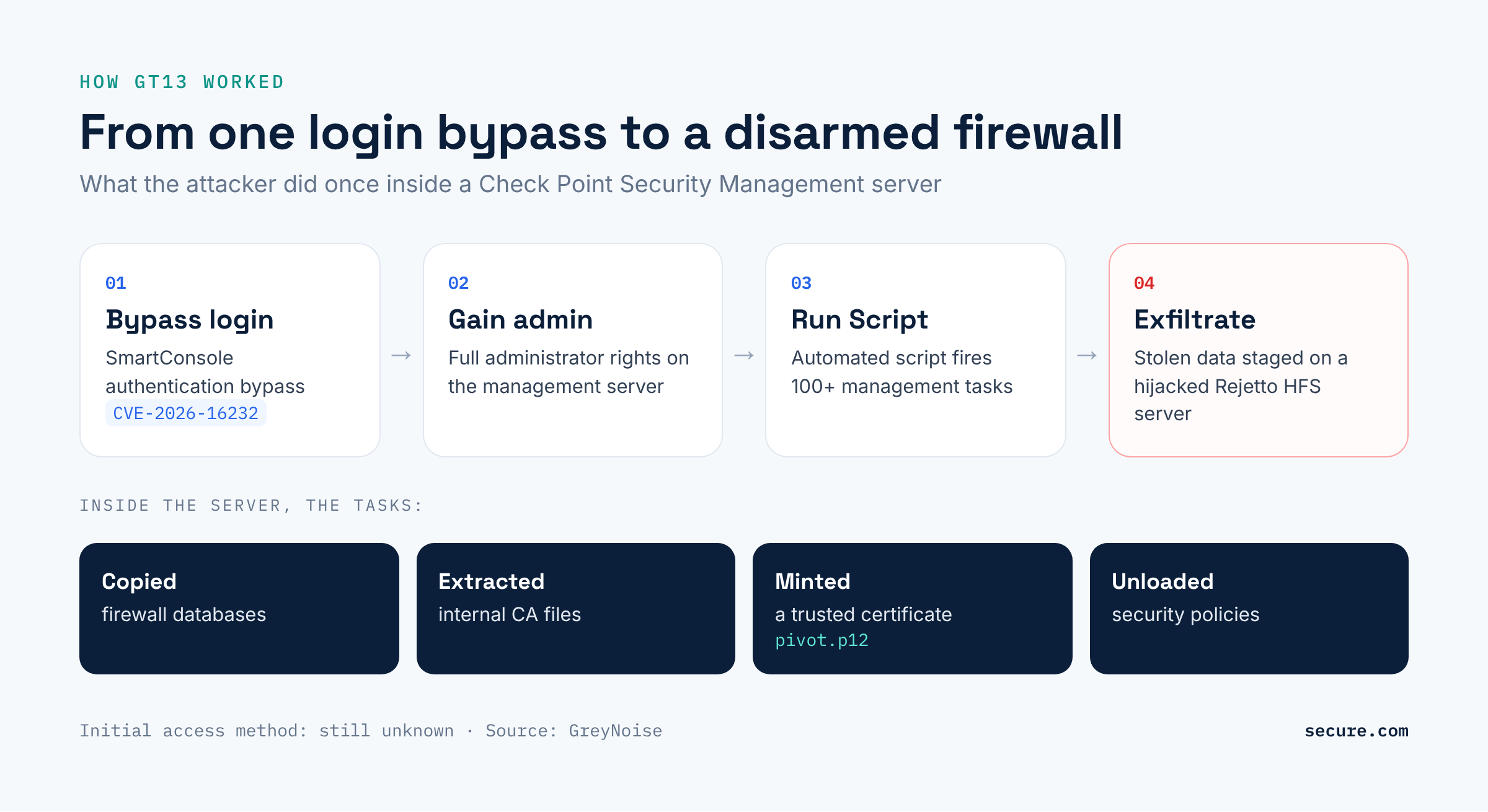
GreyNoise published its findings on November 23. Between October 17 and November 2, GT13 held admin access to 24 Check Point Security Management servers in 17 countries. A script for CVE-2026-16232, a SmartConsole login bypass rated 9.3, ran over 100 management tasks. The crew copied firewall databases and internal CA files, minted a certificate named pivot.p12 and unloaded security policies. A hijacked Rejetto HFS server stored the loot. How GT13 first got in is still unknown.
Why Researchers Suspect AI
GT13 worked from 99 IP addresses, all ExpressVPN exits or victims’ own Check Point boxes. It used at least 30 Python scripts, automated its HFS exploit and also tried old Citrix, Ivanti, vCenter and Exchange bugs, plus the CVE-2026-98432 Linux flaw. GreyNoise calls the AI angle an inference, built partly on odd gaps and choices in the timeline. Free tools like ARTEX already let crews run attacks on autopilot.
What’s the Impact?
Victims span finance, energy, government, transport, mining, engineering and manufacturing. A management server holds every rule and certificate for the firewalls it controls, so the stolen data maps each network. GreyNoise lost sight of GT13 on November 2 and thinks the campaign is still running.
How to Avoid This
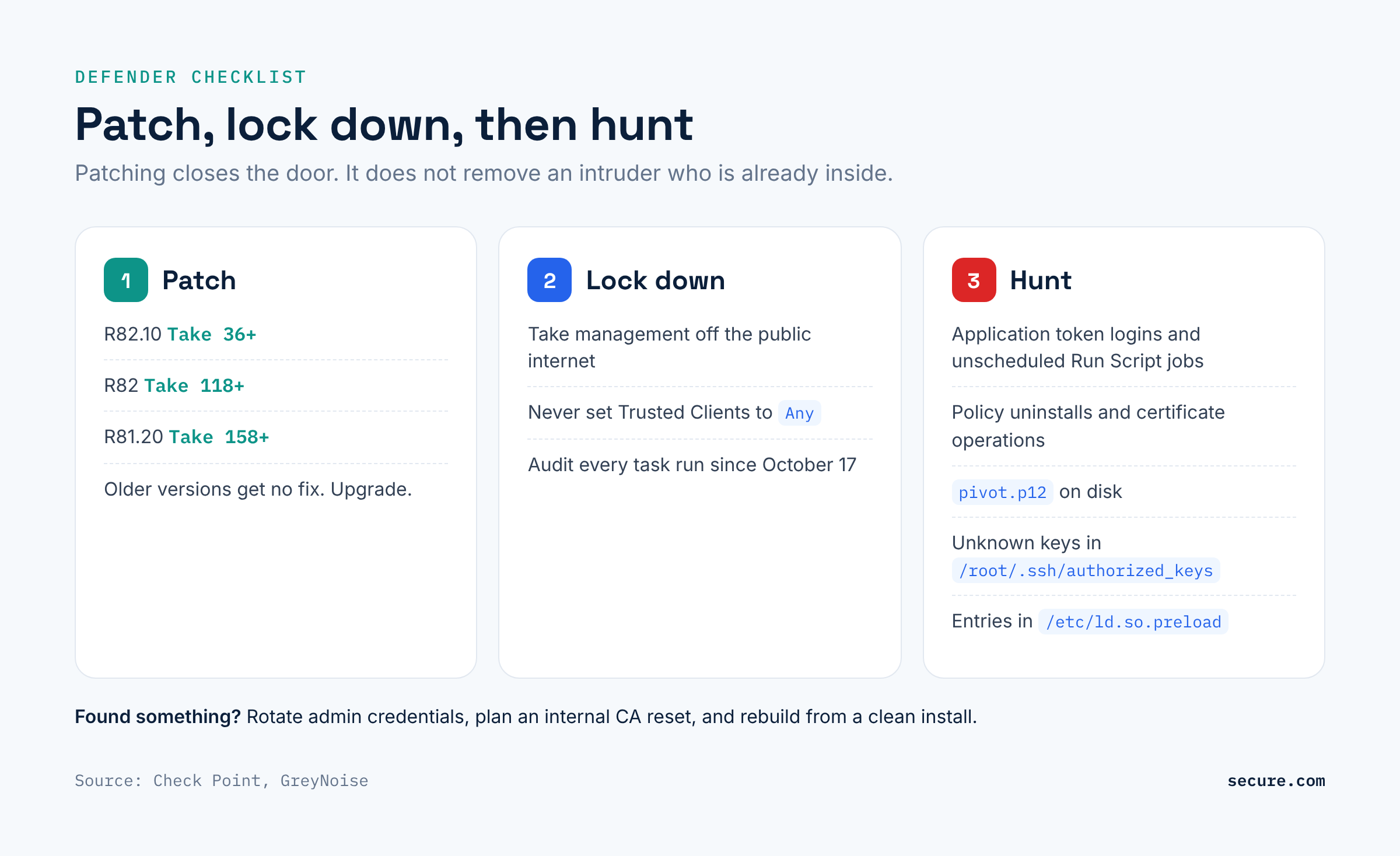
- Update to R82.10 Take 36, R82 Take 118 or R81.20 Take 158 or later. Older versions get no fix, so upgrade them.
- Keep management off the internet and never set Trusted Clients to “Any”. Start by seeing your edge the way attackers do.
- Search audit logs for “application token” logins, plus Run Script jobs, policy uninstalls and certificate operations nobody scheduled.
- Hunt for pivot.p12, unknown keys in /root/.ssh/authorized_keys and an /etc/ld.so.preload entry pointing to /usr/lib/.libproc.so.
- Found something? Rotate admin credentials, plan an internal CA reset and rebuild the server from a clean install.
Check Point Management Servers Indicators of Compromise
GreyNoise tied the domain newpayapp[.]com and three subdomains, two “research” user agents, a HASSH fingerprint and 99 IP addresses to GT13. Most IPs are shared ExpressVPN exits, so hunt on them rather than blanket-block them. The full IP list is in the GreyNoise report.
Check Point Management Servers IOCs
Domains
NETWORK- newpayapp[.]com
- data-zt.newpayapp[.]com
- api-zt.newpayapp[.]com
- 2ev5.newpayapp[.]com
User agents & HASSH
FINGERPRINT- Mozilla/5.0 (X11; Linux x86_64) research
- Mozilla/5.0 research
- eeca2460550b9ded084ecf2f70a75356HASSH (SSH client fingerprint)
Host artifacts
FILE- pivot.p12Certificate minted by the attacker
- /etc/ld.so.preloadEntry pointing to /usr/lib/.libproc.so
- /root/.ssh/authorized_keysCheck for unknown keys
Audit log strings
LOG- Authentication method: application token
- Authentication method: Password based application token
- Unscheduled Run Script jobsPlus policy uninstalls and certificate operations
Attacker IP addresses (sample of 99)
IPA July Patch Can’t Guard a November Firewall
GT13 didn’t need a new bug. It needed a 9.3 that sat unpatched on an exposed console for months. Secure.com runs Service as a Software: you tell us the outcome you need, and we run the work behind it under one service and one bill.
- Managed Exposure Management finds every internet-facing management console and ranks flaws by real reachability, starting with ones like CVE-2026-16232.
- We attack your edge the way GT13 did, fix what we find and prove each fix with a retest.
- Managed SecOps watches around the clock for unplanned policy unloads, new certificates and VPN exit logins to admin planes, and experts contain them fast.
- A vCISO sets patch deadlines for security appliances and reports progress to your board.
Governed defense, powered by offense. No more grunt work. No more burnout.
Conclusion
GT13 walked through a door Check Point closed in July. The organizations it hit had the fix available and an admin console facing the internet. Patch, take management off the open web, then check whether someone already used it before you assume you are clean.