NoisyTCP Vulnerability Lets Anyone Crash a Linux Server Without Logging In
- Who should care: Teams running internet-facing Linux servers, cloud VMs, or container hosts on kernel 4.4 or later, which the NoisyTCP vulnerability can crash.
- What could go wrong: A stranger who can reach one open port takes down the whole host and every container on it.
- Do this: Move to kernel 6.12.117, 6.18.63, 7.3.4 or a distro backport, then reboot.
- Worth remembering: Exploit code isn’t public. Yet.
Introduction
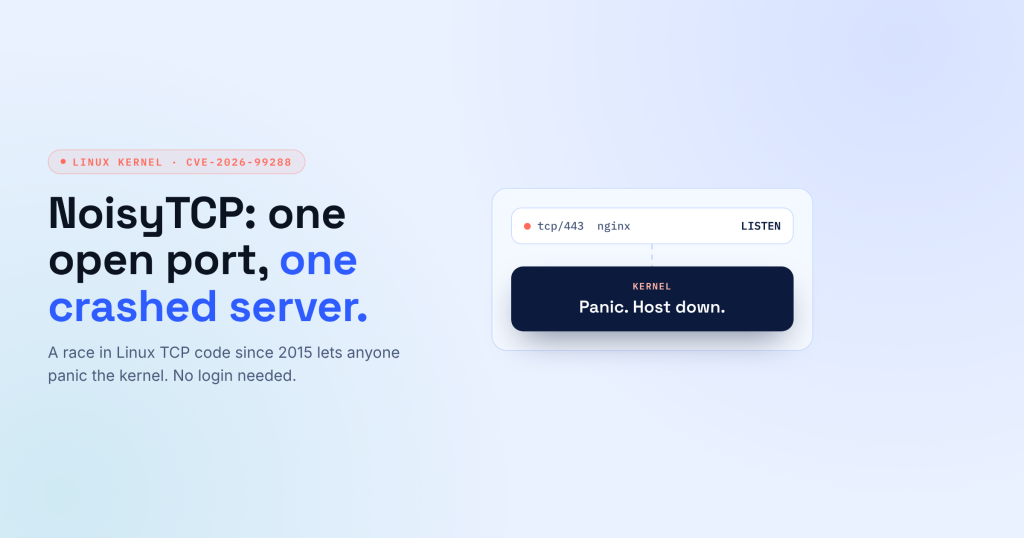
The NoisyTCP vulnerability is an 11-year-old race in the Linux kernel’s TCP code. It slipped in during October 2015, and it lets a remote attacker crash a server by sending packets to an open TCP port. The attacker needs no password, and the server needs no unusual settings.
What Happened?
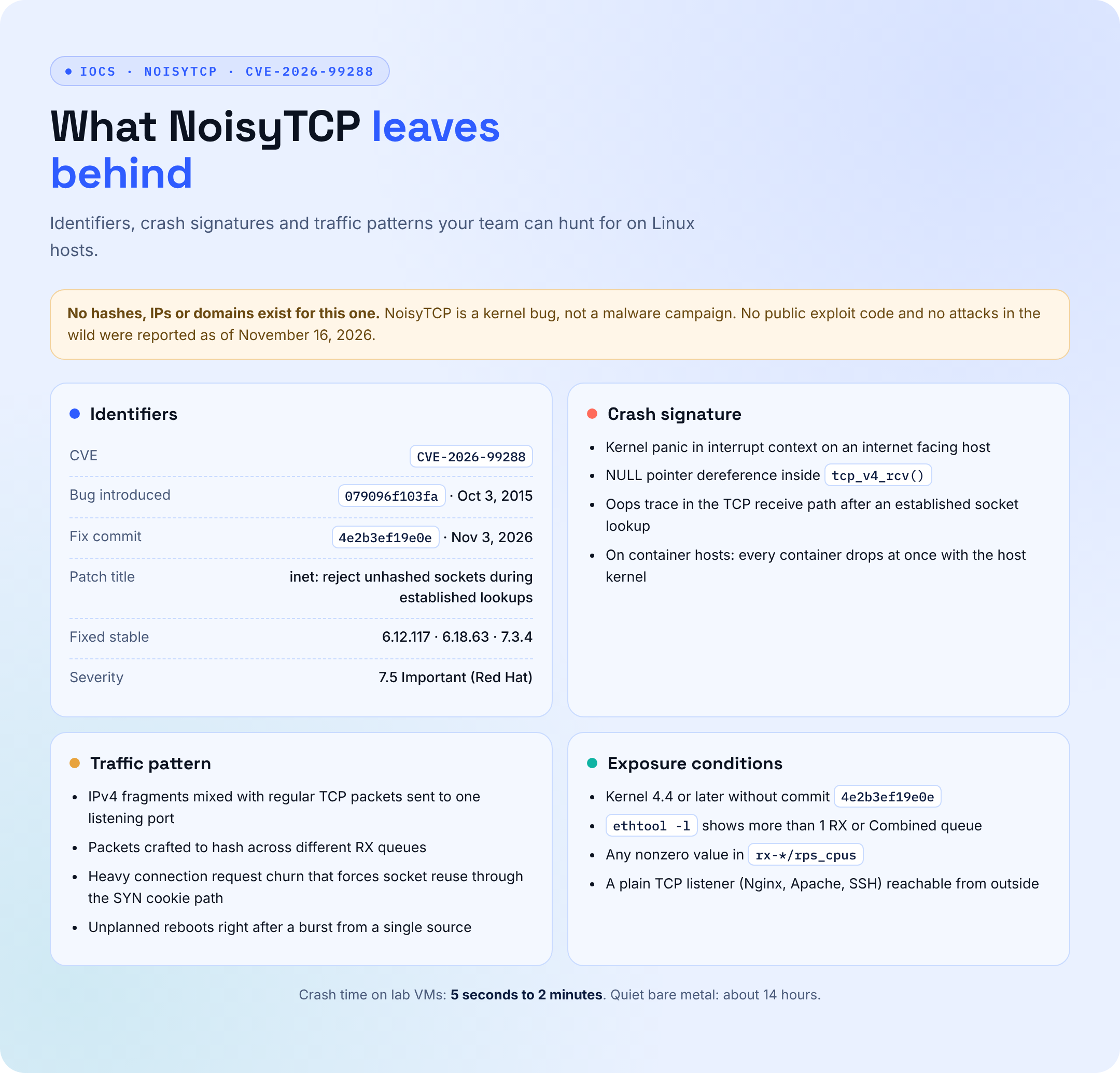
The flaw is tracked as CVE-2026-99288 and nicknamed NoisyTCP. It went public on the oss-security mailing list on November 15, after a private embargo with Linux vendors ended, as iTnews reported.
The NoisyTCP vulnerability is a race condition in how the kernel matches incoming packets to sockets without taking a lock. With the right timing, two CPU cores collide over a recycled connection request built through the SYN cookie path. One core ends up holding an object with no listener attached and follows a NULL pointer, causing a kernel panic.
The fix landed upstream on November 3 and reached stable kernels on November 10. It is a separate bug from the Linux kernel TCP flaw that hands attackers root (CVE-2026-98432).
What’s the Impact of the NoisyTCP Vulnerability?
Red Hat rates the flaw 7.5 (Important). Any host that spreads traffic across more than one receive queue, or uses RPS, is exposed, and that covers most cloud VMs.
In lab tests, VMs running default Nginx, Apache or SSH crashed in 5 seconds to 2 minutes. A quiet bare metal server held out for about 14 hours. On a container host, one panic takes every container down.
Is It Only a Crash?
For now. The CVE record documents only the crash. The researcher describes a second, much harder path that could corrupt memory. Asked about remote code execution, the answer was “Not yet.” No public exploit exists, and no vendor has reported attacks, according to Cyber Kendra.
Where the Patches Stand
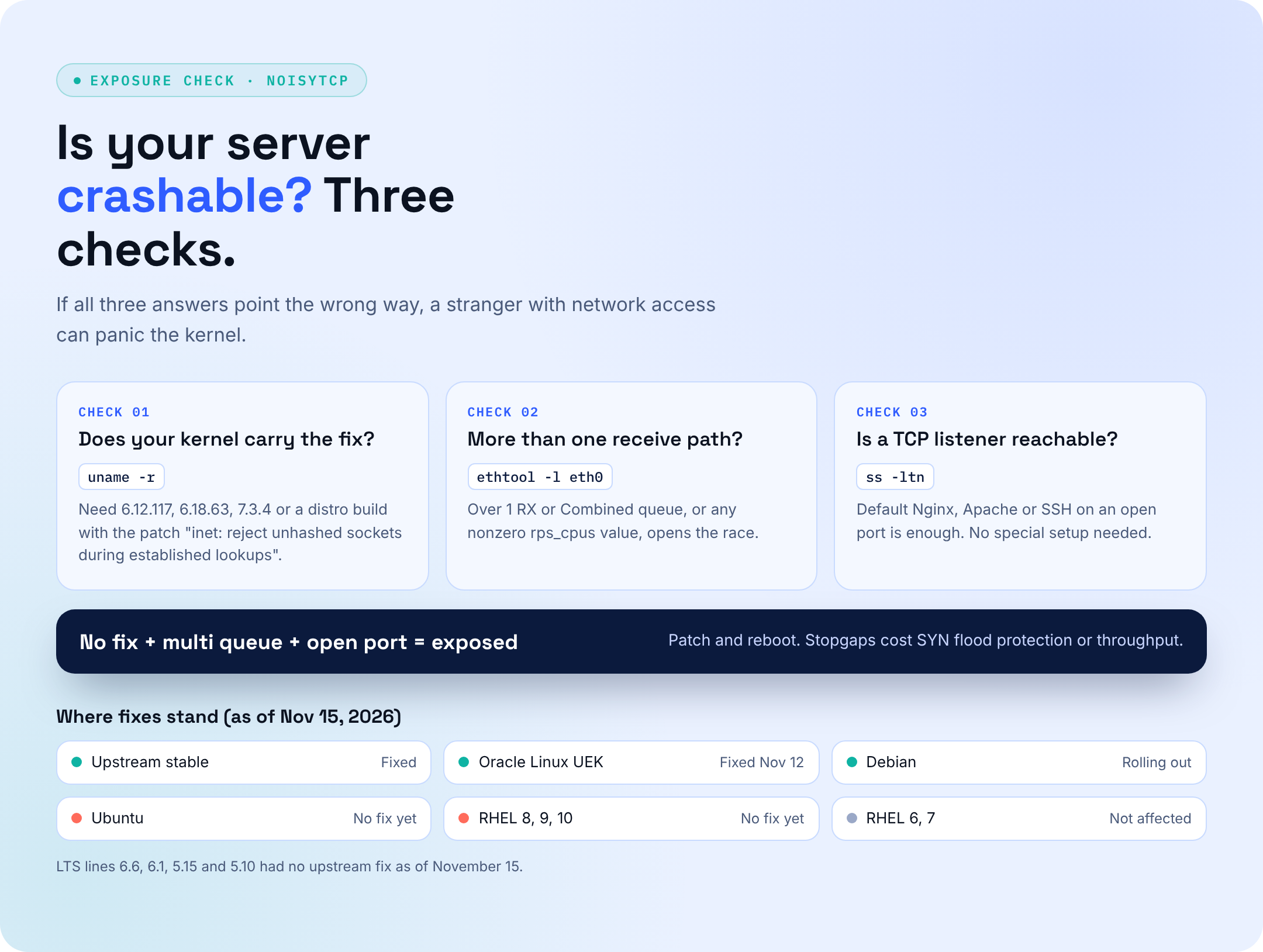
- Upstream stable: fixed in 6.12.117, 6.18.63 and 7.3.4
- Oracle Linux UEK: fixed November 12
- Debian: fixed kernels rolling out
- Ubuntu: listed as affected, no fixed package yet
- RHEL 8, 9 and 10: affected, no fixed kernel yet (RHEL 6 and 7 are not affected)
- LTS lines 6.6, 6.1, 5.15 and 5.10: no upstream fix as of November 15
How to Avoid the NoisyTCP Vulnerability
- Patch and reboot into a kernel that carries the commit titled “inet: reject unhashed sockets during established lookups.” Search your distro changelog for that title or the CVE number.
- Run
ethtool -lon each interface. More than one RX or Combined queue, or any nonzerorps_cpusvalue, opens the race. - Stopgap one: run
sysctl -w net.ipv4.tcp_syncookies=0in every network namespace. You lose built in SYN flood protection. - Stopgap two: drop each NIC to a single receive queue and turn off RPS and RFS. Expect lower throughput.
- If neither stopgap works for you, keep unpatched hosts off the open internet until a fixed kernel ships.
Find the Crashable Box Before a Stranger Does
The NoisyTCP vulnerability sits on fleets for weeks because nobody can say which kernel runs where, or which hosts have more than one receive queue. Secure.com gives your team AI teammates that attack your defenses, harden what they find and prove the fix held.
- Map every internet facing Linux host to its exact kernel build, so you know in minutes which ones still carry the bug.
- Rank NoisyTCP by real reachability, so the first reboot window goes to the hosts strangers can actually hit.
- Track every stopgap, like disabled SYN cookies, so a temporary fix doesn’t quietly become permanent.
- Retest after each reboot and keep the evidence ready for the next audit.
- Your team sets the rules on what changes automatically and what waits for approval.
Attack. Harden. Prove. Repeat.