Who should care: Perp DEX operators, market makers, and trading desks running bots on exchange API keys.
What could go wrong: One leaked trading key lets a stranger close your positions and drain your balance.
Do this: Strip transfer rights from every trading key today.
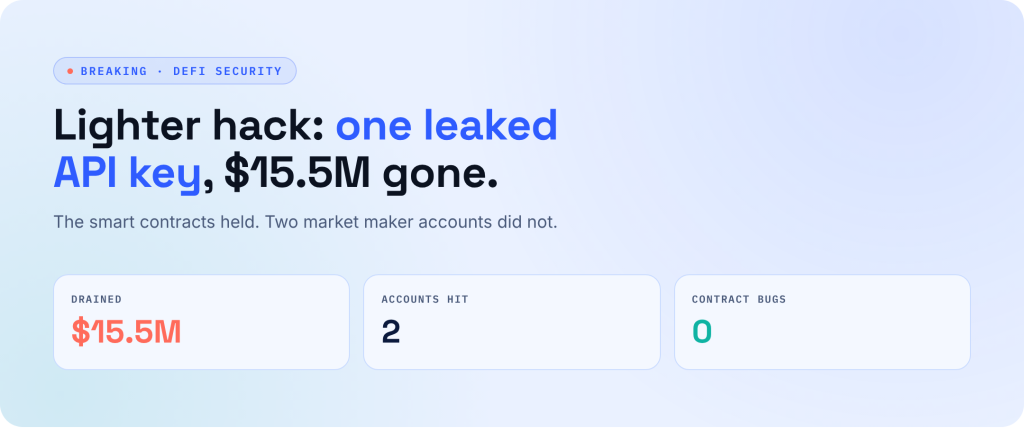
Lighter, the Ethereum Layer 2 perpetuals exchange, froze all withdrawals and pool creation on Monday after roughly $15.5 million in USDC left two market maker accounts. The smart contracts held. A leaked trading API key did not, and that single credential is what made the Lighter hack possible.
What Happened in the Lighter Hack?
Lighter posted its first alert at 6:02 a.m. ET on November 16, blaming a single compromised external party. A later update narrowed it to a leaked API key on a trader’s account. Lighter says the protocol and its smart contracts were not affected.
Researchers filled in the rest. The attacker closed the victims’ open positions and turned everything into USDC. Next, using a compromised account, they spun up a public liquidity pool with zero fees, bought 99.99% of its shares for about $10,000, and fed the stolen USDC in roughly $1 million batches. Redeeming those shares pulled the money out. Account #714710 lost about $10.39 million. Account #714723 lost about $5.09 million, according to CoinLaw.
Five moves. No exploit needed.
Reconstruction based on onchain research. Lighter confirmed a leaked trader API key but has not confirmed every step.
The contracts did exactly what they were told. The key told them the wrong thing.
Follow the Money
A wallet funded with about $10,000 through a relay, roughly 30 minutes before the drain, pulled $10.39 million USDC from Lighter’s Ethereum contract. It swapped the haul for about 5,400 ETH on CoW Swap, then broke it into transfers of around 160 ETH. One branch bridged 640 ETH (about $1.12 million) to Hyperliquid and bought 2,240 XMR. Once money becomes Monero, tracing it gets very hard.
What’s the Impact of the Lighter Hack?
Users can still trade ETH perpetuals but cannot withdraw. LIT fell as much as 17% intraday before settling near $2.50. Upbit and Bithumb paused LIT deposits and withdrawals. The loss is about 2% of Lighter’s roughly $759 million in locked value, as crypto.news reported.
What Lighter Is Doing
Guardian mode is on across its contracts. The Security Council is pushing a contract upgrade, and Lighter says withdrawals should return once it lands. The team has also flagged a wallet it links to the attacker and is chasing funds from a second withdrawal attempt, per TokenPost.
Lighter Hack IOCs
These indicators come from public onchain research. Lighter has not published its own list yet, so treat them as reported, not confirmed.
What to block and watch.
Compiled from public onchain research. Lighter has not published its own IOC list, so treat these as reported, not confirmed.
No malware hashes, IPs or domains have been published for this incident. Update this list as Lighter’s postmortem lands.
How to Avoid This
- Give trading keys trade rights only. No transfers, no pool creation, no withdrawals.
- Lock every key to a fixed IP allowlist and rotate it on a schedule.
- Require a second signature for moves between subaccounts, even under the same wallet.
- Alert on the combo: mass position closes, a new pool, then batched transfers within minutes.
- Keep keys in a secrets vault, never in config files, laptops, or chat threads.
If a key has already leaked, work through these immediate steps after a data breach before anything else.
Your Contracts Passed the Audit. Your Keys Never Took One.
Lighter’s code did its job. The Lighter hack came through a credential nobody was testing, and attackers look for that kind of gap first.
Secure.com’s AI teammates get there before they do, under rules your team sets:
- Attack: hunt for exposed keys and secrets across repos, CI logs, endpoints, and vendor touchpoints.
- Harden: flag keys carrying transfer or withdrawal rights they never use, and queue fixes for your sign-off.
- Detect: link odd sequences like mass closes plus new pools into one alert, not fifty.
- Prove: keep a clean record of every rotation and permission change.
- Repeat: rerun it all continuously, so the grunt work stops landing on your analysts.
Governed Defense, Powered by Offense.