GL.iNet Cloud Flaw Lets Hackers Plant Root Shells on Routers and KVMs
- Who should care: Anyone exposed to the GL.iNet cloud flaw, meaning people running GL.iNet routers or Comet KVMs with GoodCloud remote management turned on, and IT teams whose staff carry them.
- What could go wrong: A stranger gets root on the box that sits between your laptop and the internet, or on the KVM wired into your server’s keyboard and screen.
- Do this: Check for the indicator before you reboot, install the fixed firmware, and rotate every secret the device stored.
- Worth remembering: The cloud fix stops new infections. Removing malware already on a device takes the firmware update.
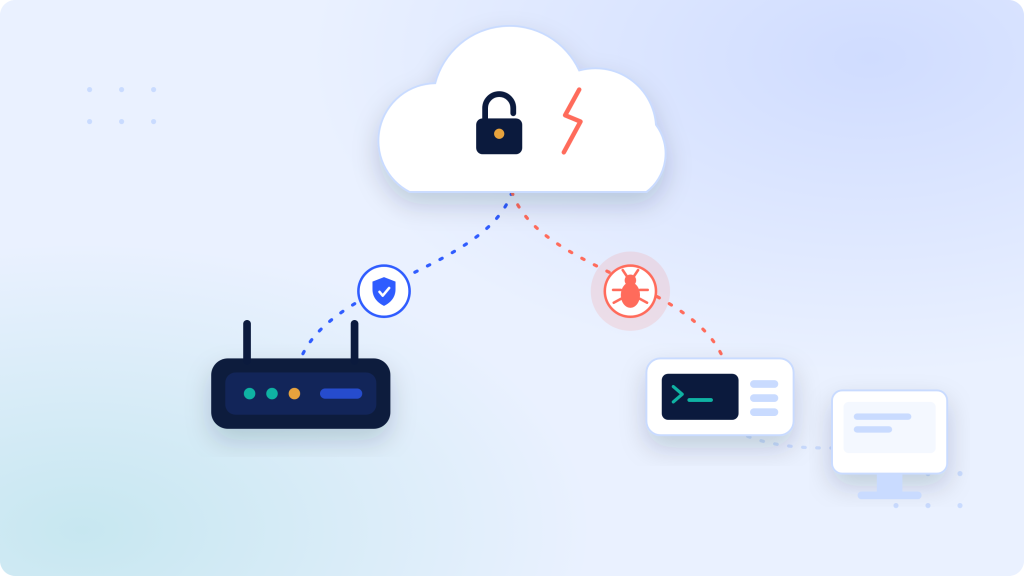
GL.iNet says attackers exploited the GL.iNet cloud flaw, a vulnerability in its cloud remote management service, and used it to install malware on some customer routers and KVM devices. Community responders have found root reverse shells on affected units. If you linked your device to GoodCloud, treat it as reachable until you check it.
What Happened?
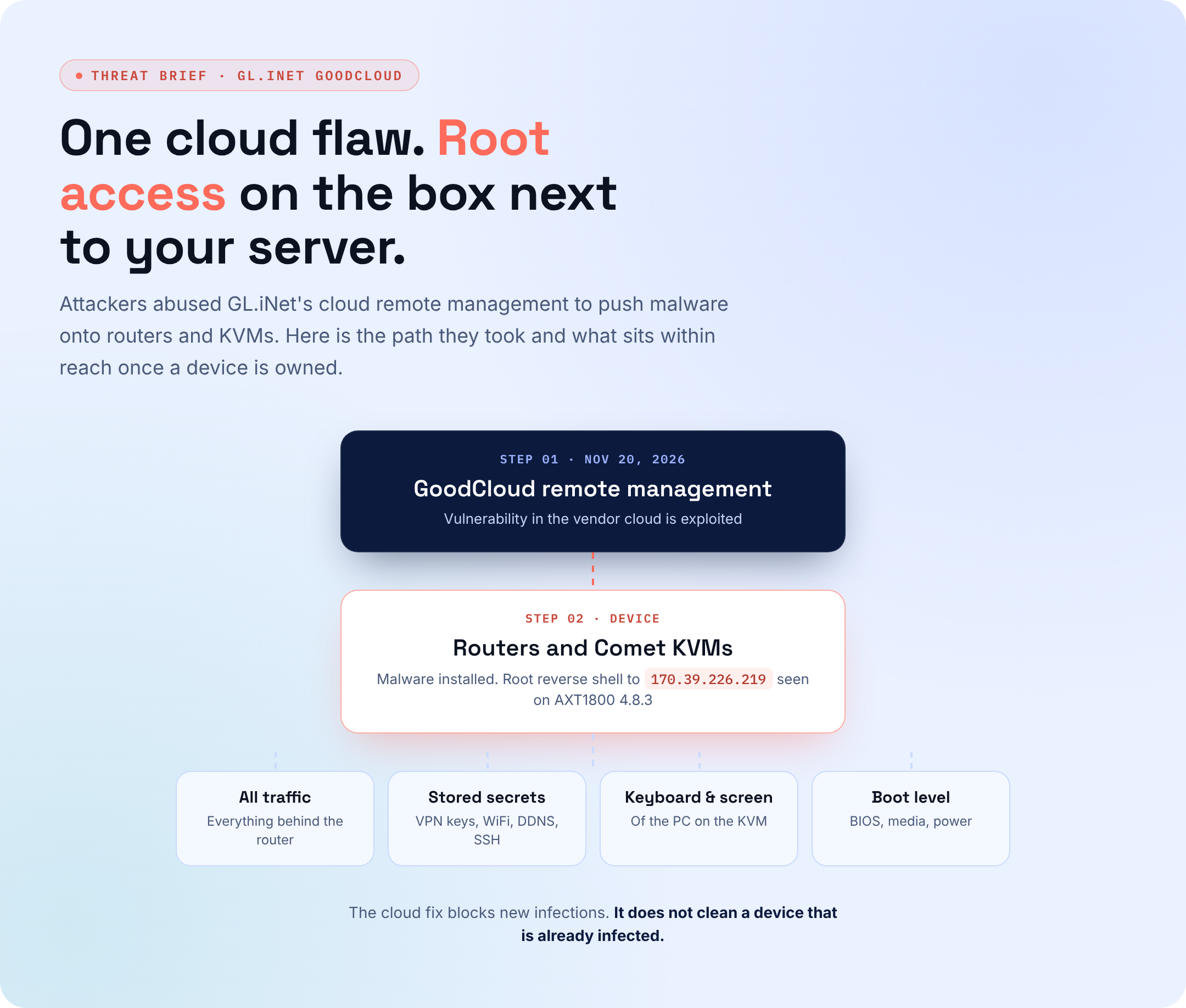
On November 20, 2026, GL.iNet found a vulnerability in its cloud remote management platform and confirmed that an unauthorized party had used it to install malicious software on some routers and KVMs. The company says it has fixed the cloud side, so attackers can no longer use it to infect new devices. According to the GL.iNet security notice, a model missing from its list is not necessarily safe.
Community responders went further. On a GL.iNet AXT1800 running firmware 4.8.3, they verified a root reverse shell that started around 21:40 UTC on November 20 and connected out to 170.39.226.219. On some KVMs, a file called gl-helper showed up as an implant. GL.iNet has not published a CVE, a device count, or how the attackers got into its cloud. BleepingComputer also covered the incident.
What’s the Impact of the GL.iNet Cloud Flaw?
A compromised router sees and steers all traffic behind it. It also stores VPN keys, WiFi passwords, and DDNS credentials. A compromised KVM is worse. It can type, click, and boot the server attached to it as if someone were sitting at the desk.
GL.iNet is still checking whether the attack reached computers connected to infected KVMs. Its notice also leaves open when the attack began and whether attackers took stored credentials. For another case where a trusted control plane became the way in, see our report on management platform attacks.
How to Protect Your Devices From the GL.iNet Cloud Flaw
- Check before you reboot. Community responders report that the reverse shell writes nothing to disk and dies on restart. On routers, run
ps | grep tmpover SSH. On KVMs, open Toolbox, then Terminal, and runps -aux | grep tmp(orps -a | grep tmpon the RMQ1). Save the output. - Install the latest stable firmware for your exact model, even if the check comes back clean. Fixed builds include KVM RM1 family 1.10.3, RMQ1 1.8.7, MT3000 and MT6000 4.11.1, and AXT1800 and X3000 4.8.4. The full list is in the vendor notice.
- If you find the indicator, treat the device as infected. GL.iNet says the update removes the known malware without a reset. For extra assurance, reflash without keeping settings, then rotate VPN keys, WiFi, admin, DDNS, and SSH credentials.
- Turn off GoodCloud on any device that doesn’t need remote management, and block 170.39.226.0/24 outbound.
- Scan every computer plugged into a GL.iNet KVM for new accounts, browser extensions, startup items, and scheduled tasks, then run a full scan with current security software.
GL.iNet Cloud Flaw Indicators of Compromise
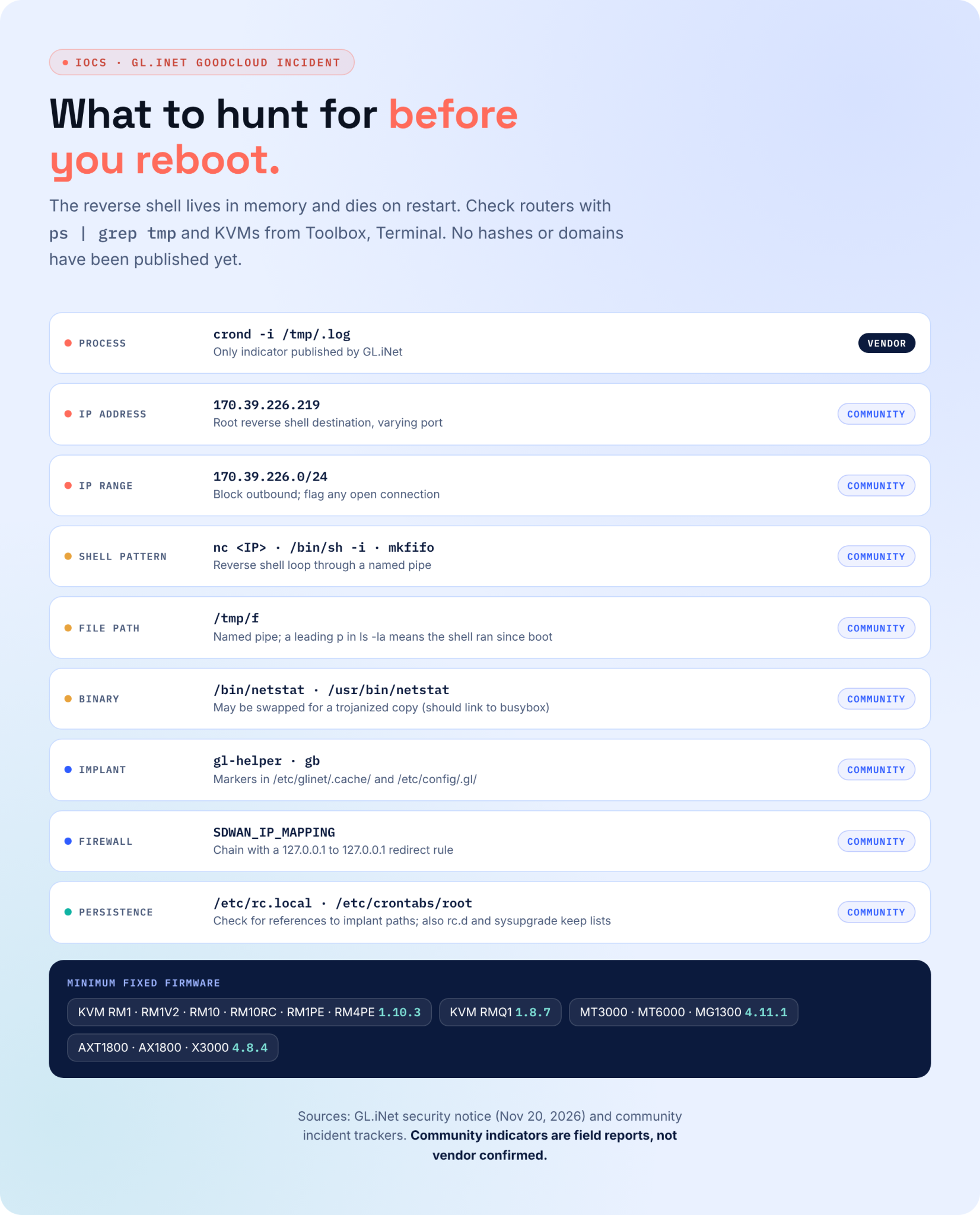
GL.iNet published one indicator: a running process containing crond -i /tmp/.log. The community incident tracker adds a named pipe at /tmp/f, nc and /bin/sh -i reverse shell loops, outbound traffic to 170.39.226.0/24, a swapped /bin/netstat, gl-helper marker files under /etc/glinet/.cache/ and /etc/config/.gl/, and an odd SDWAN_IP_MAPPING firewall chain. GL.iNet has not confirmed these, and no hashes or domains are public yet.
A community check script can speed up the hunt. GL.iNet does not endorse it, so read the source before you run it.
Small Boxes, Big Blind Spots
Travel routers and pocket KVMs rarely make the asset list, and nobody gets paged when one calls an unknown IP at 2 a.m. Secure.com runs that watch for you as a service, with one team and one bill.
- Managed Exposure Management finds every router, KVM, and remote access box with a cloud link and ranks which ones to fix first.
- Our team attacks those devices the way an intruder would, hardens what breaks, and verifies the fix actually landed.
- Managed SecOps watches 24/7 for reverse shells and outbound beacons like the one to 170.39.226.0/24, then contains the device.
- A vCISO sets the policy on which vendor clouds get remote access to your hardware, and puts the proof in front of the board.
Governed defense, powered by offense. No more grunt work.
Conclusion
The GL.iNet cloud flaw turned a remote management feature into a delivery route for malware. GL.iNet has closed the cloud hole, but that does not clean a device that is already infected. Check each device before you reboot it, install the fixed firmware, and rotate anything it stored. Then decide which devices really need a vendor cloud connection at all.