Key Takeaways
- The average SOC receives 3,832 security alerts per day. Over 60% go uninvestigated. (Vectra AI, 2026)
- AI can shrink alert investigation time from 30+ minutes to under 3 minutes.
- Up to 70% of incoming alerts are low-value or false positives that AI can filter before a human ever sees them.
- Organizations using AI in their SOC saved an average of $1.9M per breach and shortened their breach timeline by 80 days. (IBM 2025)
- Secure.com customers report 75% faster alert triage and 30-40% faster detection (MTTD) after deploying the Digital Security Teammate.
- AI works best as a first responder. Human analysts still own the complex, high-stakes calls.
Introduction
A typical SOC analyst starts their shift with 3,832 alerts waiting in the queue. By the time they’ve worked through a fraction of them, attackers have already moved deeper into the network. That gap between alert volume and human capacity is exactly the problem AI-driven triage was built to close.
How Does AI Provide Investigation Steps for a Security Alert?
An AI teammate reads the alert, pulls related evidence, checks it against known behavior, scores the risk, and writes up what it found. A human reviews anything consequential before action is taken.
What Is AI-Driven Threat Triage (And Why Rule-Based Tools Fall Short)
Most security teams already have some form of automation. SOAR playbooks, detection rules, ticketing workflows. So why are analysts still buried in noise?
Because traditional automation executes steps. It doesn’t think.
What Is Automated Alert Triage
Automated alert triage is the process of using software to classify, prioritize, and route security alerts without requiring a human to manually review each one first.
In a rules-based setup, an alert either matches a condition or it doesn’t. That creates two problems fast: too many false positives clogging the queue, and too much rigidity to catch new attack patterns.
AI-driven triage adds context to the process. It asks:
- What is the risk score of this asset?
- Has this IP appeared in recent threat intelligence feeds?
- Does this behavior match past incidents in our environment?
- Is this part of a larger attack chain or an isolated event?
That’s closer to how a skilled analyst actually thinks. And it happens in seconds, not minutes.
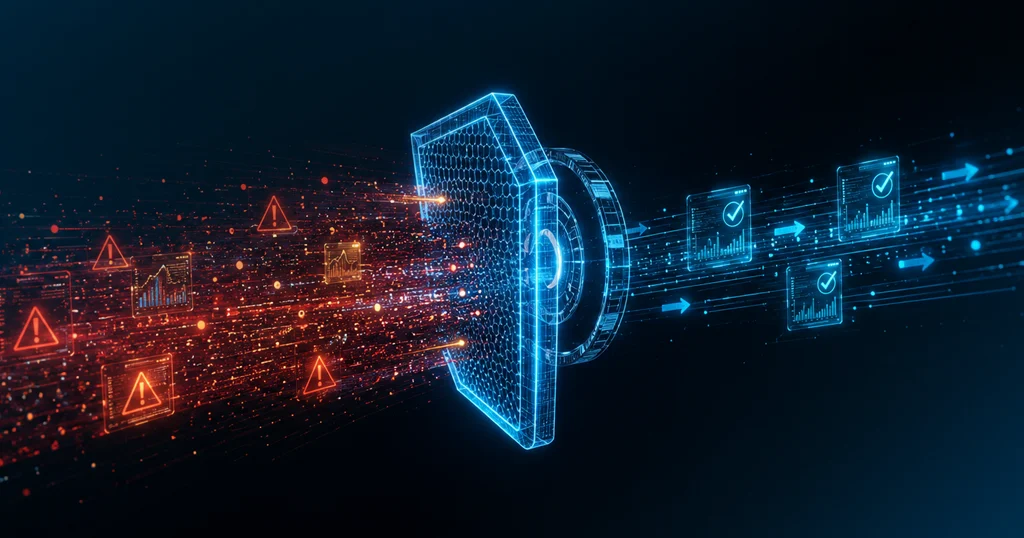
Up to 70% of security alerts are low-value or false positives. AI catches most of them before a human ever opens the ticket, which means your analysts spend their time on alerts that actually matter.
How Does AI-Driven Threat Triage Work in a Modern SOC
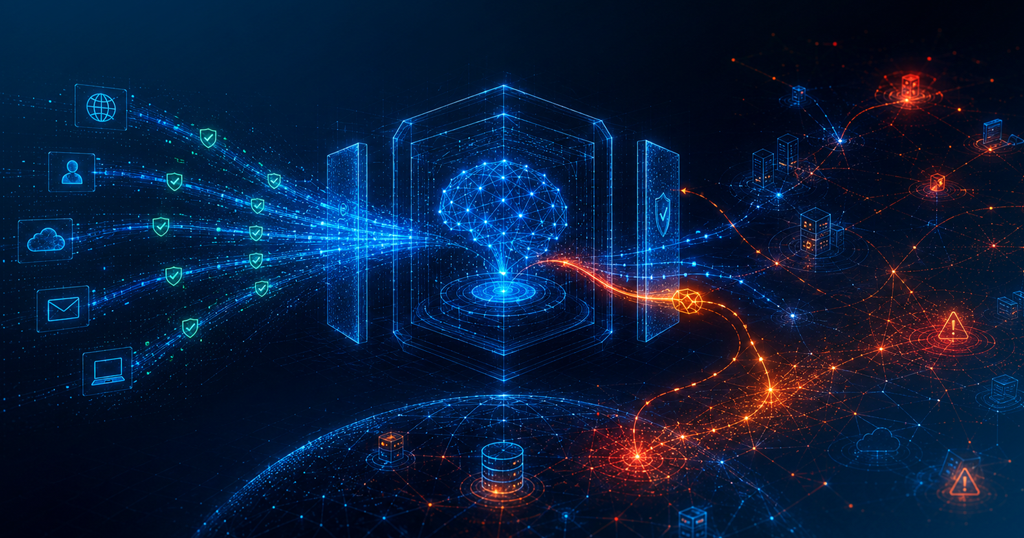
When AI investigates an alert, it doesn’t just stamp a severity label on it and move on. It runs through a structured investigation workflow, similar to what a Tier 1 analyst would do, but without the wait.
How Does Autonomous Threat Triage Work in an AI SOC
Here’s what the process looks like, step by step:
The Five Steps, and Who Stays in Control at Each One
Speed is not the whole story. What makes AI investigation safe to run in production is that every step has a boundary around it. Here is the same investigation flow, with the control layer named at each stage.
Step 1. Read and sort. The teammate reads the alert, sets a severity, and drops duplicates. This runs inside a defined scope, so it only touches the alerts and systems you assigned it.
Step 2. Gather the evidence. It pulls the logs, endpoint records, identity data, and network activity tied to the alert. Read access is explicit. The teammate sees what you allowed it to see, nothing more.
Step 3. Connect the dots. It checks the evidence against threat feeds, past cases, and normal behavior for your environment. This is where a single alert becomes a real picture.
Step 4. Score and route. The teammate assigns a confidence score, then closes, queues, or escalates. Consequential actions stop at a human gate. Lower-risk work moves within the rules you set.
Step 5. Write it down. Every check, finding, and decision is logged. Your analyst picks up a documented case, and you keep an audit trail you can show a CISO, an auditor, or the board.
The work moves to the teammate. The authority stays with your team.
Modern AI SOC platforms complete this entire workflow in under 3 minutes. The average manual investigation runs 30+ minutes per alert. Do that math across 3,800 alerts a day and you start to understand why teams feel like they’re always behind.
How Much Does an AI SOC Cut Triage Time
Organizations using AI-based incident response reduced MTTR from 75 to 90 hours down to 18 to 25 hours. That’s a 70% improvement. Teams using AI and automation also shortened their overall breach lifecycle by 80 days compared to teams running without it. (IBM 2025 Cost of a Data Breach Report)
That’s not a minor efficiency gain. That’s the difference between catching an intrusion early and discovering it 241 days after it started.
Can You Trust AI to Triage Security Alerts
This is the question most security leaders sit with longest. It’s a fair one.
How Accurate Is AI Alert Triage
AI triage accuracy depends on two things: the quality of data the system is trained on, and how well it’s been tuned to your specific environment.
Out of the box, most AI systems already cut false positives significantly. The bigger gains come when analysts actively provide feedback and the system learns what is normal versus suspicious in your particular environment.
Here’s some useful context on the baseline problem. The SANS 2025 SOC Survey found that 90% of alerts that do get investigated in traditional SOCs turn out to be false positives anyway. AI doesn’t create that problem. It just handles it far more efficiently. In documented case studies, AI triage accuracy on known threat patterns matched or exceeded Tier 1 and Tier 2 analyst accuracy on phishing-related account compromise investigations.
Human-in-the-Loop Is Not Optional
The teams getting the best results from AI triage treat AI as a first responder, not a final decision-maker.
That means:
- Analysts review AI decisions on high-severity alerts before any automated response triggers
- Every AI action is logged with a full, searchable audit trail
- Analysts can override or correct AI decisions, and those corrections improve the model over time
AI handles the repetitive groundwork. Humans handle business-context decisions, genuinely novel threats, and anything where a wrong call could cause downstream harm. That balance is what makes AI-driven SOC platforms with human oversight reliable in production at scale.
What About Explainability and Auditability
Explainability matters for two reasons: analyst trust and compliance. If an AI recommends closing an alert or escalating an incident, analysts need to understand why, not just accept it.
Well-built AI SOC tools show their reasoning, not just their conclusions. Every automated action is documented with context. That makes the system fully auditable, which matters when security teams report to leadership or demonstrate due diligence during a compliance review.
AI SOC Triage for Lean Teams and Large Enterprise SOCs
Alert triage challenges look different depending on team size. AI helps both ends of the spectrum, just in different ways.
How Can AI SOC Reduce Alert Triage Time for Lean Security Teams
Small and mid-market security teams often have two to five analysts covering 24/7 monitoring. Coverage gaps are common. Fatigue sets in fast. And there’s no senior analyst available at 2 a.m. to catch what a junior analyst missed.
AI helps lean teams by:
- Automatically handling Tier 1 triage so analysts focus only on escalated alerts
- Running investigations around the clock without requiring additional shifts
- Giving junior analysts structured investigation notes they can act on without guessing
- Cutting repetitive, low-value work that leads to burnout
For a lean team, the biggest win isn’t just speed. It’s continuous coverage. AI makes sure no alert queue sits untouched at 3 a.m. on a Sunday.
How Can AI SOC Reduce Alert Triage Time for Enterprise SOC Teams
Enterprise SOCs face the opposite challenge. More tools, more data sources, more alert volume, and faster SLAs demanded by leadership.
AI helps enterprise teams by:
- Correlating alerts across dozens of sources that no analyst team could manually monitor simultaneously
- Cutting MTTD and MTTR by completing Tier 1 and Tier 2 investigations before humans step in
- Producing consistent, documented investigation records across shifts and team rotations
- Absorbing sudden alert volume spikes without requiring a headcount increase
By end of 2026, large enterprises are expected to have more than 30% of SOC workflows executed by AI agents. (Gartner 2026) Teams investing in this now are building a real operational head start.
How Secure.com’s SOC Teammate Handles Alert Investigation
Secure.com’s Digital Security Teammate is built to handle exactly the steps that drain analyst time every day.
It runs inside your existing security stack, works across SIEM, cloud, endpoint, and identity tools, and handles investigation from the moment an alert fires. No ripping out existing infrastructure. No months-long deployment.
Here’s what it does in practice:
Keeps humans in control.
Unlike rigid playbooks, the SOC Teammate reasons through alerts the way a skilled analyst would. It builds a complete case, not just a ticket.
For lean teams, this closes the coverage gap without adding headcount. For enterprise SOCs, it means your analysts stop spending 60% of their day gathering evidence and start spending it on the cases that actually need their judgment.
FAQs
What percentage of alerts can an AI SOC auto-triage?
How accurate is AI alert triage compared to human analysts?
Does AI alert triage replace SOC analysts?
What’s the difference between AI-driven threat triage and traditional SOAR?
Conclusion
SOC teams aren’t failing because they lack skill. They’re failing because the volume of alerts has outpaced what any human team can handle alone, and most tools were not built for this scale.
AI-driven triage doesn’t fix that by being smarter than your analysts. It fixes it by doing the groundwork: classification, evidence gathering, pattern matching, investigation documentation. That frees your team for the decisions that actually require a human in the room.
The teams seeing the best results are treating AI as a first responder with clear human oversight built in, not as a black box they trust blindly or a tool they deployed once and forgot to tune.
If your analysts are still manually investigating every alert in the queue, they’re not just slower. They’re exposed.