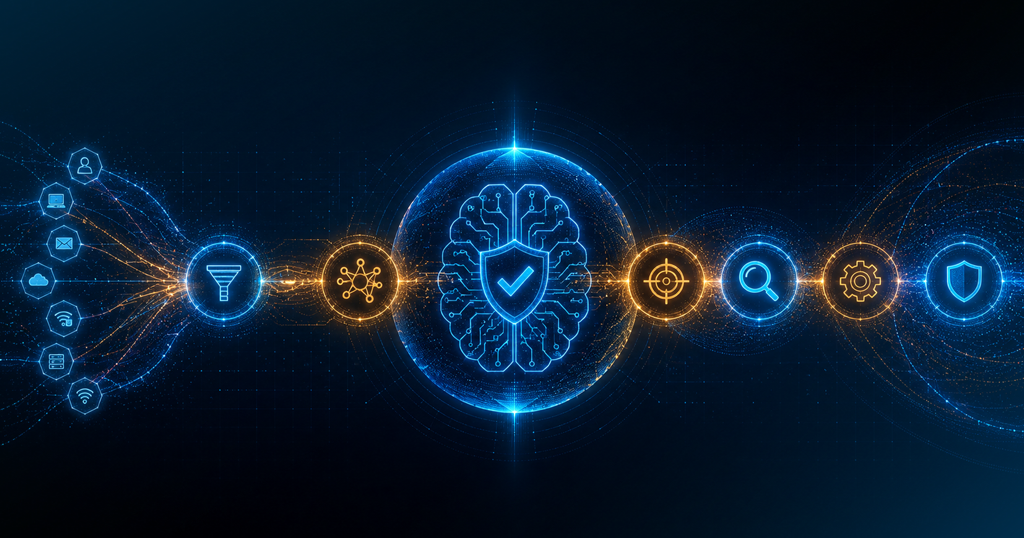
Key Takeaways
- An AI SOC replaces manual alert triage with AI agents that investigate threats in real time, around the clock
- The average enterprise gets hit with 960+ security alerts per day. Most are false positives nobody has time to review
- An AI SOC is not just SOAR with a fresh coat of paint. It reasons through threats instead of following rigid, pre-written playbooks
- A trustworthy AI SOC keeps humans in the loop and maintains a full, signed audit trail of every decision made
- You do not need to grow your headcount to grow your security coverage. That is the core promise of the AI SOC
Introduction
71% of SOC analysts say they are burned out. 64% plan to quit within a year.
That is not a people problem. That is a system design problem. Security teams are being asked to manually review thousands of alerts a day using tools built for a different era. Something had to change. The AI SOC is what changed it.
What Does AI SOC Stand For, and What Is It, Really?
AI SOC stands for Artificial Intelligence Security Operations Center. It is a security operations setup where AI agents handle the heavy lifting of threat detection, investigation, and initial response—with human approval required for high-impact containment actions.
A traditional SOC has a team of analysts staring at dashboards, sorting through alert queues, and manually triaging what looks real versus what is noise. The AI SOC flips that model. AI does the repetitive groundwork. Humans step in when things actually require judgment.
The SOC Crisis:
Why Manual Triage Can’t Scale
Attack surfaces grow exponentially. Analyst headcount grows linearly. The math hasn’t worked for a long time.
Sources: Osterman Research · AI SOC Market Landscape 2025 · SANS 2025 · IBM Cost of a Data Breach Report 2025
What Is an LLM-Powered SOC?
You will also see the term “LLM-powered SOC” used alongside AI SOC. It refers to a SOC that uses large language models to read, interpret, and reason through security alerts the way a senior analyst would. Instead of matching an alert to a fixed rule, the LLM can read the full context of an event, cross-reference historical data, and produce a human-readable explanation of what likely happened and why.
This matters because real-world attacks rarely follow the exact pattern for which a playbook was written. LLMs can reason through ambiguity and adapt to novel attack patterns. Static rules cannot.
The Agentic SOC
Another term worth knowing: the agentic SOC. This describes a setup where AI agents do not just analyze threats but take action on them, within defined guardrails. They can isolate an endpoint, block a suspicious IP, open a case, escalate to a human analyst, and log every step they took. All without waiting for someone to click a button.
The shift from automated (following a script) to autonomous (reasoning and acting) is what separates a true AI SOC from older automation tools.
What Problems Does an AI SOC Solve?
Start with the math. Attack surfaces grow exponentially. Analyst headcount grows linearly. You cannot hire your way out of that gap. Here is where the AI SOC fills in.
Alert Volume and Alert Fatigue
According to the AI SOC Market Landscape 2025 report, organizations face an average of 960 security alerts daily. Enterprises with over 20,000 employees see more than 3,000 per day. Nearly 90% of SOCs report feeling overwhelmed by backlogs and false positives. (Osterman Research)
When analysts see that volume every shift, they stop trusting the alerts. They start skimming. Real threats get missed. That is not incompetence. That is human nature under an impossible workload.
The AI SOC fixes alert fatigue by doing what humans cannot: reviewing every single alert, every time, at machine speed.
Analyst Burnout and Turnover
The average SOC analyst stays in their role for 18 to 24 months. That is among the shortest tenures in all of IT. The SANS 2025 survey found that 70% of analysts with five or fewer years of experience leave within three years.
Every time someone leaves, institutional knowledge walks out with them. New analysts take months to ramp up. The team falls further behind. The AI SOC breaks this cycle by removing the repetitive triage that burns people out fastest. Analysts shift from processing noise to handling the cases that actually need a human.
MTTR and Response Speed
In 2025, the fastest recorded attacks achieved lateral movement in just four minutes after initial access. Data exfiltration happened in as little as six minutes.
A SOC running manual processes measured in hours cannot contain threats within that window. AI agents close the gap. They process and correlate data instantly, contain threats before they spread, and do it without waiting for a shift handoff.
Why Do Companies Need an AI SOC?
Simply put: because hiring more analysts is not a scalable answer. IBM’s 2025 Cost of a Data Breach Report found that organizations using AI extensively cut the breach lifecycle by 80 days and saved roughly $1.9 million per incident on average. The ROI is not theoretical. It is measurable.
How Is AI SOC Different from SOAR?
This is one of the most common questions in security circles right now. And it deserves a straight answer.
SOAR (Security Orchestration, Automation, and Response) works by running predefined playbooks. If alert type A fires, execute steps 1, 2, and 3. It is rule-based and linear. If the attack does not match the playbook, the playbook fails.
The AI SOC does not run on scripts. It reasons.
AI SOC vs. SOAR —
What’s the Real Difference?
Both automate security operations. Only one can think its way through a novel attack.
Follows
the Script
- Runs rigid, pre-written playbooks — one rule per scenario
- Breaks down when attacks don’t match a known playbook
- 60–70% false positive rates still persist
- Requires specialist coders to keep every rule updated
- No organizational context — doesn’t know your environment
Reasons
Through Context
- Reads full alert context — user history, device behavior, threat intel
- Handles novel attack patterns without a pre-written playbook
- Reasons through ambiguity — adapts to your specific environment
- Human approval required for high-impact containment actions
- Full explainability — shows every step, all decisions logged
Key distinction: SOAR executes predefined scripts. An AI SOC reasons through context, then acts — with human oversight for what matters most.
Where SOAR Falls Short
Organizations that deployed SOAR still report 60 to 70% false positive rates. The reason is structural: SOAR cannot handle novel attack patterns it was never programmed for, and it has no way of knowing organizational context. It does not know that the CFO logging in from Singapore at 2 AM is actually traveling for work.
On top of that, SOAR creates a new burden called playbook maintenance fatigue. Teams spend hours keeping hundreds of automation rules up to date every time a tool changes or a vendor updates its alert schema.
What the AI SOC Does Instead
An AI SOC agent reads the full context of an alert, not just the raw event. It checks user history, device behavior, threat intelligence feeds, and past incidents. It reasons through what is likely happening. Then it takes action or escalates with a complete written summary of what it found and why.
No playbook required. No specialist coder needed to write new rules every week.
The key distinction: SOAR executes predefined scripts. An AI SOC reasons through context, then acts with human oversight for high-impact decisions.
What Makes an AI SOC Trustworthy? (And What Is a Governed AI SOC?)
Speed and scale are table stakes. Trust is the harder part. Any security team considering an AI SOC should ask: what happens when the AI makes a call? Who is accountable? Can you explain it to an auditor?
A governed AI SOC is one that answers those questions clearly. Here is what that looks like in practice.
Human in the Loop
For high-stakes actions like taking a production server offline or blocking a user account, a governed AI SOC requires human sign-off before proceeding. AI does the investigation. A human makes the call. That distinction keeps your team legally and operationally protected.
Signed Audit Trails and Decision Logs
Every action the AI takes should be logged with full context: what data it looked at, what reasoning it applied, what it did, and why. These are called signed decision logs.
Auditors and regulators are not satisfied with knowing that something happened. They need to know why, under what authority, and by what process. Black box AI decisions are not acceptable in a regulated environment—which is why Secure.com’s SOC Teammate provides full explainability and signed audit trails for every action. A governed AI SOC produces human-readable audit trails that can stand up to scrutiny.
Explainability Over Speed
The best AI SOC platforms do not just close alerts fast. They show their work. Every investigation step is visible. Analysts can review, correct, and teach the system. That feedback loop is how the AI gets smarter over time, adapting to your specific environment rather than generic global threat models.
A trustworthy AI SOC is one your team can actually verify, not just trust blindly.
Security ops that don’t sleep — or burn out.
The SOC Teammate handles Tier 1 and Tier 2 alert triage around the clock — investigating threats, escalating what matters, and keeping a full audit trail.
$2.5K/month per Digital Security Teammate
vs. $300K/year per analyst 120× cheaper
FAQs
What does AI SOC stand for?
How is an AI SOC different from SOAR?
What is a governed AI SOC?
Why do companies need an AI SOC?
Conclusion
The AI SOC is not a futuristic concept anymore. It is the practical answer to a very real operational problem: too many alerts, too few analysts, and attackers who are not waiting around.
The organizations that move toward AI-native security operations today are the ones that will respond faster, burn out their teams less, and spend less per incident over time. The math is clear: $2.5K/month for a Digital Security Teammate vs. $300K/year per analyst. The only question is how long to wait.
If your team is still manually triaging every alert, that is a good place to start the conversation.