TL;DR
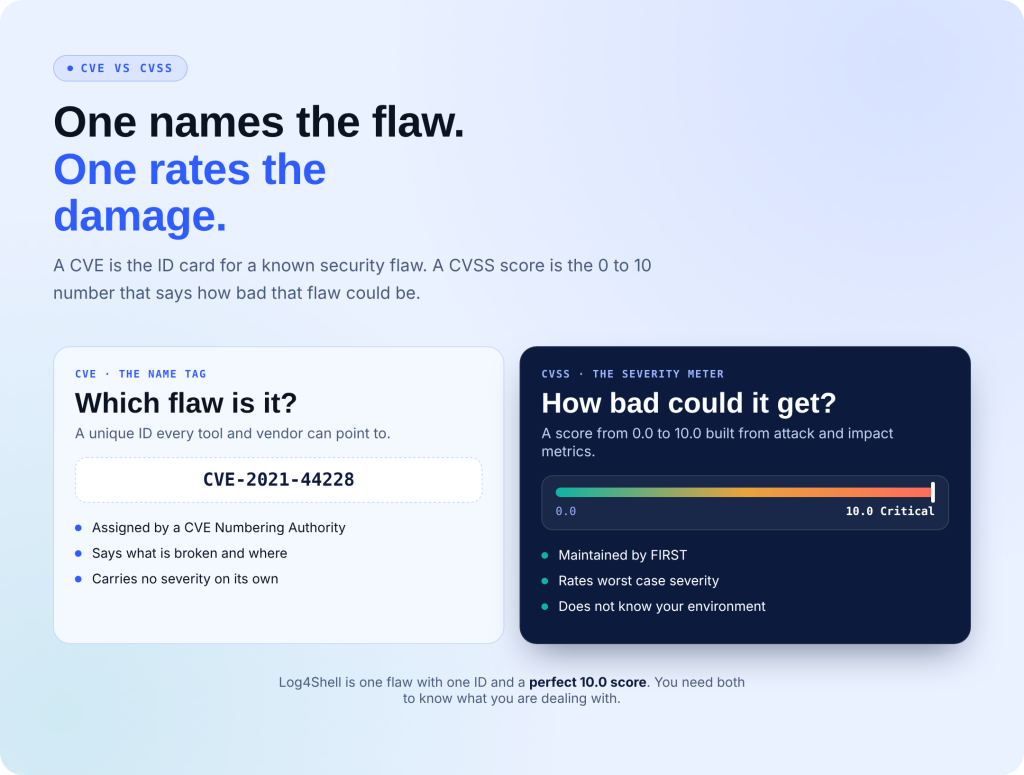
Here is CVE vs CVSS in one paragraph. A CVE is the ID for one known security flaw. A CVSS score rates how bad that flaw could be, from 0.0 to 10.0. A CWE names the type of coding mistake behind it. You need all three to talk about a vulnerability clearly, but none of them tells you what to patch first in your environment. For that, you add exploit data and business context.
In 2025, the CVE Program published 48,185 CVEs, a 20.6% increase from 2024’s 39,962. Each one has an ID and usually a score. If CVE and CVSS still blur together for you or your team, this guide explains CVE vs CVSS in plain English.
What Is a CVE?
CVE stands for Common Vulnerabilities and Exposures. It’s a public list of known security flaws, and each flaw gets its own ID. MITRE runs the CVE Program with funding from CISA. Before CVE existed, though, vendors and tools gave the same bug different names. So CVE solved the problem by providing one canonical identifier per flaw: a reference number that every tool, vendor, and analyst can point to unambiguously.
Who Assigns CVE IDs?
CVE Numbering Authorities (CNAs) assign the IDs. MITRE approves these vendors, researchers, and security groups. The program is big. The CVE Program now counts 510 CNAs from 42 countries and one organization without country affiliation.
How to Read a CVE ID
Every ID follows the same pattern: CVE, then a year, then a number. Take CVE-2021-44228.
- CVE: the program prefix
- 2021: the year the program assigned the ID
- 44228: the flaw’s unique number. Since 2014, the program supports five or more digits to accommodate volume growth.
In short, a CVE record tells you what’s broken and which products are affected. It doesn’t tell you how dangerous the flaw is. That’s the job of CVSS.
What Is a CVSS Score?
CVSS stands for Common Vulnerability Scoring System. It turns a flaw’s traits into one number from 0.0 to 10.0. The nonprofit FIRST (Forum of Incident Response and Security Teams) maintains it. CVSS captures the principal technical characteristics of a security vulnerability and produces a numerical score denoting its severity.
CVSS Score Range and Severity Ratings
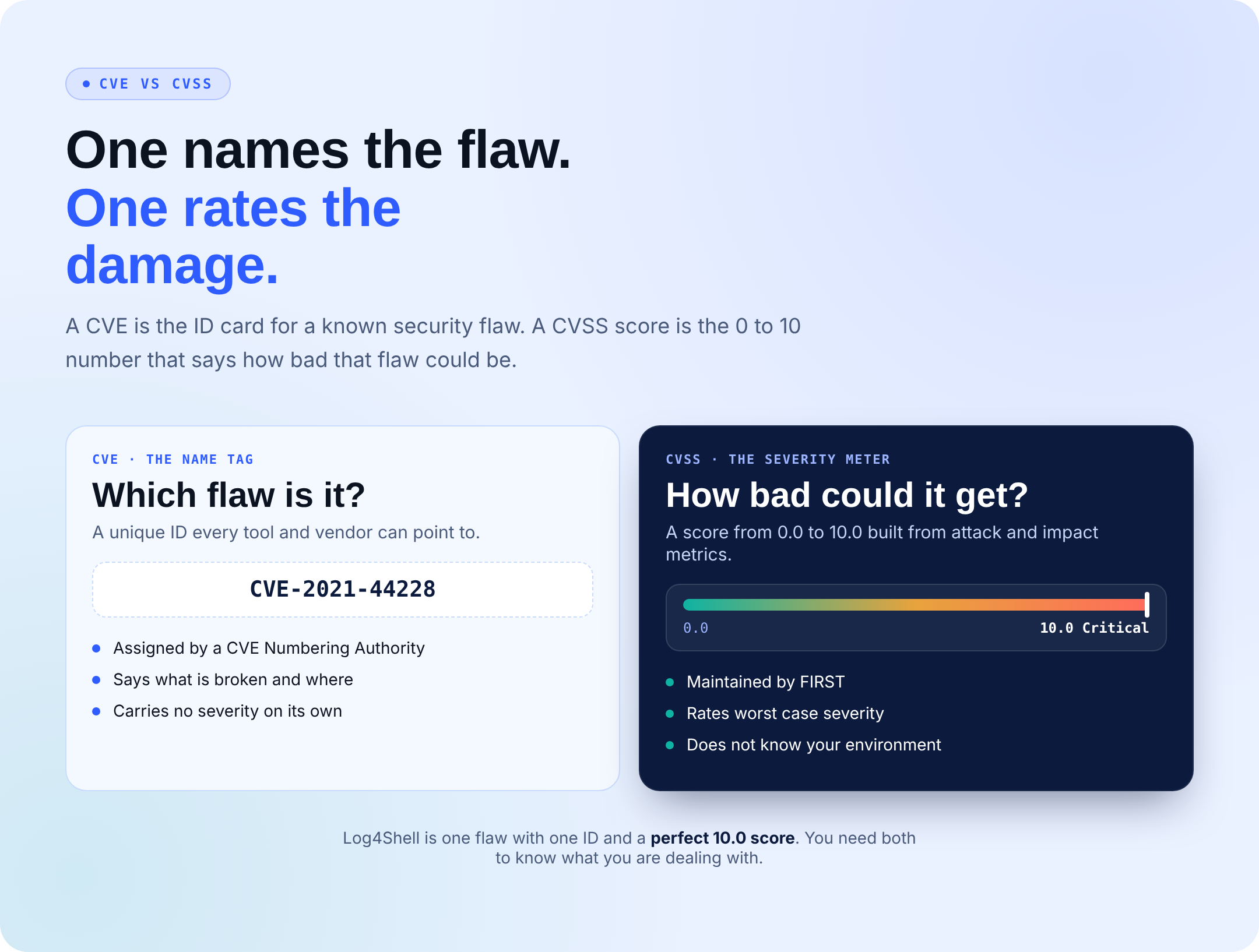
Every score falls into one of five bands. CVSS v3.1 and v4.0 use the same bands.
| Rating | Score range | What it usually means |
|---|---|---|
| None | 0.0 | No real security impact |
| Low | 0.1 to 3.9 | Hard to exploit or small impact |
| Medium | 4.0 to 6.9 | Worth fixing on your normal schedule |
| High | 7.0 to 8.9 | Serious impact if exploited |
| Critical | 9.0 to 10.0 | Easy to exploit with severe impact |
Also, high scores are common. In Jerry Gamblin’s 2025 CVE review, 8.3% of CVEs were Critical, 31.1% were High, and 53.0% were Medium.
The Metric Groups Behind the Score
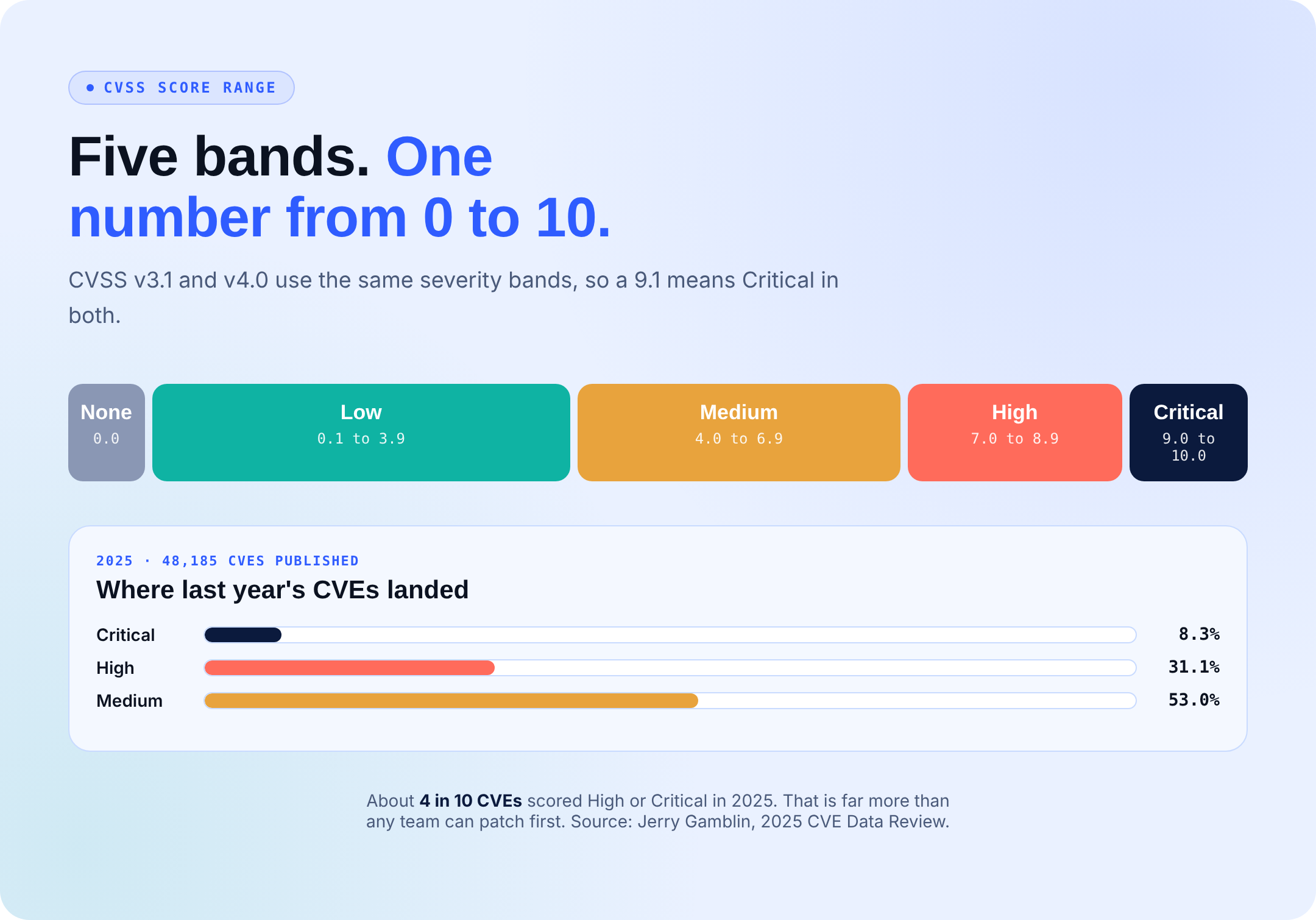
A CVSS score isn’t a guess. It’s built from metric groups:
- Base: the flaw’s built-in traits, like attack vector, complexity, and impact
- Threat: whether exploit code exists or attacks are already happening (v3.1 called this Temporal)
- Environmental: how the flaw affects your specific systems
- Supplemental: extra context in v4.0, like automation or recovery, which doesn’t change the score
However, most public scores you see are Base scores only. To clarify, v4.0 introduces new nomenclature to enumerate CVSS scores using a combination of Base (CVSS-B), Base + Threat (CVSS-BT), Base + Environmental (CVSS-BE), and Base + Threat + Environmental (CVSS-BTE) severity ratings.
Is CVSS Still Used?
Yes. It’s still the most common way to rate how severe a flaw is. The current version is CVSS version 4.0, released on November 1, 2023. Plenty of tools and advisories still show v3.1 scores next to v4.0 scores, so check which version you’re reading.
There is one catch, though: not every CVE gets a score. In 2025, 5,803 kernel CVEs were published, but 85% have no CVSS score. The kernel became a CNA in 2024 but intentionally doesn’t score vulnerabilities.
CVE vs CVSS: Key Differences
Here’s the side-by-side view, so you can compare them at a glance.
| Feature | CVE | CVSS |
|---|---|---|
| What it is | A unique ID for a known flaw | A severity score for a flaw |
| Question it answers | Which flaw is this? | How bad could it be? |
| Format | CVE-YEAR-NUMBER | 0.0 to 10.0 plus a vector string |
| Who runs it | MITRE, with IDs assigned by CNAs | FIRST |
| Who adds it to a record | The CNA that assigns the ID | The CNA, NVD analysts or vendors |
| What it misses | Severity and risk | Your environment and active attacks |
CVE vs CVSS in Layman’s Terms
Think of a car crash. The CVE is the license plate: it tells you exactly which car was involved. The CVSS score is the damage rating: it tells you how bad the crash could be. A license plate with no damage rating leaves out severity. A damage rating with no plate leaves out which car you’re talking about.
CVE vs CVSS Example: Log4Shell
Log4Shell is the textbook case. The flaw is CVE-2021-44228, found in the Apache Log4j logging library. It got a CVSS v3.1 Base Score of 10.0, Critical, with the vector CVSS:3.1/AV:N/AC:L/PR:N/UI:N/S:C/C:H/I:H/A:H. In plain words, attackers could hit it over the network with low effort, no login, and no user clicks.
As a result, the score matched what happened next. CISA added it to KEV on 12/10/2021. Years later, it still showed up on the list of 15 most routinely exploited vulnerabilities in 2023, despite being disclosed in December 2021.
CWE vs CVE vs CVSS: Where Each One Fits
There’s a third acronym that often gets mixed in. CWE stands for Common Weakness Enumeration. It names the type of mistake in the code, not one specific bug.
| Term | What it labels | Example |
|---|---|---|
| CWE | The weakness type | CWE-917: expression language injection |
| CVE | One real flaw in one product | CVE-2021-44228 in Log4j |
| CVSS | How severe that flaw is | 10.0 Critical |
One CVE can map to more than one CWE. For example, Log4Shell maps to CWE-917, CWE-502, CWE-20, and CWE-400.
CVE vs CWE
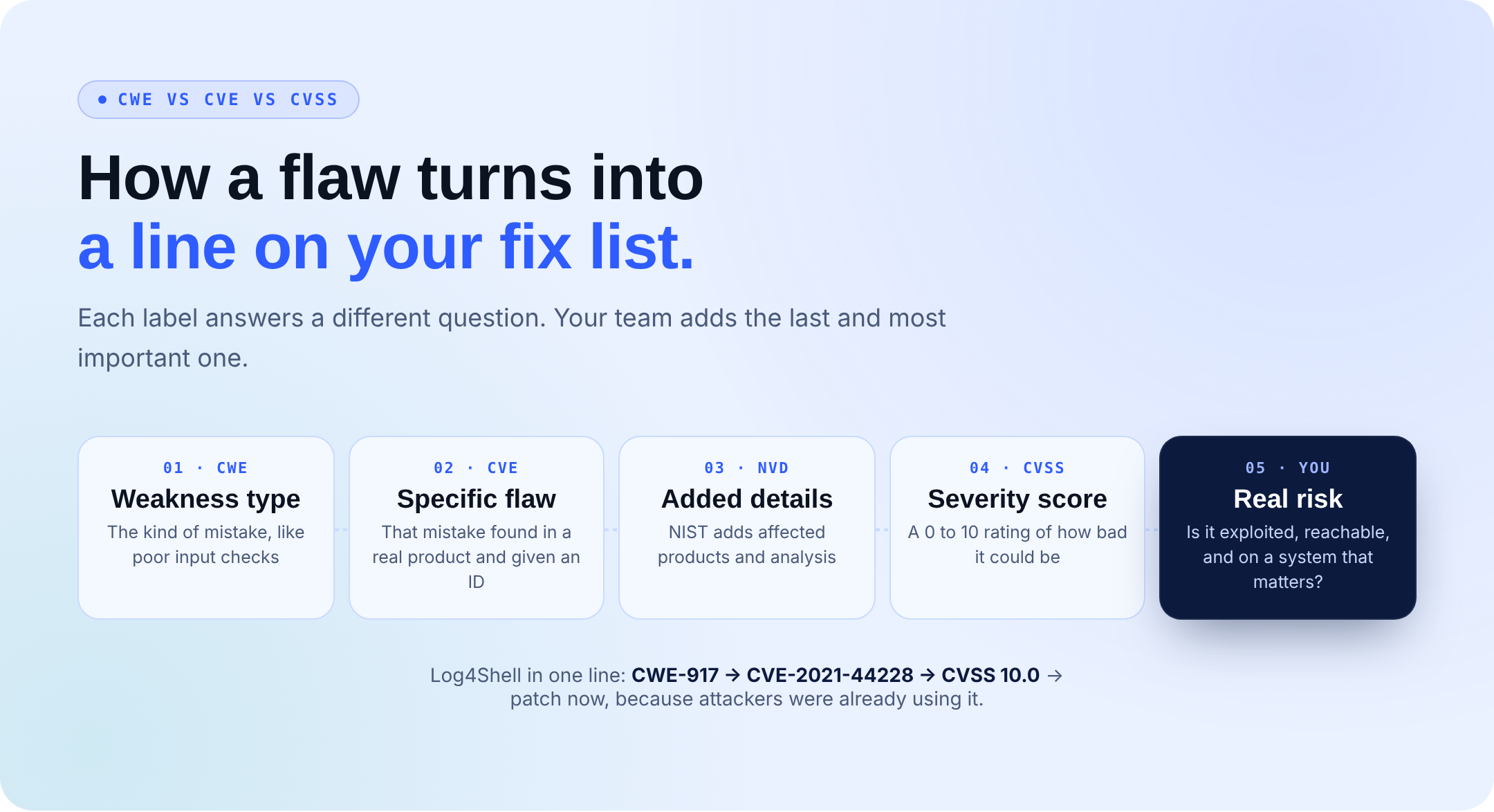
A CWE is the recipe for a mistake. A CVE is that mistake showing up in a real product. Developers use CWE to stop the same type of bug from coming back. Meanwhile, security teams use CVE to track and patch specific flaws.
CVE vs NVD
CVE is the list of IDs. The NVD (National Vulnerability Database) is a NIST database that adds detail to each record, like affected products, CVSS scores, and CWE mappings. The NVD has fallen behind, though. NVD fully analyzed only 28% of newly disclosed CVEs in 2025, down sharply from 46.2% in 2024. As a result, many CVEs reach you with limited data or only a score from the CNA.
How CVE and CVSS Work Together in Cyber Security
In practice, CVE vs CVSS is never a choice between the two. Every vulnerability follows the same path, and both show up along the way:
- Someone finds a flaw and reports it.
- A CNA assigns a CVE ID and publishes a record.
- The CNA or the NVD adds a CWE and a CVSS score.
- Scanners match the CVE to the software you run.
- Your team decides what to fix and when.
Steps 1 to 4 are the same for everyone. However, step 5 is where programs succeed or fail.
Why a CVSS Score Alone Won’t Tell You What to Fix First
CVSS tells you how bad a flaw could be. However, it doesn’t tell you whether anyone is attacking it, or whether it sits on a system that matters to you. FIRST says this itself: “CVSS is designed to measure the severity of a vulnerability and should not be used alone to assess risk.”
The numbers back this up. According to the FIRST Exploit Prediction Scoring System (EPSS), attackers exploit only around 5% of all published CVEs. If 4 in 10 CVEs score High or Critical but only a small share ever get used by attackers, sorting by score alone sends your team after the wrong fires. That’s the real lesson of CVE vs CVSS: severity is not the same as risk.
That is why smart teams add three more filters:
- CISA KEV: Is this flaw being exploited in the wild right now?
- EPSS: how likely is exploitation in the next 30 days?
- Asset context: can an attacker reach it, and does the system matter to the business?
We go deeper in our guide on why CVSS scores aren’t risk scores. If you want to build your own model, see how to set up a vulnerability risk scoring framework that actually works. Our walkthrough of threat-informed vulnerability prioritization also shows how CVSS, EPSS, and KEV fit together.
Fewer Scores to Sort. More Fixes That Count.
Every week brings hundreds of new CVEs, and most teams don’t have the hours to triage them all. Secure.com runs this work for you as Service as a Software: you get security outcomes from one service on one bill, with no extra tools to manage.
- Managed Exposure Management finds weak spots across your cloud and systems and matches them to real CVEs.
- Risk-based ranking: we rank findings by exploit activity and business impact, so you don’t have to work down a list sorted by CVSS.
- Expert remediation: our experts fix the top risks, then retest to prove each one is closed.
- vCISO reporting: a vCISO turns that work into clear board and compliance reports, so you don’t have to hire a full-time CISO.
- You stay in control: your team sets the rules and approvals, and we do the grunt work.