TL;DR
A vulnerability is a weak spot that lets an attacker in. The main types of vulnerabilities are code flaws, network gaps, misconfigurations, broken access, unpatched software, risky APIs, supply chain flaws, and human error. You can’t fix them all at once, so find every flaw, rank it by real risk, and close the ones attackers can reach first.
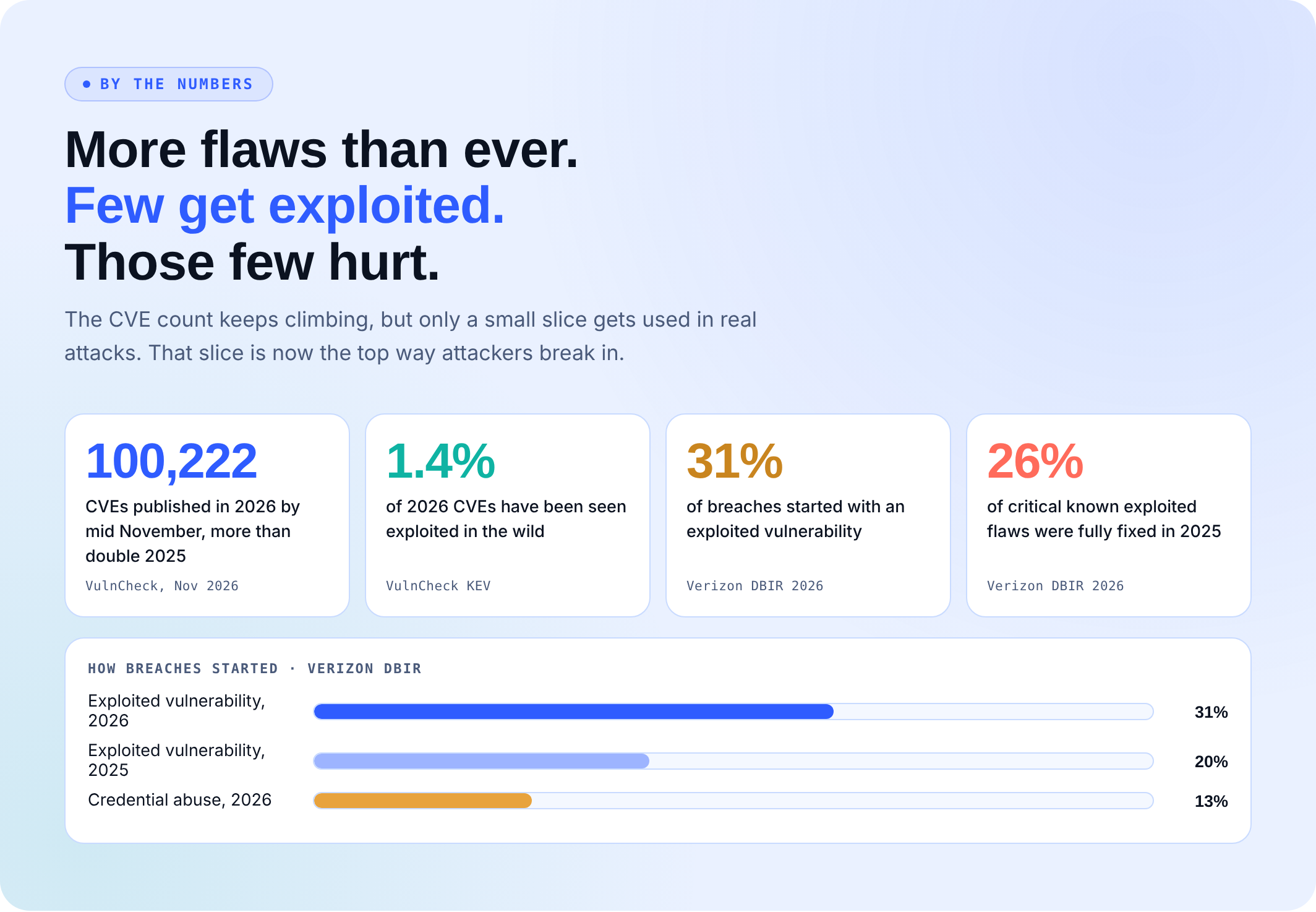
By mid-November 2026, VulnCheck had counted more than 100,000 new CVEs for the year. That’s more than double the total for all of 2025. However, attackers will only ever use a small share of them, so the hard part is knowing which ones matter to you. Learning the main types of vulnerabilities is the best place to start.
What Is a Vulnerability in Cyber Security?
A vulnerability is a flaw or weakness in a system that an attacker can use to cause harm. It can live in code, a network, a cloud setting, or a person’s habits. On its own, a vulnerability does nothing. The damage starts when someone exploits it.
Vulnerability vs Threat vs Exploit vs Risk
People mix up these four words all the time. Here’s how they differ.
| Term | What it means | Simple example |
|---|---|---|
| Vulnerability | A weak spot in a system | A login page with no limit on password tries |
| Threat | Someone or something that could cause harm | A criminal group that guesses passwords |
| Exploit | The method or code used to abuse the weak spot | A script that tries thousands of passwords a minute |
| Risk | The chance of harm and how bad it would be | High, if that login protects customer data |
How Vulnerabilities Are Tracked: CVE, CWE and CVSS
Three labels show up in almost every security report. A CVE is an ID for one specific flaw in one product. Meanwhile, a CWE names the type of weakness behind it, such as SQL injection. CVSS scores the flaw’s severity on a scale of 0 to 10. For a closer look, read our guide on how CVE and CVSS work together.
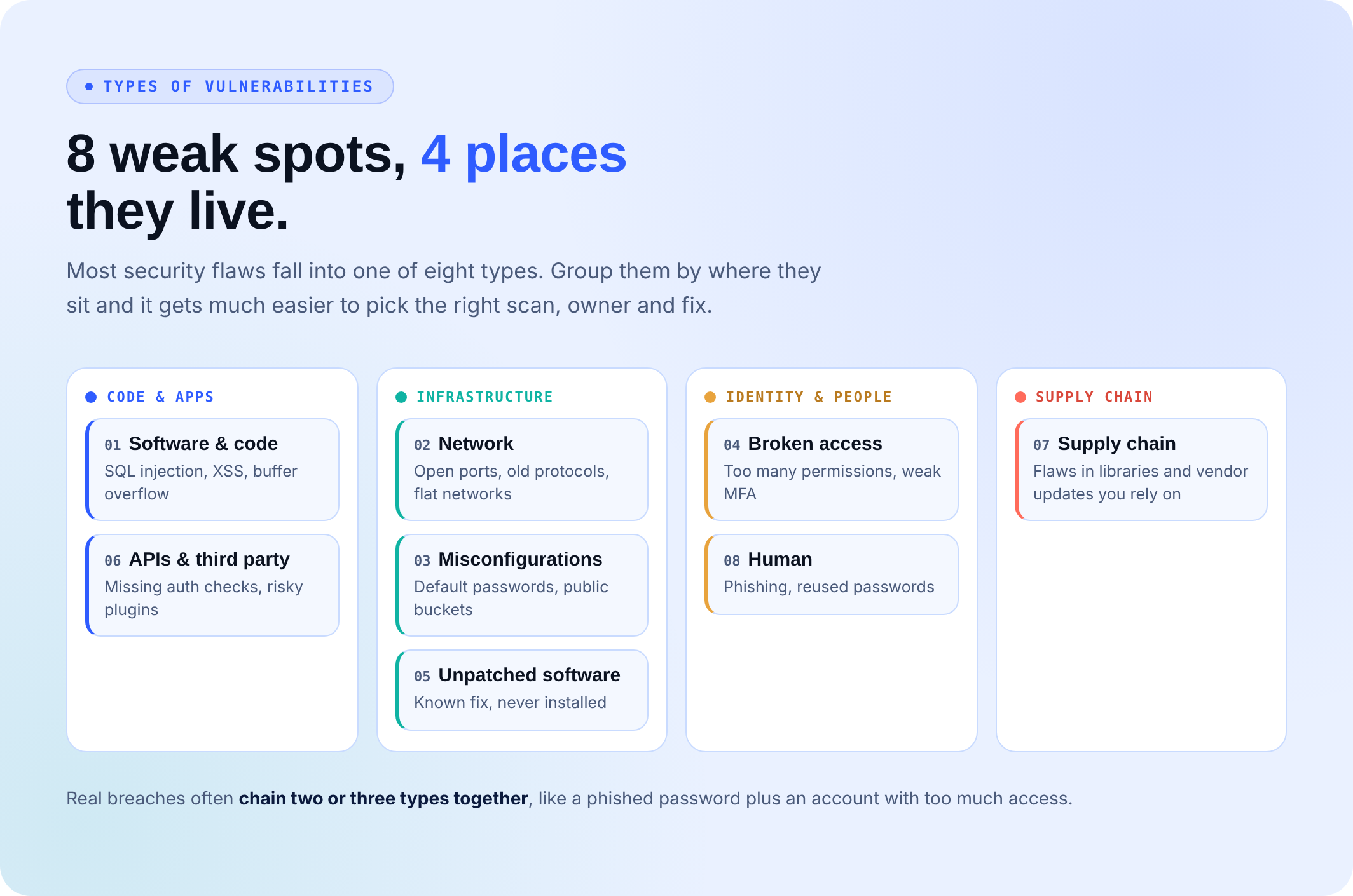
8 Types of Vulnerabilities in Cyber Security
Most security flaws fit into one of these eight types of vulnerabilities. They overlap, and a single breach often chains two or three together.
1. Software and Code Vulnerabilities
These are mistakes developers make when they write an app. For example, the most common ones let an attacker slip their own commands into an app through a form, a link, or a file upload. Cross-site scripting and SQL injection hold the top two spots on MITRE’s 2025 CWE Top 25, the yearly list of the most dangerous software weaknesses.
Common examples:
- SQL injection: an attacker types database commands into a search box or login field.
- Cross-site scripting (XSS): a harmful script runs in another user’s browser.
- Buffer overflow: an app takes in more data than it can hold, which can crash it or run attacker code.
- Missing authorization: an app forgets to check whether a user is allowed to do something.
How to fix it: Check every input, use safe database queries, and scan code before it ships.
2. Network Security Vulnerabilities
These are gaps in how devices and systems connect. Open ports, old protocols like Telnet, weak Wi-Fi encryption, and flat networks with no zone separation all count. Edge devices are also a growing target. In Verizon’s 2025 DBIR, edge devices and VPNs accounted for 22% of vulnerability exploitation cases, up from 3% the year before.
How to fix it: Close unused ports, split the network into zones, and patch firewalls and VPNs first.
3. Security Misconfigurations
A misconfiguration is a setting that leaves a door open. For example, think of default admin passwords, a cloud storage bucket set to public, or error pages that show too much detail. OWASP ranks security misconfiguration #2 in its 2025 Top 10. However, version-based scanners often miss these because many misconfigurations never get a CVE.
How to fix it: Start with hardened settings, remove defaults, and check cloud settings regularly. Our guide on preventing cloud misconfiguration walks through the most common ones.
4. Broken Access and Identity Weaknesses
These flaws let people reach data or actions they shouldn’t. This includes users with too many permissions, shared admin accounts, weak MFA, and apps that skip permission checks. Broken access control holds the #1 spot in OWASP’s 2025 Top 10.
How to fix it: Give each person only the access they need, turn on MFA everywhere, and review permissions every quarter.
5. Unpatched and Outdated Software
This is the most avoidable type. The vendor already released a fix, but nobody installed it. In 2017, WannaCry ransomware used a Windows flaw called EternalBlue that Microsoft had patched about two months earlier, and it still spread to more than 150 countries. Patching is still slow today. In fact, Verizon’s 2026 DBIR found that organizations fully fixed only 26% of critical flaws in CISA’s Known Exploited Vulnerabilities catalog in 2025, down from 38% the year before.
How to fix it: Patch flaws that are already being exploited first, track software that has reached end of life, and set clear fix deadlines.
6. API and Third-Party Vulnerabilities
Modern apps talk to each other through APIs. A weak API can leak data when it skips checks on who is asking or what they’re allowed to see. Plugins and outside tools also bring their own flaws. In 2025, WordPress security firms Patchstack and Wordfence assigned 5.3 times more CVEs than Microsoft, Google, and Apple combined, most of them in third-party plugins.
How to fix it: Keep a list of every API you run, require strong authentication on each endpoint, and vet vendors before you connect them.
7. Supply Chain Vulnerabilities
A supply chain flaw lives in software you didn’t write but depend on. So when attackers hit a popular library or vendor, everyone who uses it inherits the problem. In 2020, attackers hid malware in a SolarWinds update that reached about 18,000 organizations. A year later, the Log4j flaw put many Java apps at risk overnight. As a result, OWASP added Software Supply Chain Failures as #3 in its 2025 Top 10.
How to fix it: Keep a software bill of materials (SBOM), verify the packages you pull in, and watch vendor security notices.
8. Human Vulnerabilities
People make mistakes, and attackers plan for that. For example, phishing emails, reused passwords, and fake login pages open doors that technology alone can’t close. Verizon’s 2026 DBIR found a human element in 62% of breaches.
How to fix it: Train staff with real examples, use phishing-resistant MFA, and make reporting a strange email quick and easy.
Known vs Zero-Day: How Vulnerabilities Get Exploited
A known vulnerability has a public CVE and usually a patch. In contrast, a zero-day is a flaw the vendor doesn’t know about yet, so no patch exists. Zero-days grab headlines, but known flaws are the bigger problem for most teams, because patches often sit uninstalled for months. For example, Verizon’s 2026 DBIR shows how much this matters: exploiting a vulnerability was the first step in 31% of breaches, which made it the top way attackers got in.
What Makes a Security Vulnerability Exploitable?
Not every flaw is dangerous. A vulnerability turns into a real problem when:
- An attacker can reach it, often straight from the internet.
- Working exploit code is public or easy to write.
- It needs little or no login and no user action.
- It runs on a system that holds valuable data or provides broad access.
That’s why attackers use so few published CVEs. Of the 100,000+ CVEs published in 2026 so far, about 1.4% have made it onto VulnCheck’s list of known exploited vulnerabilities.
Remote, Local and Zero-Day Exploits
| Exploit type | How it works | Example |
|---|---|---|
| Remote | The attacker abuses the flaw over a network | Hitting an unpatched VPN from the internet |
| Local | The attacker needs access to the device first | Using a driver bug to become an admin |
| Zero-day | Attackers use the flaw before a patch exists | A browser bug used before the vendor knows about it |
The OWASP Top 10 (2025) at a Glance
OWASP’s Top 10 is the best-known list of web app security risks. Here is the 2025 version and where each item fits among the 8 types of vulnerabilities above.
| Rank | OWASP category | Fits under |
|---|---|---|
| A01 | Broken Access Control | Broken access and identity |
| A02 | Security Misconfiguration | Misconfigurations |
| A03 | Software Supply Chain Failures | Supply chain |
| A04 | Cryptographic Failures | Software and code |
| A05 | Injection | Software and code |
| A06 | Insecure Design | Software and code |
| A07 | Authentication Failures | Broken access and identity |
| A08 | Software or Data Integrity Failures | Supply chain |
| A09 | Security Logging and Alerting Failures | Misconfigurations |
| A10 | Mishandling of Exceptional Conditions | Software and code |
Types of Vulnerability Scans
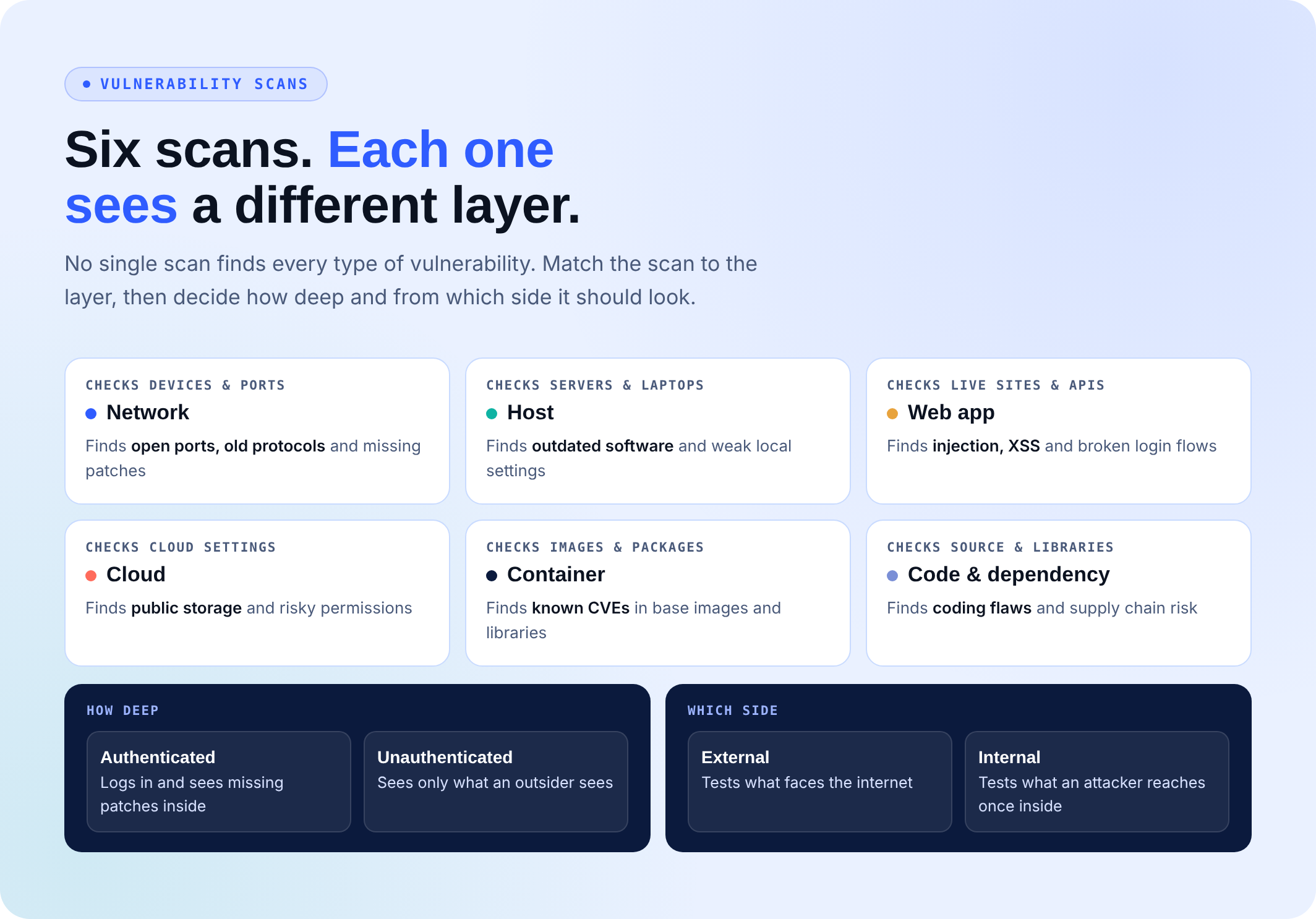
A scan is how you find these flaws before attackers do. Because each scan type covers a different layer, most teams run several to catch all types of vulnerabilities.
| Scan type | What it checks | What it finds |
|---|---|---|
| Network scan | Devices, ports and services | Open ports, old protocols, missing patches |
| Host scan | Servers and laptops, from the inside | Outdated software, weak local settings |
| Web app scan | Live websites and APIs | Injection, XSS, broken login flows |
| Cloud scan | AWS, Azure and Google Cloud settings | Public storage, risky permissions |
| Container scan | Container images and their packages | Known CVEs in base images and libraries |
| Code and dependency scan | Source code and open-source libraries | Coding flaws and supply chain risk |
Two more choices shape every scan. An authenticated scan logs in, so it can see missing patches deep inside a server. In contrast, an unauthenticated scan only sees what an outsider sees. External scans test what faces the internet, and internal scans test what an attacker could reach after getting inside. In short, a healthy program runs all four.
Activity: Identify Types of Vulnerabilities
Many security courses ask students to match a scenario to the right vulnerability type. Try these five, then check your answers below.
- A company’s login page lets anyone guess passwords forever with no lockout.
- A cloud storage bucket full of customer files is set to public.
- A server still runs a software version that got a security fix last year.
- An employee types their password into a fake Microsoft 365 page.
- A popular open-source logging library inside your app has a newly found flaw.
Answers: 1 is broken access and identity, since there’s no limit on login tries. 2 is a security misconfiguration. 3 is unpatched software. 4 is a human vulnerability. 5 is a supply chain vulnerability.
How to Reduce Vulnerabilities Across Your Stack
You can’t fix all of these vulnerability types at once. Instead, these habits cut the most risk for the effort:
- Know what you own. Keep a live list of devices, cloud accounts, apps, and APIs.
- Fix what’s exploited first. CVSS alone can mislead you, so rank flaws by real exploit activity and business impact. Our exposure prioritization playbook shows how to build that queue.
- Harden by default. Remove default passwords and lock down cloud settings from day one.
- Limit access. Give people and apps only the permissions they need.
- Scan all the time. A monthly scan misses everything that shows up in between.
- Verify the fix. Rescan to confirm a patch worked before you close the ticket, and track metrics like time to fix by severity.
Stop Sorting Findings. Start Closing Them.
Most teams have plenty of scan results and not enough hours to sort them and push fixes through. Secure.com runs that work for you as one service on one bill: AI sorts the findings, and security experts decide what gets fixed.
- Managed Exposure Management finds weak spots across your cloud, systems, and apps, and maps them to real CVEs.
- We rank findings by exploit activity and business impact, so your team fixes the most critical issues first.
- Experts work with your system owners to drive each fix, then rescan to verify the fix worked.
- A vCISO turns the results into a security plan, compliance evidence, and board-ready reports, without a full-time hire.
You tell us what needs protecting, and we run the program.