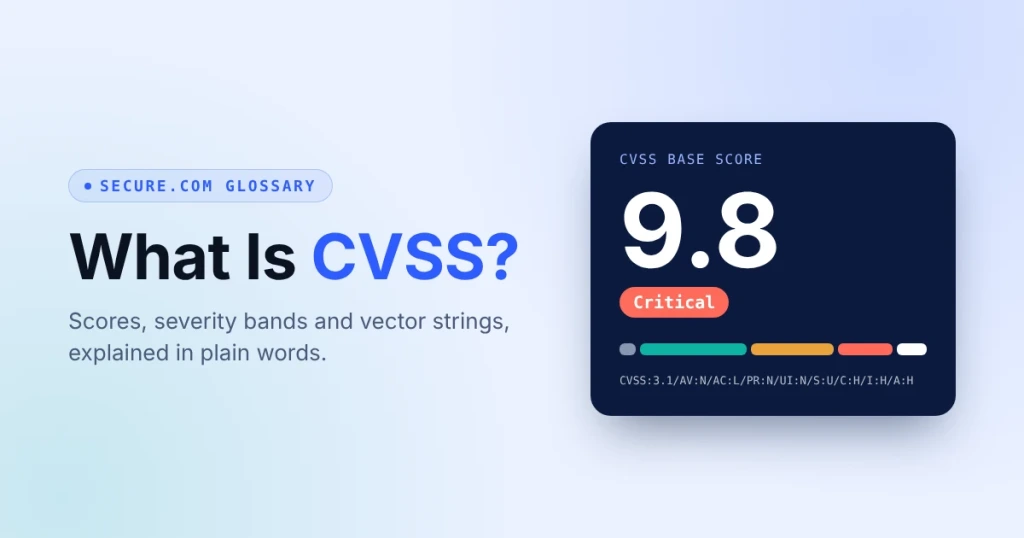
TL;DR: CVSS is a free, open system from FIRST that rates how bad a software flaw could be on a scale of 0.0 to 10.0. Each score falls into one of five bands, from None to Critical. A CVSS score measures severity, not risk, so you still need to know if attackers are using the flaw and how much the affected system matters to you.
CVE submissions jumped 263% between 2020 and 2025, reaching about 48,185 in 2025 alone. In April 2026, NIST said the National Vulnerability Database (NVD) would analyze only the riskiest CVEs going forward. So that 9.8 in your scanner might come from a vendor, from NVD, or from nobody yet. So what is CVSS, and how does the score actually work? Here is the plain version.
What Is CVSS?
CVSS stands for Common Vulnerability Scoring System. It is an open framework that describes how severe a software vulnerability is, using a number from 0.0 to 10.0.
FIRST (the Forum of Incident Response and Security Teams), a nonprofit, owns and manages CVSS. Anyone can use it for free, and you don’t need to be a FIRST member.
The newest version is CVSS v4.0, released on November 1, 2023. Version 3.1, from June 2019, is still everywhere, so you will see both in scanners and advisories.
What Is CVSS in Cyber Security?
In cyber security, CVSS is the shared language for how bad a bug is. A vendor, a scanner, and your patch team can all read “8.1 High” and know roughly what they are dealing with.
What Is CVSS Used For?
- Sorting which vulnerabilities to look at first
- Setting patch deadlines in internal policy, like Critical in days and Low in the next cycle
- Rating flaws in security advisories and scanner reports
- Showing auditors you rate vulnerabilities the same way every time
What Is a CVSS Score?
A CVSS score is a number from 0.0 to 10.0 that sums up how much damage a flaw could do if someone used it. Higher means worse.
FIRST says it plainly: the Base score measures severity, not risk. It describes the flaw on its own and ignores your network, your controls, and whether any attacker cares.
What Is CVSS Severity? The Five Rating Bands
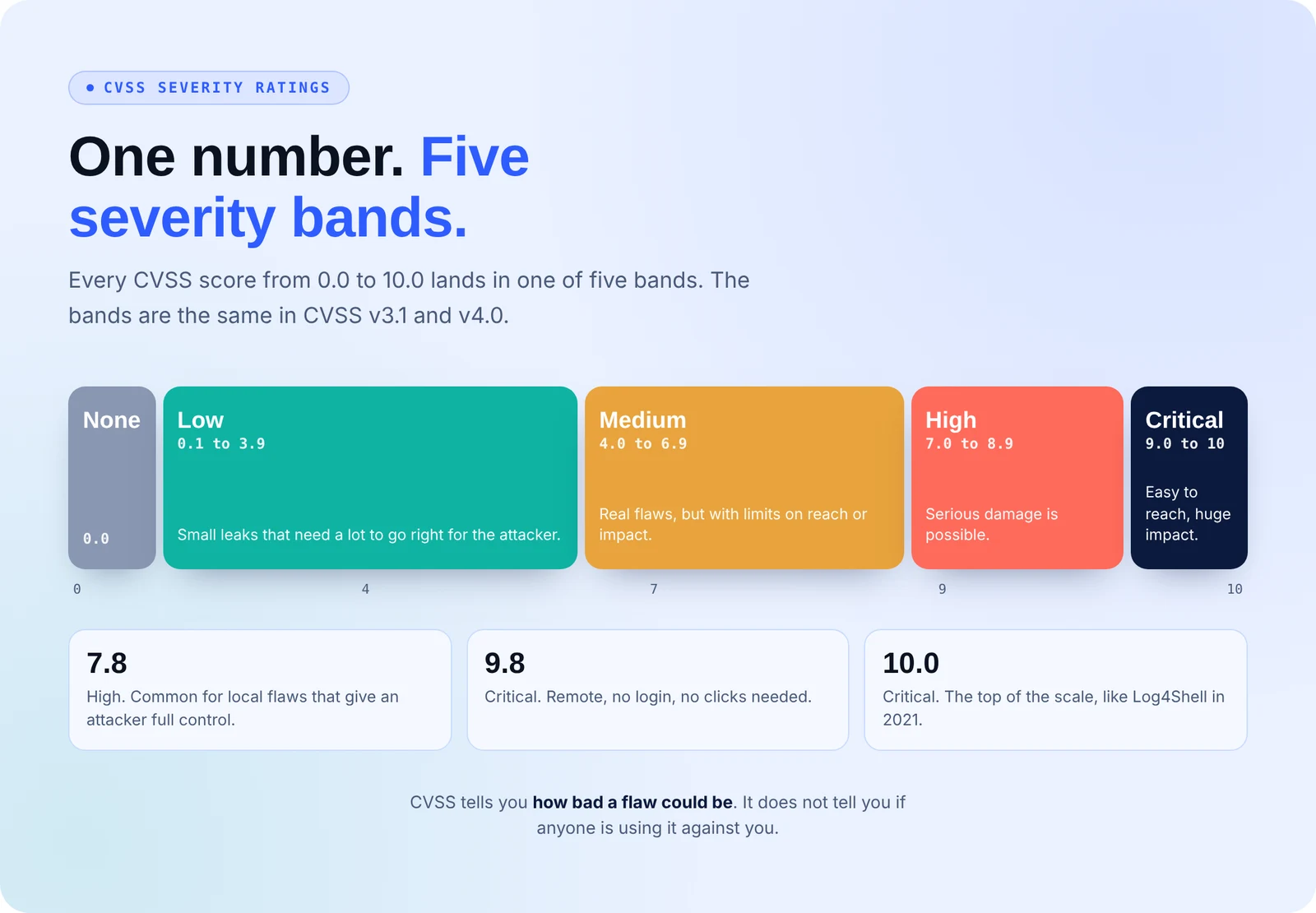
CVSS turns each number into a plain word rating. The bands are the same in v3.1 and v4.0.
- None: 0.0
- Low: 0.1 to 3.9
- Medium: 4.0 to 6.9
- High: 7.0 to 8.9
- Critical: 9.0 to 10.0
Is CVSS 7.8 High?
Yes. A 7.8 falls in the High band. You will see this exact number often on local privilege flaws, where an attacker needs a foothold on the machine first and then gains full control.
What Does a CVSS Score of 10 Mean?
A 10.0 is the top of the scale. The flaw can be exploited over the network with no login and no clicks, and the damage can spread beyond the buggy component itself. NVD gave Log4Shell, the Apache Log4j flaw from December 2021, a 10.0.
CVSS Metrics Explained
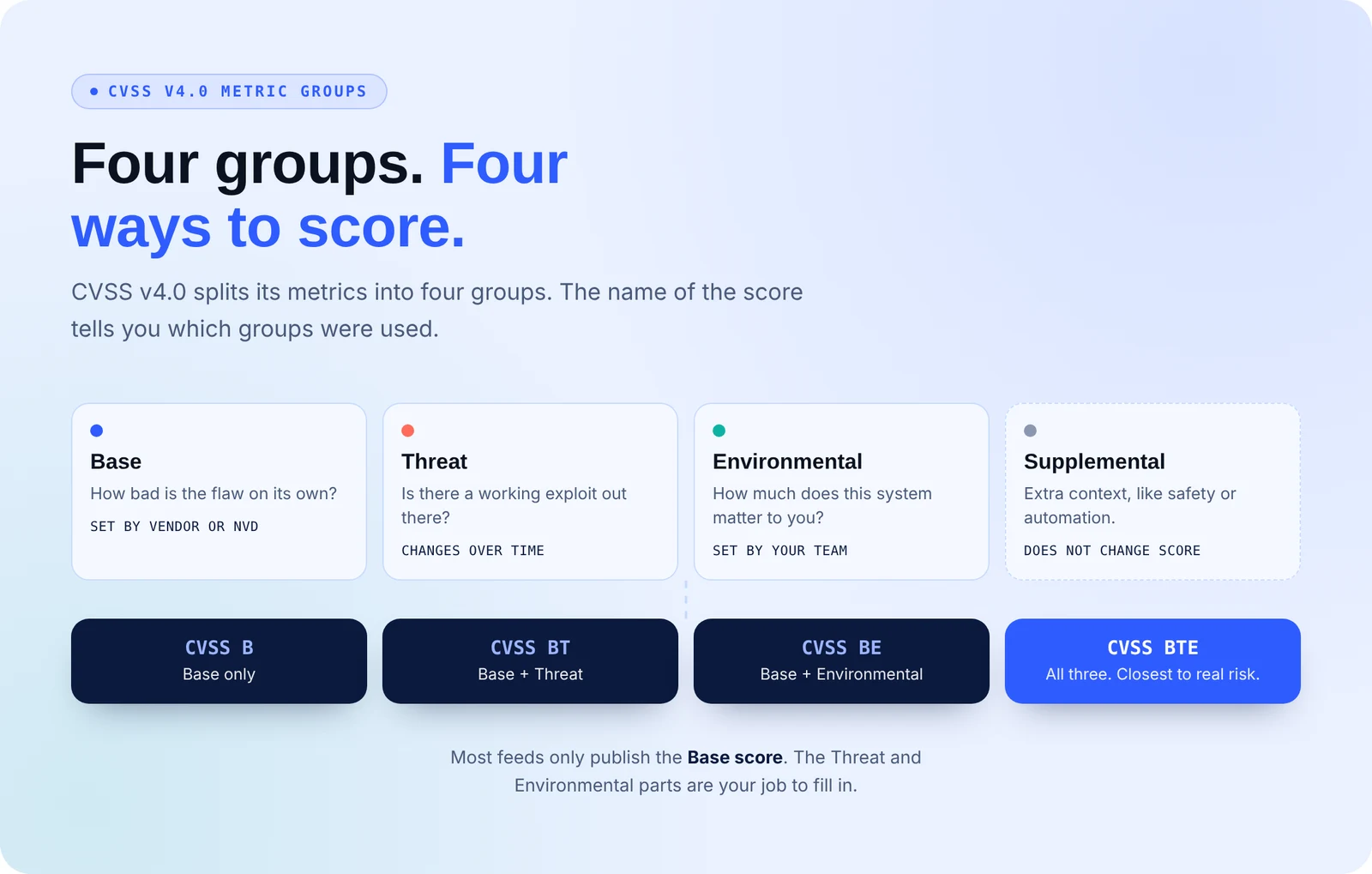
CVSS v4.0 sorts its metrics into four groups: Base, Threat, Environmental, and Supplemental. Version 3.1 had three, with Temporal in place of Threat and no Supplemental group.
What Is the Base Score?
The Base score covers the parts of a flaw that stay the same over time and across companies. It asks two questions: how easy is the attack, and what breaks if it works?
In v4.0, the ease side looks at Attack Vector, Attack Complexity, Attack Requirements, Privileges Required, and User Interaction. The impact side rates confidentiality, integrity, and availability twice: once for the vulnerable system and once for any systems hit after it.
The product vendor or NVD usually sets the Base score. It is the number you see in most feeds.
Threat Metrics
Threat metrics replaced Temporal metrics in v4.0. They mainly ask one thing: is there a working exploit, or proof of attacks in the wild?
By default, CVSS assumes the worst. Adding threat data can only keep a score where it is or bring it down.
Environmental Metrics
Your own team fills these in. You say how much confidentiality, integrity, and availability matter for that system, and you can adjust Base answers to match your setup.
A 9.8 on a lab box that nothing can reach over the network can drop a long way once you score it this way.
Supplemental Metrics
Supplemental metrics are new in v4.0. They include Safety, Automatable, Recovery, Value Density, Vulnerability Response Effort, and Provider Urgency.
They add useful context, but they never change the score.
How Is a CVSS Score Calculated?
You pick an answer for each metric, and CVSS turns those answers into a number.
- Step 1: Answer each Base metric for the flaw
- Step 2: Your answers form a vector string
- Step 3: The vector becomes a score. Version 3.1 uses a weighted formula. Version 4.0 grouped about 15 million possible vectors into 270 sets, had experts rank them, and built the scores from those rankings.
- Step 4: Add Threat and Environmental answers to fit the score to your situation
What Is a CVSS Calculator?
A CVSS calculator does the math for you. FIRST and NVD both offer free online calculators where you click an answer for each metric and get the score and vector back.
Calculators are also handy for “what if” checks. Switch Attack Vector from Network to Local, and you can watch the score fall.
What Is a CVSS Vector?
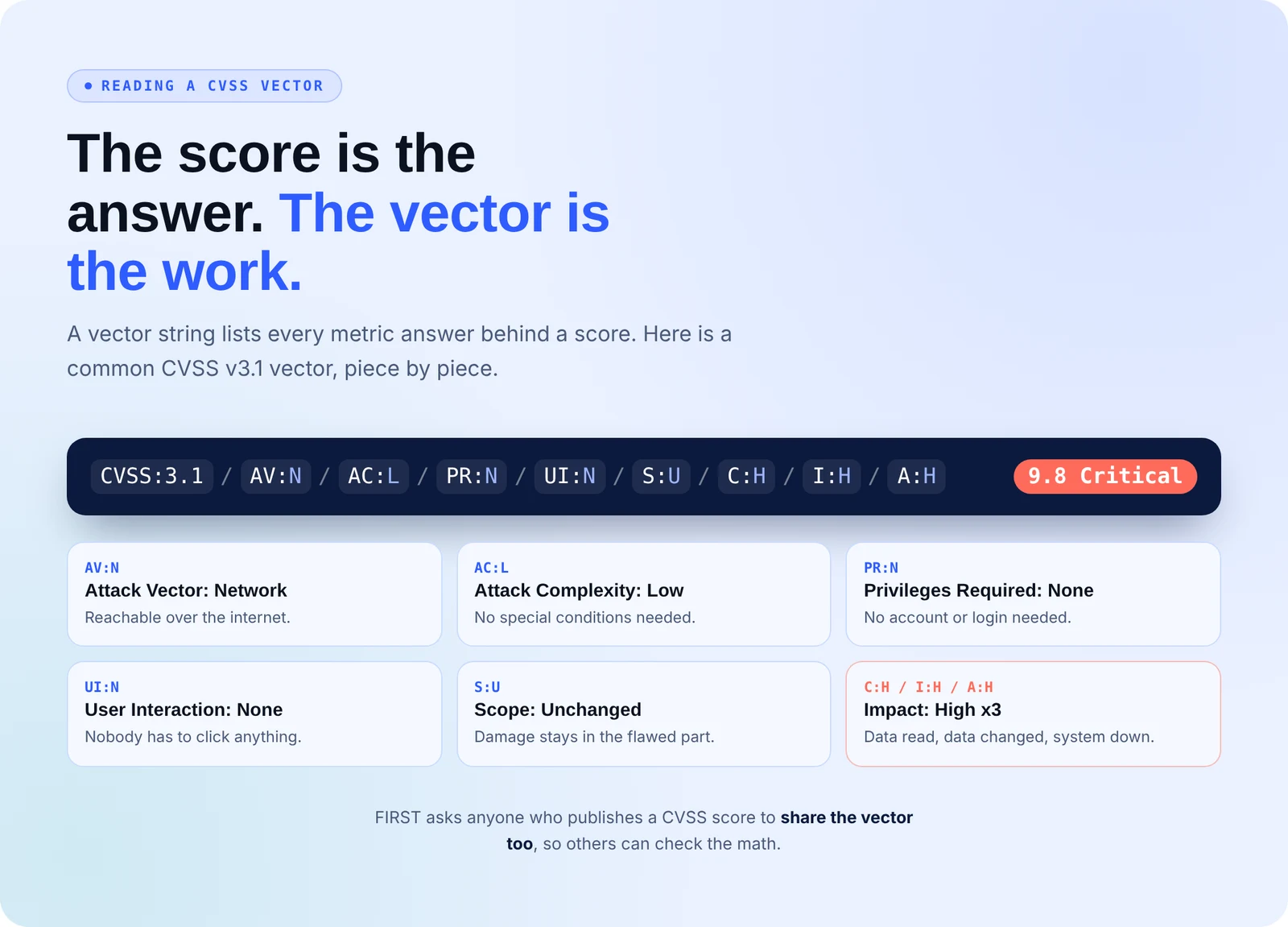
A CVSS vector is a short text code that lists every metric answer behind a score. FIRST asks anyone who publishes CVSS data to share the vector along with the score, so others can check the work.
Here is a common v3.1 example: CVSS:3.1/AV:N/AC:L/PR:N/UI:N/S:U/C:H/I:H/A:H. It reads as a network attack, low complexity, no login, no user clicks, scope unchanged, and high impact on all three. That works out to 9.8 Critical.
A v4.0 vector follows the same idea with more fields, like this: CVSS:4.0/AV:N/AC:L/AT:N/PR:N/UI:N/VC:H/VI:H/VA:H/SC:N/SI:N/SA:N.
CVSS v3.1 vs CVSS v4.0: What Changed
Version 4.0 was built to fix the biggest complaints about 3.1. Here are the main changes:
- Temporal metrics became Threat metrics and got simpler
- A new Supplemental group adds context without moving the score
- A new Attack Requirements metric covers conditions an attacker can’t control
- Scope is gone, and impact is now split between the vulnerable system and the systems after it
- New score names show which groups were used: CVSS B, CVSS BT, CVSS BE, and CVSS BTE
- Safety metrics now cover OT, ICS, and IoT, where a flaw can hurt people, not only data
CVSS vs CVE (and Where NVD Fits)
A CVE is the ID for one specific flaw, like a case number. CVSS is the score for how bad that flaw could be.
NVD, run by NIST, adds the analysis on top: CVSS scores, weakness types and lists of affected products. One CVE can carry several CVSS scores, such as a vendor score and an NVD score, or a v3.1 score and a v4.0 score.
NVD Scores and the 2026 Backlog
NVD has struggled with a backlog of unscored CVEs since early 2024. In April 2026, NIST moved to fully analyze only the highest priority CVEs, and the Cloud Security Alliance estimates about 80% of CVEs won’t get NVD enrichment.
A blank NVD score does not mean a flaw is safe. Use the vendor or CNA score when NVD has none, and treat a CVE on CISA’s exploited list as urgent no matter what.
What Is CVSS in Vulnerability Management?
In vulnerability management, CVSS is the starting point for sorting work. The trouble is that most scans return piles of High and Critical findings, and a Base score can’t tell you which ones attackers are using or which systems matter most.
That is why teams add more signals. EPSS estimates how likely a flaw is to be exploited soon, and you can see how EPSS and CVSS work together in a real prioritization workflow. The CISA Known Exploited Vulnerabilities catalog then flags flaws attackers are already using. Your own asset context finishes the picture.
How Secure.com Helps You Act on Vulnerability Scores
CVSS scores pile up faster than any team can check them by hand. Secure.com runs on Governed Defense, Powered by Offense: AI teammates attack your defenses, harden what they find, and hand your team back hundreds of hours a month.
- Pull CVSS, EPSS, KEV, and your asset context into one ranked list
- Test whether a flaw can actually be reached and used in your environment, so a 9.8 on an isolated box doesn’t jump ahead of a 7.5 on your login page
- Harden what they find, inside rules your team sets
- Prove the fix with evidence ready for audits and leadership
- Repeat on every new CVE: Attack. Harden. Prove. Repeat.
Your team sets the rules. AI teammates do the work. No More Grunt Work. No More Burnout.
FAQs
What is CVSS used for?
What is CVSS vs CVE?
Is CVSS 7.8 high?
What does a CVSS score of 10 mean?
What does CVSS stand for?
Is CVSS 4.0 replacing CVSS 3.1?
Recommended Reading
- EPSS in Practice: A Real Vulnerability Prioritization Workflow: picks up where this page stops and shows how to combine CVSS with exploit odds.
- What Is Known Exploited Vulnerabilities (KEV)?: covers the one list that should outrank any CVSS number.