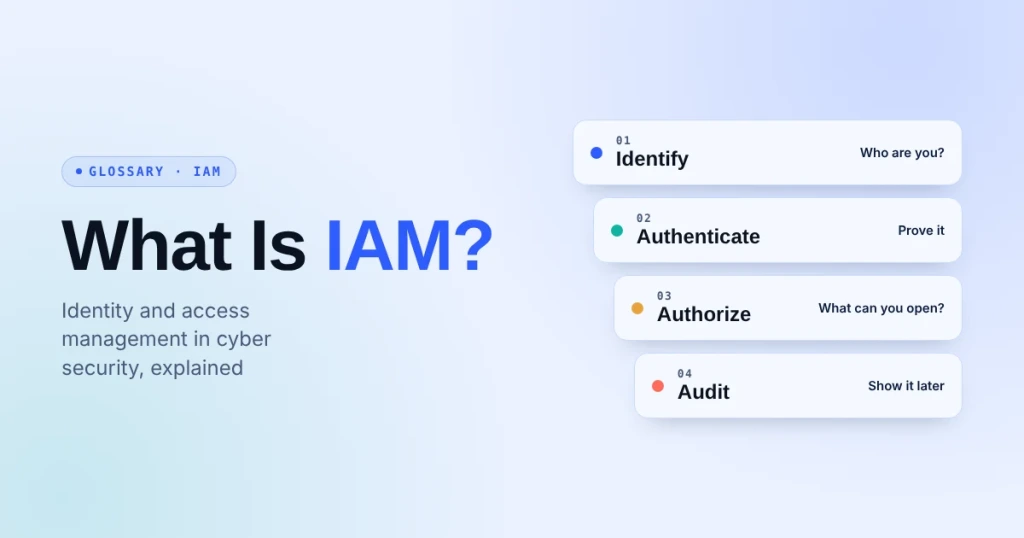
IAM stands for identity and access management. It is the set of tools and rules that decide who can log in to your systems, what they can touch once inside, and when that access should end. Attackers go after logins because a valid login rarely sets off alarms.
What is IAM?
Identity and access management (IAM) is a security discipline that manages digital identities and controls what each identity can access. An identity can be a person, like an employee, contractor, or vendor. It can also be a machine, like a service account, an API key, or an AI agent. IAM gives each identity a verified profile and grants only the access it needs to do its job.
What is an IAM identity?
An IAM identity is the digital record that stands for one user or one machine inside your systems. The record holds attributes such as name, job title, department, manager, and device. IAM reads those attributes to decide what the identity can open. When someone changes teams, their attributes change, and their access should change that day.
What is IAM in IT?
In IT, identity and access management is the daily work of creating accounts, assigning permissions, resetting passwords, and removing access when people leave. IT teams usually run the directory, such as Microsoft Entra ID or Active Directory, and the single sign-on portal. Security teams write the access policies those systems enforce. In a midmarket company, the same two or three people often do both jobs.
Identity and access management in cyber security
Identity and access management is a front-line security control because almost every attack needs a working login at some point. The latest numbers show how much rides on it:
- Credential abuse appears in 39% of breaches when you count every stage of an attack (Verizon 2026 DBIR).
- The global average cost of a data breach reached a record $4.99 million in 2026, up 12% from 2025 (IBM Cost of a Data Breach Report 2026).
- Breaches took an average of 247 days to identify and contain in 2026 (IBM).
- The IAM market is projected to reach $42.61 billion by 2030, up from $25.96 billion in 2025 (MarketsandMarkets).
The 2026 DBIR also showed exploited vulnerabilities passing stolen credentials as the most common first step into a network, at 31% of breaches. Identity risk did not shrink with that shift. Once inside, attackers still use valid logins to move between systems and raise their privileges. That is why a zero trust architecture checks identity on every request, not only at the front door.
How IAM works
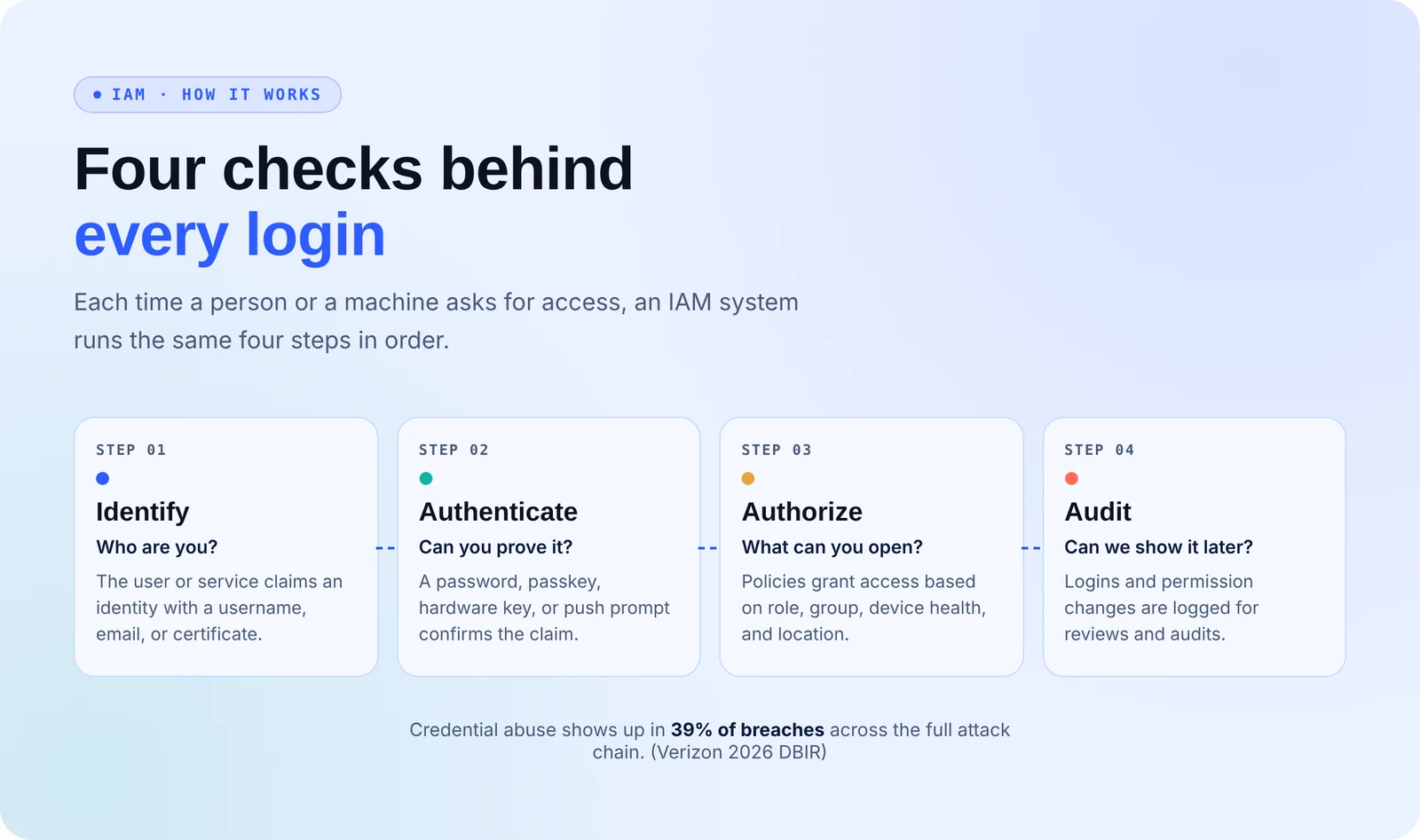
Most IAM systems run four checks every time someone asks for access.
- Identify: The user or machine claims an identity with a username, email, or certificate.
- Authenticate: The system confirms that claim with a password, passkey, hardware key, or push prompt.
- Authorize: Policies decide what the identity can open based on role, group, device health, and location.
- Audit: Every login and permission change gets logged so you can review it and show it to auditors.
Core components of an IAM program
- Directory: The single source of truth for every identity and its attributes.
- Single sign-on (SSO): One login for many apps, so people stop reusing weak passwords.
- Multifactor authentication (MFA): A second proof of identity. Phishing-resistant options like passkeys and hardware keys hold up best.
- Role-based access control (RBAC): Permissions tied to job roles instead of handed out one person at a time.
- Privileged access management (PAM): Extra controls for admin accounts, like time-limited elevation and session recording.
- Identity governance and administration (IGA): Joiner, mover, and leaver workflows plus scheduled access reviews.
IAM requirements
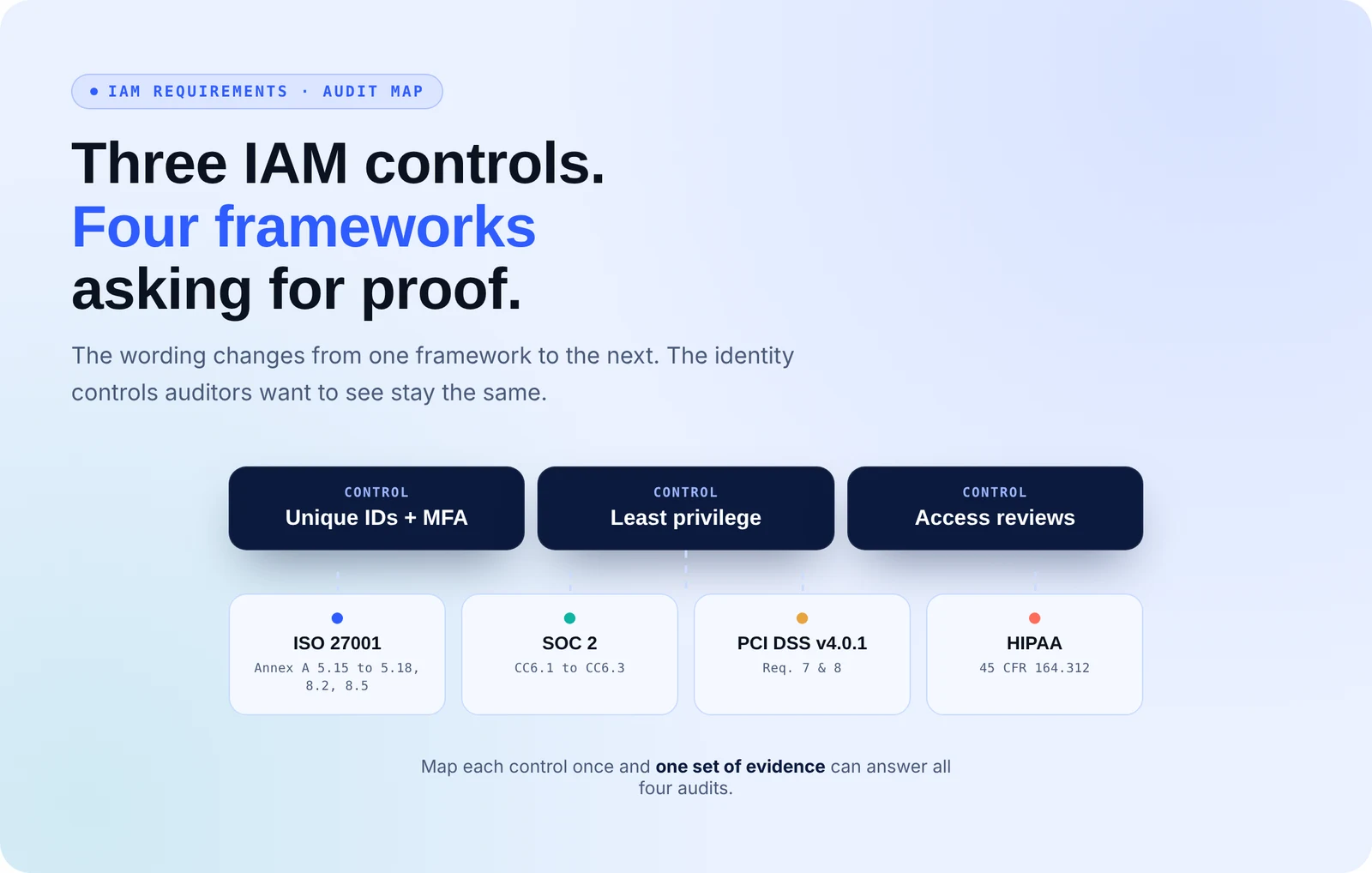
IAM requirements are the identity controls that security frameworks and auditors expect you to prove. The wording differs by framework, but the asks repeat:
- A unique ID for every user, with no shared accounts.
- MFA for remote access and admin access.
- Least privilege, which means each identity gets the minimum access it needs.
- Quickly remove access when someone leaves or changes roles.
- Regular access reviews with a record of who approved what.
- Keep login and permission-change logs long enough for an audit.
Where these requirements live:
- ISO 27001:2022: Annex A controls 5.15 to 5.18, 8.2, and 8.5.
- SOC 2: Common Criteria CC6.1 to CC6.3.
- PCI DSS v4.0.1: Requirements 7 and 8.
- HIPAA Security Rule: Access control and authentication standards in 45 CFR 164.312.
IAM cybersecurity jobs
IAM jobs sit within security or IT teams and focus on maintaining correct access as people and systems change. Common titles include:
- IAM analyst or administrator: Handles access requests, onboarding, offboarding, and review campaigns.
- IAM engineer: Builds and runs SSO, MFA, provisioning, and app integrations.
- PAM engineer: Locks down admin accounts and service accounts.
- Identity architect: Designs how identity works across cloud, SaaS, and on-premises systems.
- IAM manager or head of identity: Owns the roadmap, the budget, and the audit results.
IDPro, the professional body for identity practitioners, says experienced identity and access management practitioners are harder to find than ever. Demand is also shifting toward machine identities, which MarketsandMarkets expects to be the fastest-growing identity type in the IAM market through 2030.
Cybersecurity IAM salary
IAM pay in the US depends on level, location, and specialty. Salary sites disagree, so treat any single number as a rough guide.
- Salary.com puts the average IAM engineer base salary at $107,186 (April 2026).
- PayScale lists an average IAM engineer base salary of $109,727 in 2026.
- Glassdoor shows an average total pay of $135,259, including bonus (via KORE1).
- Location moves the number. Salary.com shows IAM engineers in San Jose averaging $135,194.
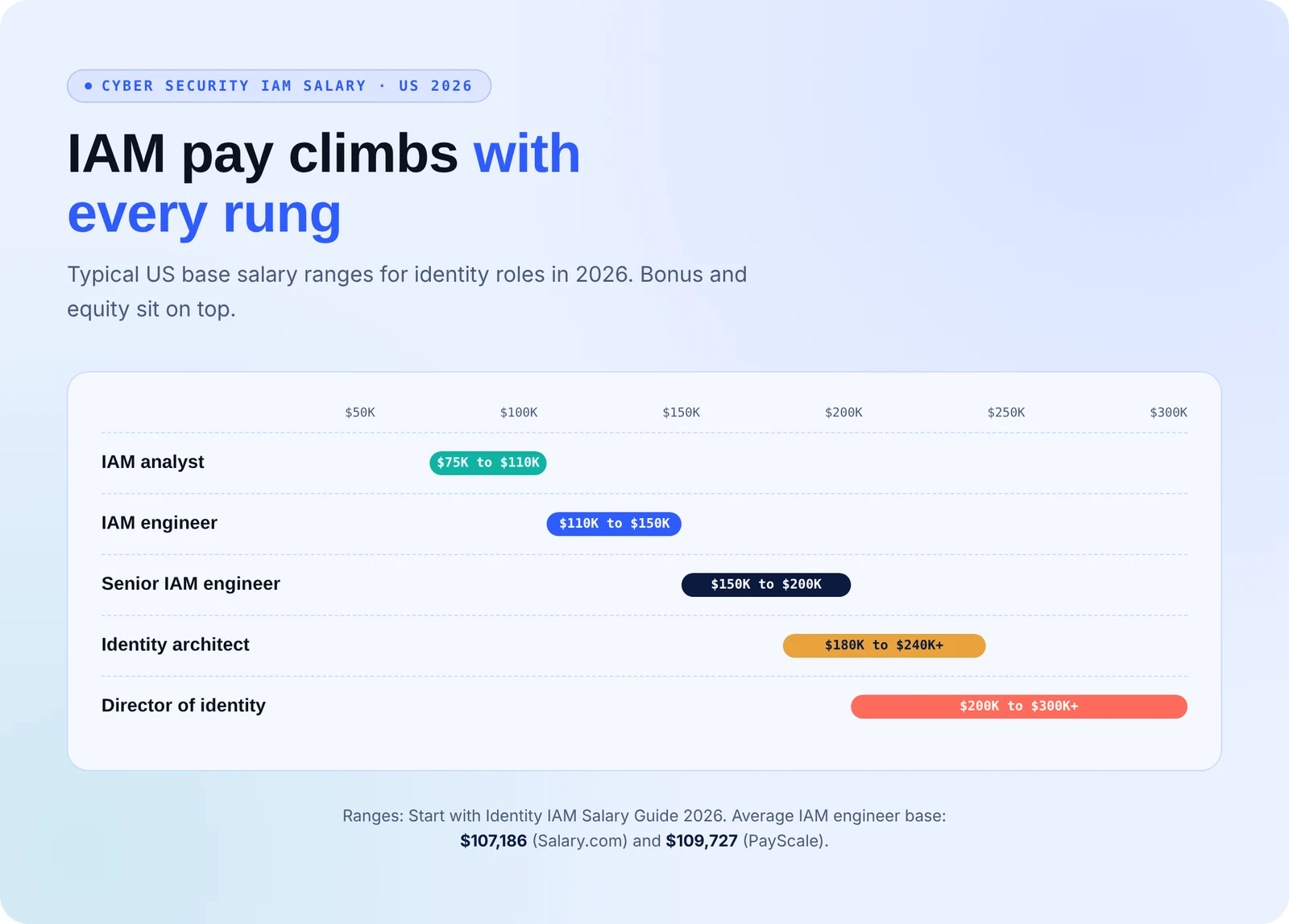
Typical 2026 US base ranges by role, from the Start with Identity salary guide:
- IAM analyst: about $75K to $110K
- IAM engineer: about $110K to $150K
- Senior IAM engineer: about $150K to $200K
- Identity architect: about $180K to $240K+
- Director or head of identity: about $200K to $300K+
IAM cybersecurity course and certification options
You do not need a degree in identity to get started. Many IAM pros move over from help desk, sysadmin, or general security roles. These credentials carry weight with hiring managers:
- CIDPRO from IDPro: A vendor-neutral certification that covers provisioning, authentication, authorization, governance, and compliance.
- Identity Management Institute certifications such as CIAM, CAMS, and CIST, with exams priced between $195 and $395 (TechTarget).
- CISSP: A broad security credential with a full domain on identity and access management. Senior and leadership roles often ask for it.
- Vendor certifications from your directory, SSO, or PAM provider, which prove you can run the platform your company already owns.
Identity and access management in cyber security PDF resources
These free PDFs make good offline references:
- NIST Digital Identity Guidelines (SP 800-63-4): Federal guidance on identity proofing, authentication strength, and federation.
- CISA and NSA IAM Recommended Best Practices for Administrators: Practical steps for the admins who run IAM day-to-day.
- Verizon 2026 Data Breach Investigations Report: Breach data you can use to make the case for IAM budget.
Where IAM breaks down in midmarket teams
- Access piles up. People change roles and keep old permissions, a problem called privilege creep.
- Offboarding lags. Accounts stay active in SaaS apps that sit outside SSO.
- Machine identities go untracked. Service accounts and API keys often hold broad, permanent access with no clear owner.
- Reviews turn into rubber stamps. Managers approve everything because the list is too long to check.
- Audit evidence lives in spreadsheets. Each audit eats weeks of analyst time.
How Secure.com helps with IAM
Secure.com delivers Governed Defense, Powered by Offense: AI teammates attack your identity defenses, harden what they find, and prove it to your auditors. Your team sets the rules, the AI teammates do the work, and your analysts get back hundreds of hours a month.
- Attack: AI teammates probe your identity setup like an attacker, hunting for stale accounts, missing MFA, and admin rights nobody needs.
- Harden: They fix what they find inside the guardrails your team approves, such as removing dormant access or flagging a risky service account.
- Prove: Every change and review is logged and mapped to frameworks like ISO 27001, SOC 2, and PCI DSS, so audit evidence is ready when you need it.
- Repeat: Checks run on a loop, so access drift gets caught between quarterly reviews.