
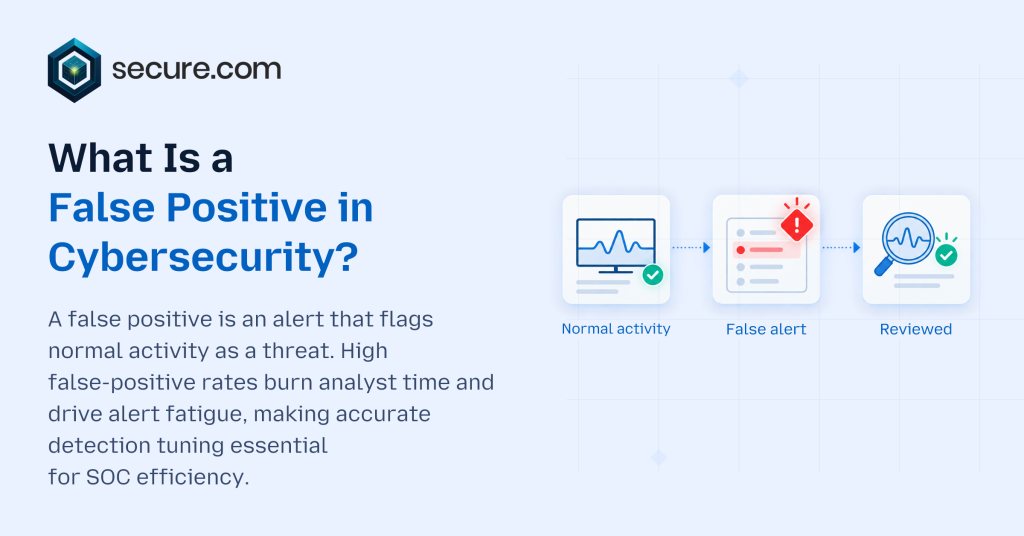
A false positive in cybersecurity occurs when a security tool or control identifies an activity, file, configuration, or event as malicious or risky when it is actually legitimate or harmless. In security alerting, false positives can create unnecessary investigations and contribute to alert fatigue.
For example, a security tool may flag a legitimate administrator action as suspicious behavior, even though no security incident has occurred.
What does a False Positive mean in security alerting?
In security alerting, a false positive is an alert that indicates a potential threat or security issue that, after investigation, turns out not to require security action.
A false positive may involve:
- Legitimate user activity flagged as suspicious
- Safe software identified as malicious
- Normal network traffic classified as an attack
- Authorized configuration changes flagged as security violations
- Benign behavior matching a detection rule
- A vulnerability finding that does not apply to the affected system
For example, an employee may access a system from an unusual location or at an unusual time. A security tool may generate an alert because the behavior differs from the user’s normal activity. After investigation, the activity may be confirmed as legitimate.
False positives are a normal challenge in security operations, but large volumes can make it harder for teams to identify genuine threats.
Why do security tools generate False Positives?
Security tools generate false positives because they often rely on rules, patterns, behavioral models, or detection thresholds to identify potentially suspicious activity. To avoid missing real threats, these systems may flag activity that resembles malicious behavior even when it is legitimate.
Common causes include:
- Overly broad detection rules: Rules may match legitimate activity as well as malicious behavior.
- Incorrect thresholds: Detection settings may be too sensitive and generate unnecessary alerts.
- Limited context: A tool may not have enough information about the user, asset, or business process to determine whether an event is legitimate.
- Changing environments: New applications, workflows, or infrastructure can trigger existing detection rules.
- Similar behavior: Legitimate administrative or automated activity can resemble attacker behavior.
- Data quality issues: Incomplete or inaccurate data can lead to incorrect detections.
- Detection model limitations: Behavioral and machine learning models may misclassify unusual but legitimate activity.
Security teams often tune detections and add contextual information to reduce false positives without creating blind spots that could allow real threats to go undetected.
Why are False Positives a problem?
False positives can consume security resources and make it more difficult to identify genuine threats.
They can lead to:
- Alert fatigue
- Wasted investigation time
- Delayed responses to genuine incidents
- Reduced trust in security tools
- Important alerts being overlooked
- Increased workload for security teams
- Higher operational costs
When analysts repeatedly investigate alerts that turn out to be harmless, they may become less responsive to future alerts, including legitimate threats.
False Positive vs. False Negative
A false positive occurs when a security system identifies a threat that does not actually exist.
A false negative occurs when a real threat or security issue is not detected.
Both can create security risks, but they have different consequences. Too many false positives can overwhelm security teams, while false negatives can allow genuine threats to remain undetected.
Security teams need to balance detection sensitivity carefully to reduce unnecessary alerts without missing important threats.
How can organizations reduce False Positives?
Organizations can reduce false positives by improving detection quality and adding more context to security alerts.
Common approaches include:
- Regularly tuning detection rules
- Adjusting alert thresholds
- Adding asset and user context
- Identifying known legitimate behavior
- Improving data quality
- Correlating related security events
- Automating repetitive alert triage
- Reviewing detection performance over time
The goal is not necessarily to eliminate every false positive, as overly restrictive detection can increase the risk of false negatives. Instead, organizations aim to improve detection accuracy while maintaining sufficient visibility into potential threats.
Challenges of Managing False Positives
Managing false positives can be difficult, particularly in large and complex environments where security tools generate high volumes of alerts.
Common challenges include:
- Alert volume: Security teams may receive more alerts than they can investigate manually.
- Limited context: Individual tools may lack the information needed to determine whether activity is truly malicious.
- Changing behavior: Normal business activity can change and trigger existing detection rules.
- Tool fragmentation: Different security tools may generate overlapping or duplicate alerts.
- Detection tradeoffs: Reducing sensitivity may lower false positives but increase the risk of missed threats.
- Manual investigations: Analysts may need to spend significant time validating alerts.
The Future of False Positive Management
Security operations are increasingly using automation and contextual analysis to reduce the time spent investigating false positives. Rather than treating each alert independently, modern approaches can correlate events with asset, identity, threat intelligence, and historical activity data.
Future approaches are likely to focus on:
- AI assisted alert triage
- Automated event correlation
- Context aware detection
- Adaptive detection thresholds
- Automated investigation and enrichment
- Improved behavioral analysis
- Continuous detection tuning
These approaches can help security teams reduce unnecessary investigations while maintaining strong threat detection capabilities.
Frequently Asked Questions
What is a false positive?
Why are false positives a problem?
What is the difference between a false positive and a false negative?
What causes false positives?
How can teams reduce false positives?
How does automation help with false positives?
Conclusion
A false positive in cybersecurity occurs when a security tool incorrectly identifies legitimate activity as malicious or risky. False positives are often caused by broad detection rules, limited context, sensitive thresholds, and changing environments. While some false positives are unavoidable, improving detection logic, adding context, and automating alert triage can help security teams reduce alert fatigue and focus more attention on genuine security threats.