Exposure Management is a cybersecurity approach that helps organizations identify, understand, prioritize, and reduce security exposures across their environment. It looks beyond individual vulnerabilities to assess the different conditions that could increase the likelihood or impact of a compromise.
An exposure may involve a vulnerability, misconfiguration, excessive permission, exposed asset, weak security control, or other condition that creates an opportunity for an attacker. Exposure management brings these risks into a broader context to help security teams focus on the issues that could create the greatest impact.
What does Exposure Management mean in security operations?
In security operations, exposure management is the continuous process of identifying and reducing conditions that could allow an attacker to gain access, move through an environment, or reach valuable assets.
It provides a broader view of risk by considering factors such as:
- Vulnerabilities
- Cloud misconfigurations
- Exposed internet facing assets
- Excessive permissions
- Weak or missing security controls
- Identity risks
- Attack paths
- Sensitive or critical assets
- Network connectivity
Rather than treating every finding as an isolated issue, exposure management helps security teams understand how different weaknesses may be connected and which combinations could create a realistic path to compromise.
How is an Exposure different from a Vulnerability?
A vulnerability is a specific weakness or flaw in software, hardware, or a system that could potentially be exploited.
An exposure is broader. It refers to any condition that increases an organization’s potential risk of compromise, whether or not it involves a known vulnerability.
For example:
- An unpatched software flaw is a vulnerability.
- A publicly accessible database is an exposure, even if the database has no known vulnerability.
- An account with excessive privileges is an exposure.
- An internet facing server with a critical vulnerability may represent both a vulnerability and an exposure.
Exposure management considers these different conditions together to provide a more complete view of the organization’s attack surface and potential risk.
What does an Exposure Management program include?
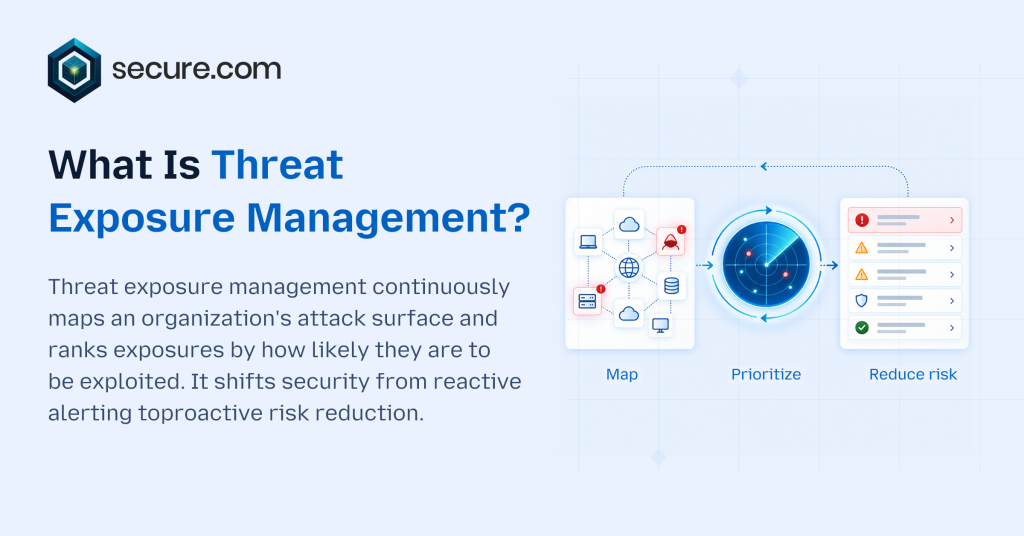
An Exposure Management program typically includes processes and capabilities for continuously identifying, assessing, prioritizing, and reducing security risks across the environment.
Key components can include:
- Asset discovery: Identifying known and unknown assets across cloud, on premises, and external environments.
- Attack surface visibility: Understanding which assets, services, and applications are exposed.
- Vulnerability management: Identifying and tracking known security vulnerabilities.
- Configuration monitoring: Detecting insecure or unintended configurations.
- Identity and access analysis: Identifying excessive permissions and risky access relationships.
- Attack path analysis: Understanding how multiple weaknesses could be chained together to reach critical assets.
- Risk prioritization: Evaluating exposures based on exploitability, accessibility, asset criticality, and potential business impact.
- Remediation management: Assigning, tracking, and verifying actions taken to reduce exposure.
- Continuous monitoring: Detecting new exposures as the environment changes.
Together, these activities help organizations move from managing individual findings to managing the conditions that create meaningful security risk.
Why is Exposure Management important?
Modern environments generate large numbers of security findings, but not every finding presents the same level of risk. Security teams often need to decide which issues require immediate action and which can be addressed later.
Exposure management helps teams:
- Gain visibility across different types of security risks
- Identify the most significant exposures
- Understand how weaknesses may be connected
- Prioritize remediation based on potential impact
- Reduce unnecessary alert and finding overload
- Focus security resources on high risk attack paths
- Continuously monitor changes across the environment
This broader approach can help organizations make more informed decisions about where to focus limited security resources.
Common Exposure Management Use Cases
Attack Surface Discovery
Exposure management can help identify internet facing, cloud, and internal assets that may create unnecessary exposure.
Vulnerability Prioritization
Instead of prioritizing vulnerabilities only by severity scores, teams can consider exploitability, asset importance, exposure, and potential attack paths.
Identity Risk Analysis
Excessive permissions and risky identity relationships can be identified as potential exposures that increase the impact of a compromised account.
Attack Path Analysis
Security teams can analyze how vulnerabilities, misconfigurations, identities, and connectivity could be chained together to reach critical systems or data.
Continuous Risk Monitoring
New assets, vulnerabilities, configuration changes, and identity changes can be monitored continuously to identify emerging exposures.
Challenges of Exposure Management
Exposure management can be challenging because organizations must combine security data from many different systems and continuously analyze changing environments.
Common challenges include:
- Fragmented visibility: Asset, vulnerability, identity, and cloud data may exist across separate systems.
- Large volumes of findings: Organizations can generate more security findings than teams can manually investigate.
- Incomplete asset inventories: Unknown or unmanaged assets can create blind spots.
- Prioritization complexity: Determining which exposures represent the greatest real world risk requires context.
- Rapid environmental changes: New assets, permissions, and configurations can create exposures continuously.
- Data quality: Incomplete or inaccurate security data can affect risk assessments.
- Remediation coordination: Addressing exposures may require collaboration between security, IT, cloud, and engineering teams.
The Future of Exposure Management
Exposure management is moving toward more continuous and contextual approaches to risk reduction. Rather than presenting long lists of disconnected vulnerabilities and findings, modern approaches increasingly focus on understanding relationships between assets, identities, vulnerabilities, misconfigurations, and attack paths.
Future exposure management capabilities are likely to focus on:
- Continuous attack surface discovery
- AI assisted risk prioritization
- Context aware vulnerability management
- Automated attack path analysis
- Stronger identity and access visibility
- Automated remediation recommendations
- Real time detection of emerging exposures
This evolution can help security teams focus less on the total number of findings and more on reducing the exposures that could create the greatest impact.
Frequently Asked Questions
What is threat exposure management?
How is it different from vulnerability management?
Why do teams adopt threat exposure management?
What does an exposure include?
How does threat exposure management set priorities?
How does continuous testing support this program?
Conclusion
Exposure Management is the continuous process of identifying, understanding, prioritizing, and reducing conditions that could increase an organization’s risk of compromise. By looking beyond individual vulnerabilities and considering misconfigurations, exposed assets, excessive permissions, attack paths, and other security weaknesses together, organizations can gain a more complete view of their risk and focus remediation efforts on the exposures that matter most.