Kubernetes has become the de facto standard for container orchestration, with over 90% of organizations now using or evaluating containers in production according to the Cloud Native Computing Foundation. However, the complexity and dynamic nature of Kubernetes environments introduce significant security challenges. Misconfigurations remain the leading cause of security incidents in containerized environments, with Gartner estimating that through 2025, more than 99% of cloud security failures will be the customer’s fault, largely driven by misconfigured resources.
Traditional security tools were not designed for the ephemeral, declarative, and highly distributed nature of Kubernetes. Clusters spin up and scale dynamically, workloads are deployed through CI/CD pipelines at speed, and configurations are defined in YAML manifests that can introduce vulnerabilities before a single container runs.
Kubernetes Security Posture Management (KSPM) addresses this gap by providing continuous, automated assessment of security risks across Kubernetes environments ensuring that clusters, workloads, network policies, and access controls align with security best practices and compliance requirements.
What Is Kubernetes Security Posture Management (KSPM)?
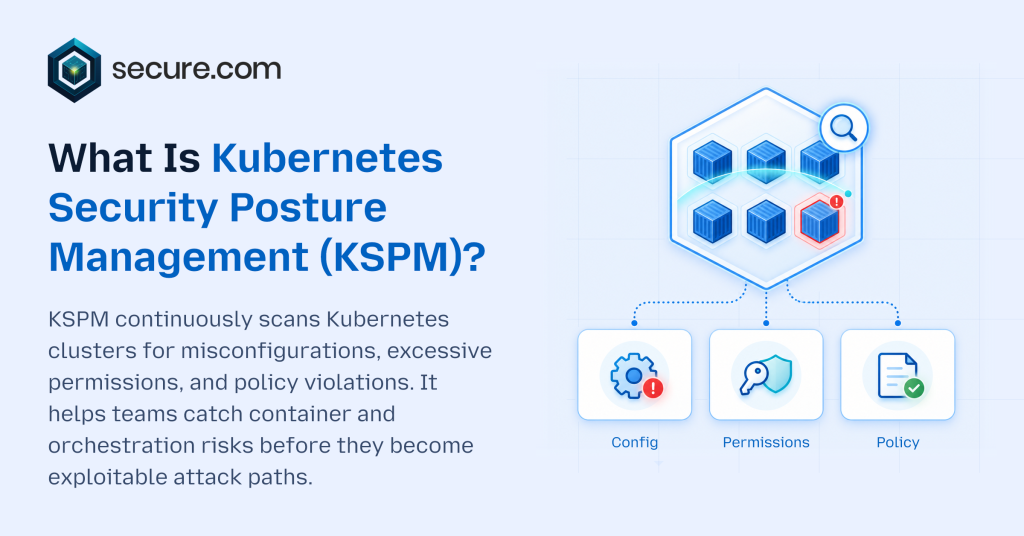
Kubernetes Security Posture Management (KSPM) is a security discipline and category of tooling focused on continuously evaluating the security posture of Kubernetes environments. KSPM identifies misconfigurations, policy violations, excessive permissions, and compliance gaps across every layer of the Kubernetes stack including cluster configuration, workload deployment, network policies, role-based access control (RBAC), secrets management, and admission controls.
Unlike runtime security tools that focus on detecting active threats, KSPM operates proactively by assessing the desired and actual state of Kubernetes configurations against established security benchmarks such as CIS Kubernetes Benchmarks, NSA/CISA Kubernetes Hardening Guidance, and organizational security policies.
KSPM provides security teams with centralized visibility into risks across multiple clusters and namespaces, enabling them to prioritize remediation based on severity and business impact rather than reacting to incidents after exploitation occurs.
How Kubernetes Security Posture Management Works
KSPM follows a continuous lifecycle of discovery, assessment, enforcement, and remediation across Kubernetes environments.
Discovery and Inventory
KSPM begins by discovering and cataloging all Kubernetes resources across clusters. This includes nodes, pods, containers, services, namespaces, RBAC roles and bindings, network policies, secrets, ConfigMaps, and admission controllers. Continuous discovery ensures that newly deployed workloads and configuration changes are immediately assessed.
Configuration Assessment
KSPM evaluates Kubernetes configurations against security benchmarks and custom policies. Assessments cover areas such as:
- Containers running as root or with privileged access
- Pods with excessive capabilities or missing security contexts
- Overly permissive RBAC roles granting cluster-wide administrative access
- Missing or misconfigured network policies allowing unrestricted pod-to-pod communication
- Secrets stored in plaintext rather than encrypted or externalized
- Lack of resource limits enabling denial-of-service conditions
- Missing pod security standards or admission control policies
Policy Enforcement and Guardrails
KSPM integrates with admission controllers and policy engines such as Open Policy Agent (OPA), Kyverno, or native Kubernetes Pod Security Standards to enforce security policies at deployment time. This prevents misconfigured workloads from entering the cluster, shifting security enforcement left into the deployment pipeline.
Continuous Monitoring and Drift Detection
Kubernetes environments change constantly. KSPM continuously monitors for configuration drift where the running state of a cluster diverges from its intended secure baseline. Drift detection identifies unauthorized changes, policy regressions, and newly introduced risks in real time.
Reporting and Remediation
KSPM generates prioritized findings with contextual remediation guidance. Reports map findings to compliance frameworks and security benchmarks, enabling security teams to address the highest-risk issues first. Many KSPM solutions provide automated remediation or integration with ticketing and CI/CD systems to streamline the fix process.
Key Characteristics of KSPM
- Kubernetes-native visibility: KSPM understands Kubernetes primitives, relationships, and configurations at a depth that general-purpose security tools cannot achieve, covering clusters, namespaces, workloads, RBAC, and network policies.
- Proactive risk reduction: By identifying misconfigurations before they are exploited, KSPM shifts security posture from reactive incident response to proactive risk prevention.
- Continuous compliance: KSPM maps Kubernetes configurations to regulatory and industry benchmarks including CIS Benchmarks, SOC 2, ISO 27001, HIPAA, PCI DSS, and NIST frameworks providing continuous compliance evidence rather than point-in-time assessments.
- Shift-left integration: KSPM integrates into CI/CD pipelines and infrastructure-as-code workflows to catch misconfigurations during development and deployment rather than in production.
- Multi-cluster scalability: Modern KSPM solutions support centralized posture management across multiple clusters, cloud providers, and hybrid environments from a single control plane.
Technologies and Techniques Used in KSPM
- CIS Kubernetes Benchmark scanning: Automated checks against industry-standard hardening guidelines for Kubernetes clusters.
- RBAC analysis: Deep inspection of roles, role bindings, cluster roles, and service accounts to identify excessive or unused permissions.
- Network policy validation: Assessment of pod-to-pod communication rules to detect unrestricted lateral movement paths.
- Admission control integration: Policy enforcement at the API server level using OPA/Gatekeeper, Kyverno, or Pod Security Standards.
- Infrastructure-as-code scanning: Pre-deployment analysis of Helm charts, Kubernetes manifests, and Terraform configurations for security issues.
Applications and Business Impact of KSPM
- Reducing misconfiguration risk: KSPM addresses the most common cause of Kubernetes security incidents by identifying and remediating configuration errors across clusters.
- Meeting regulatory requirements: Continuous compliance mapping and audit-ready reporting support frameworks such as PCI DSS, HIPAA, SOC 2, and GDPR.
- Securing multi-tenant environments: KSPM enforces namespace isolation, RBAC boundaries, and network segmentation policies critical for shared cluster environments.
- Accelerating secure DevOps: By integrating into CI/CD pipelines, KSPM enables development teams to deploy securely without slowing release velocity.
- Improving security team efficiency: Centralized visibility and prioritized findings reduce alert fatigue and enable focused remediation.
Challenges and Limitations of KSPM
- Kubernetes complexity: The breadth and depth of Kubernetes configurations require specialized expertise to interpret findings and implement remediation effectively.
- Dynamic environments: The ephemeral nature of pods and frequent deployments demand truly continuous monitoring rather than periodic scanning.
- Policy governance overhead: Defining, maintaining, and tuning security policies across multiple clusters and teams requires ongoing governance effort.
- Coverage gaps: KSPM focuses on configuration and posture. It must be complemented with runtime security, container image scanning, and network detection for comprehensive Kubernetes protection.
- Multi-cloud consistency: Enforcing uniform security posture across different managed Kubernetes services such as EKS, AKS, and GKE introduces platform-specific configuration variations.
The Future of KSPM
As Kubernetes adoption continues to accelerate across enterprises, KSPM is evolving from standalone tooling into an integrated component of broader cloud-native application protection platforms (CNAPPs). Convergence with cloud security posture management (CSPM), runtime protection, and software supply chain security will provide unified visibility from code to cloud.
AI and machine learning will enhance KSPM by enabling intelligent policy recommendations, automated risk prioritization based on exploitability context, and predictive drift detection. Integration with software bill of materials (SBOM) and vulnerability intelligence will connect posture findings with known threats for risk-based prioritization.
As organizations adopt GitOps and infrastructure-as-code at scale, KSPM will increasingly shift left embedding security validation directly into development workflows and making secure-by-default Kubernetes deployment the standard rather than the exception.
Conclusion
Kubernetes Security Posture Management is an essential capability for any organization running containerized workloads at scale. By continuously assessing configurations, enforcing security policies, and providing actionable remediation guidance, KSPM addresses the most prevalent source of Kubernetes security incidents—misconfigurations and policy violations.
Effective KSPM requires Kubernetes-native understanding, continuous monitoring, and integration with both development pipelines and security operations.
Secure.com delivers these capabilities through AI-powered Digital Security Teammates that continuously assess Kubernetes configurations against CIS Benchmarks, enforce policies at deployment time, and provide actionable remediation guidance—reducing misconfiguration risk by up to 40% while saving security teams 15+ hours per week on manual posture assessments. As Kubernetes environments grow in complexity and business criticality, proactive posture management is no longer optional—it is foundational to securing modern cloud-native infrastructure.