
Key Takeaways
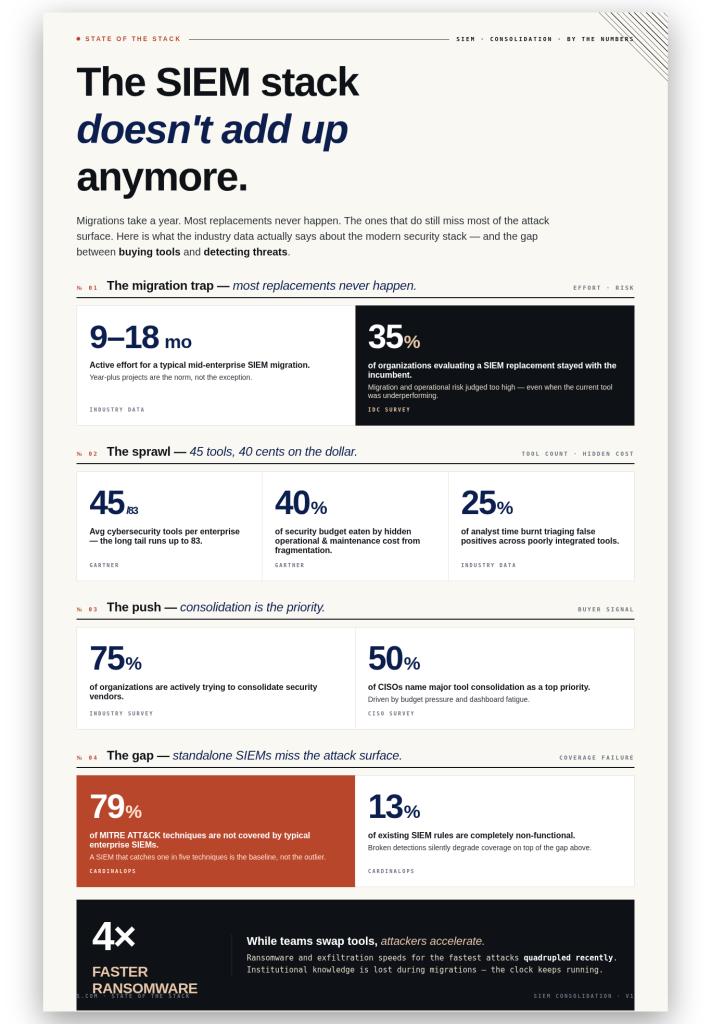
- Rip and replace projects often fail because security stacks carry years of policies, integrations, and team knowledge that can’t be swapped overnight.
- The real gap in most security operations is the decision layer that connects signals from existing tools, not the tools themselves.
- A good orchestration platform should normalize data, add context, and trigger action without forcing teams to abandon trusted systems.
- Secure.com sits between your existing stack and your outcomes, so you keep your tools and still get unified triage, prioritization, and response.
Why Tool Replacement Fails Security Teams (And What Works Instead)
A SANS report found that 73% of daily security alerts go uninvestigated. That stat alone tells you the problem isn’t a shortage of tools. Most teams already own a SIEM, an EDR, an IAM platform, and a handful of scanners. The work falling through the cracks is the work between them. Yet every vendor pitch still ends the same way: throw out what you have and start fresh.
Why Rip and Replace Keeps Letting Security Teams Down
Tearing out a SIEM or EDR sounds clean on a slide. In practice, it’s months of migrations, broken playbooks, and analysts learning a new interface during live incidents. Teams lose institutional knowledge they spent years building.
There’s also the budget side. Hidden professional services, custom connector work, and engineering hours can quietly push tool costs well past the original quote. The new platform promises consolidation, but the bill keeps growing.
And the timing is brutal. While the swap is in motion, detection coverage thins out. The very risks the new tool was meant to fix stay open for a quarter or longer.
The Real Problem Is Not Tools, It’s the Missing Layer Between Them
Look at most security operations and the same pattern shows up. SIEM fires alerts. EDR sends endpoint signals. IAM tracks identity events. Scanners flag CVEs. Each one is doing its job. None of them are talking to each other in a way that produces a decision.
That gap has a name. Fragmentation. Signals arrive, but nothing correlates them, ranks them by business impact, or assigns the next action. Analysts become the manual glue, copying data between consoles and stitching context by hand.
This is why teams feel busy but unproductive. The volume goes up. The resolution stays flat. Buying another tool only adds another window to alt-tab through.
What an Orchestration Platform Should Actually Do
A real orchestration platform doesn’t compete with your existing stack. It sits on top of it. Here’s what that looks like in practice:
- Connects to what you already run, including SIEM, EDR, IAM, cloud platforms, scanners, and ticketing tools, without asking you to migrate data
- Normalizes signals into a shared schema so an alert from your EDR and a finding from your scanner can be reasoned about together
- Adds context like asset criticality, identity ownership, and blast radius so analysts know what matters before they touch a ticket
- Runs governed playbooks with approvals and rollback paths, so automation doesn’t go rogue inside production systems
- Keeps an audit trail of every action, decision, and approver for compliance reviews
The point is leverage, not replacement. The stack stays. The work between the tools gets handled.
How Secure.com Sits On Top of the Stack You Already Trust
Secure.com is built for teams that already own most of their security tooling and need a smarter way to connect it. The platform normalizes events into a knowledge graph, links assets and identities, and lets Digital Security Teammates reason across the whole picture before suggesting or executing action.
Here’s how that plays out:
- Connects to 200+ pre-built integrations across SIEM, EDR, IAM, cloud, ticketing, and collaboration tools
- Preserves your existing SIEM, EDR, IAM, scanners, and ticketing systems with no rip and replace required
- Correlates signals through a unified knowledge graph, so context follows every alert from ingest to resolution
- Drives prioritization based on business impact, asset criticality, and exploitability instead of raw CVSS
- Logs every action with a named authorizer, rationale, and reversal path for audit-ready governance