Key Takeaways
- SIEM platforms are built to collect and correlate logs, not to make judgment calls or take action on their own.
- Alert backlogs, tool sprawl, and constant tuning are structural problems, not signs that your team is doing something wrong.
- SIEM struggles most with regulated industries, autonomous investigation, and proving hard ROI.
- Pairing a SIEM with an AI operations layer closes the gap between “we logged it” and “we understood it.”
- Secure.com’s Digital Security Teammate for SOC operations sits on top of your existing SIEM to investigate, enrich, and triage alerts around the clock.
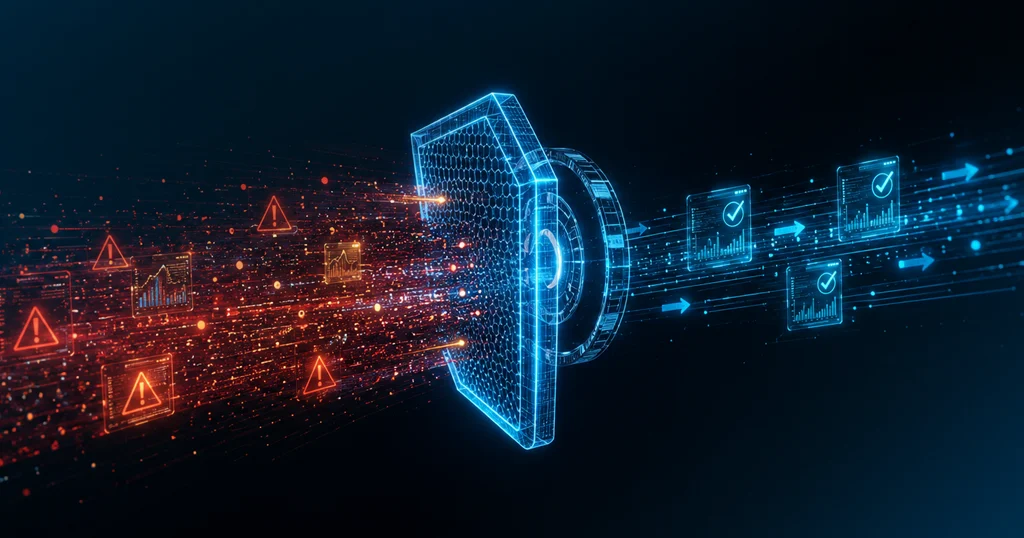
Last year, security teams handled an average of 2,992 alerts a day, and nearly half turned out to be false positives. If your SIEM feels like it’s talking constantly but saying very little, that’s not a tuning problem you can fix with one more dashboard. It’s baked into what a SIEM was designed to do in the first place.
Your SIEM is talking constantly.
It’s just not saying much.
Security teams handle thousands of alerts a day — and nearly half of them go nowhere. That’s not a tuning failure. It’s the job a SIEM was built to do.
Why SIEM Alone Can’t Keep Up Anymore
So why is SIEM hard to operate in the first place? A SIEM was built in an era when the job was simple: collect logs, apply rules, raise a flag. It was never asked to understand intent, weigh risk, or decide what happens next. That gap is exactly why SIEM is hard to operate for so many teams today, even ones with strong engineers running it.
The Staffing Math Doesn’t Work
Here’s the part nobody puts in the sales deck. Why does SIEM require constant human attention? Because every rule, every correlation, and every new log source needs someone to write it, test it, and watch it for drift. That’s also why SIEM requires so many analysts to operate in most mid-size and enterprise environments. Tuning is not a one-time project. It’s a permanent job.
- Why does SIEM require expensive skilled administrators to keep queries and parsers from breaking every time a vendor changes a log format.
- Why does SIEM require expensive skilled staff to operate detections that actually catch something instead of just filling a dashboard.
- New data sources mean new mapping work, and that work rarely gets smaller as the company grows.
Everything Gets Escalated
Ask any Tier 1 analyst why does SIEM escalate everything to tier 2, and you’ll hear the same answer: the SIEM surfaces an event, but it can’t tell anyone if that event is actually dangerous. Without context, the safest move is always to pass it up the chain. That’s how does SIEM become a bottleneck for SOC operations. Senior analysts spend their day re-triaging alerts a machine already saw, instead of hunting the threats a machine would miss.
The SIEM can see the event. It can’t tell anyone if it’s dangerous.
Without context, the safest move for Tier 1 is always to pass it up. Multiply that by thousands of alerts a day, and escalation becomes the default — not the exception.
The pattern repeats at every layer. Add cloud, SaaS, and remote work, and each new environment adds another log source and another blind spot — while headcount at the console stays flat.
Add in cloud, SaaS, and remote work, and you get a second problem. Why does SIEM not scale with growing attack surfaces? Because every new environment adds another log source, another format, and another blind spot, while the number of people watching the console stays flat.
How the Noise Piles Up
Understanding how does SIEM alert backlog grow out of control starts with one fact: alerts arrive faster than any team can review them by hand. A single suspicious login can trigger separate alerts across the SIEM, the identity platform, and the endpoint tool, and none of those systems know the other two fired too.
Alerts Without Context
This is the real root of the problem. How does SIEM data become noise without analyst context? A raw event, on its own, tells you almost nothing. Was that login from a real employee working late, or an attacker using stolen credentials? The SIEM doesn’t know, so it flags both the same way. And why does SIEM not automatically enrich alerts with the details an analyst actually needs, like user history, asset value, or threat intel? Because enrichment requires connecting to other systems and reasoning across them, and that’s outside what rule-based correlation was built to do.
Tuning Never Ends
How does poor SIEM tuning affect SOC performance? Badly tuned rules cut both ways. Too loose, and you drown in false positives. Too strict, and real threats slip through silently. Most teams end up tuning defensively, which means suppressing anything noisy rather than actually solving why it’s noisy.
The result shows up in two ways:
- How does SIEM create more work than it removes? Every alert that gets closed as “not a threat” still cost someone ten or fifteen minutes to check.
- How does SIEM fail when analyst capacity is limited? The backlog doesn’t shrink. It waits. And waiting alerts are exactly where real incidents hide.
What a SIEM Was Never Built to Do
It helps to be blunt here. What are the limitations of SIEM, really? At its core, a SIEM collects, stores, and correlates events against rules someone wrote in advance. That’s it. So what can a SIEM not do? It can’t investigate on its own, it can’t judge intent, and it can’t take action without a human or a separate automation tool telling it what to do next.
A SIEM collects, stores, and correlates. That’s the whole job.
It can’t investigate on its own, judge intent, or take action — that always requires a human, or a layer built for that work.
The gap isn’t a tuning problem. Detection and investigation are two different jobs — a SIEM handles the first well.
This shows up hardest in three places:
- ROI. Why does SIEM not deliver expected ROI? Licensing is usually priced by data volume, so costs climb every time you add a log source, even if that source rarely produces a real finding.
- Regulated industries. How does SIEM fail regulated industries? Auditors want proof of investigation, not just proof of logging. A SIEM can show that an alert fired. It can’t show why an analyst decided it was safe to close.
- Autonomous work. Why is SIEM not designed for autonomous investigation? Because investigation means pulling context from multiple systems, forming a hypothesis, and testing it, and a correlation engine has no way to do that on its own.
Put together, this is why is SIEM only part of the solution for most security teams, not the whole one. If you want proof, look at your own numbers. How to demonstrate that SIEM alone is not sufficient is usually as simple as tracking how many alerts get a full investigation versus how many get a rushed glance and a shrug.
Closing the Gap With AI, and Where Secure.com’s SOC Teammate Fits In
Once you know what a SIEM can’t do, the next question is practical. What AI capabilities should complement a SIEM? Three things matter most: automatic enrichment, alert correlation across tools, and investigation that writes up its own reasoning so a human can check it fast.
How to extend SIEM with AI capabilities usually starts smaller than people expect.
Start With Deduplication and Enrichment
How to implement SIEM alert deduplication across sources is often the first fix, since a single incident can otherwise show up as five separate tickets. Once duplicates are gone, the next step is context: pulling in identity data, asset criticality, and threat intel automatically instead of asking an analyst to open four tabs.
Then Extract More Value From What You Already Collect
How to extract more security value from SIEM data isn’t about buying a bigger SIEM. It’s about adding a layer that reads what’s already there, connects the dots, and hands analysts a finished investigation instead of a raw log line.
This is exactly the gap Secure.com’s Digital Security Teammate for SOC operations is built to close. It integrates with your existing SIEM, so you keep the log storage and detection rules you’ve already invested in, while the Digital Teammate handles enrichment, correlation, and first-pass investigation continuously in the background. Instead of a Tier 1 analyst spending twenty minutes chasing down context on one alert, the Digital Security Teammate pulls that context automatically and hands over a finding with the reasoning attached—fully explainable and auditable. You can read more about how an AI SOC actually works and see how it’s meant to sit alongside, not replace, SIEM, XDR, and SOAR in a modern stack.
The goal isn’t to replace your SIEM. It’s to stop asking it to do a job it was never built for.
Give your SIEM a partner that finishes the job
Secure.com’s Digital Security Teammate for SOC operations sits on top of your existing SIEM — you keep the log storage and detection rules you’ve already invested in, while it handles enrichment, correlation, and first-pass investigation around the clock.
- Investigates and enriches alerts continuously, no manual chasing
- Correlates across tools instead of triaging one alert at a time
- Hands analysts a finished finding, with reasoning attached
- Fully explainable and auditable — built for regulated teams
FAQs
What can a SIEM not do on its own?
Why does SIEM not deliver the ROI teams expect?
What AI capabilities should complement a SIEM?
Why is SIEM only part of the solution for most SOCs?
The Bottom Line
A SIEM is good at one thing: telling you something happened. It was never built to tell you if that something matters, why it matters, or what to do about it. That gap is where alert fatigue, analyst burnout, and missed threats all start. Closing it doesn’t mean replacing your SIEM. It means giving it a partner that can actually finish the job.