
Dateline: June 9, 2026
Introduction
Attackers are actively exploiting a critical security flaw in LiteLLM, the popular open-source AI gateway proxy used by thousands of organizations. The vulnerability allows unauthenticated remote code execution, giving hackers complete control over vulnerable systems.
What Happened?
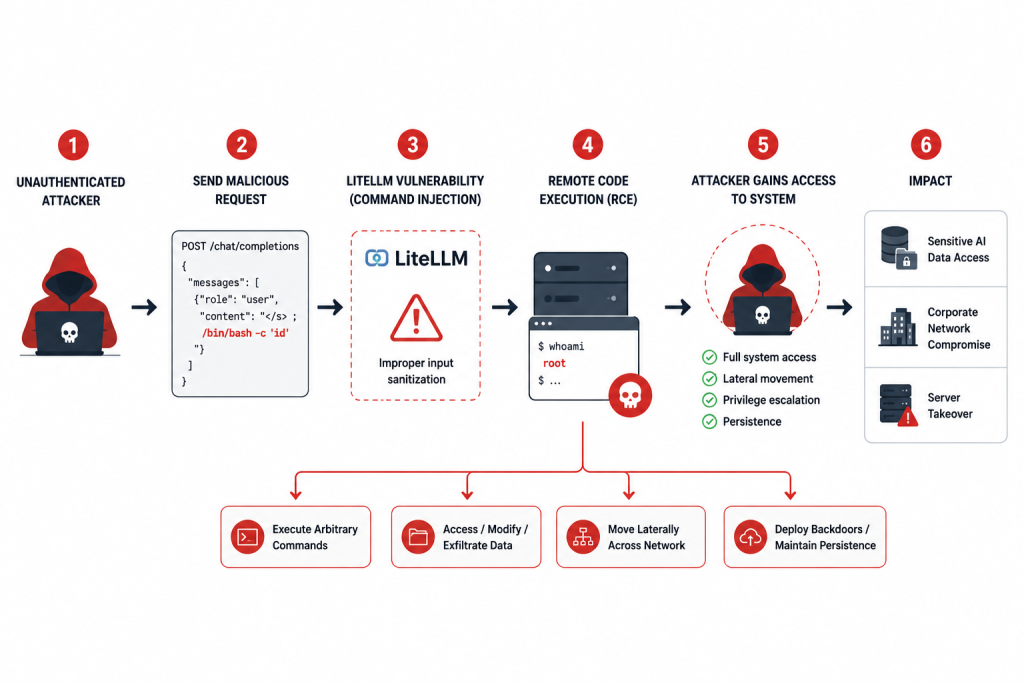
Security researchers discovered threat actors chaining multiple vulnerabilities in LiteLLM to achieve remote code execution without any authentication requirements. The attack exploits weaknesses in how LiteLLM processes certain API requests, allowing attackers to inject and execute arbitrary commands on the target server.
LiteLLM serves as a proxy layer for AI language models, handling requests between applications and various AI services like OpenAI, Anthropic, and others. Organizations use it to manage API costs, implement rate limiting, and provide unified access to multiple AI providers. The software has gained significant adoption among enterprises building AI-powered applications.
The vulnerability affects LiteLLM deployments that haven’t applied recent security patches. Attackers can exploit the flaw remotely without needing valid credentials or prior access to the target system. Once successful, they gain the ability to execute system commands with the same privileges as the LiteLLM process.
Cybersecurity firms report seeing active exploitation attempts targeting internet-facing LiteLLM instances. The attacks appear coordinated, with multiple threat groups scanning for vulnerable installations and attempting to establish persistent access to compromised systems.
The Impact
The vulnerability poses serious risks for organizations running AI infrastructure. Successful exploitation could lead to data theft, service disruption, or lateral movement within corporate networks. Companies using LiteLLM to proxy sensitive AI workloads face particular exposure.
The timing proves especially concerning as AI adoption accelerates across industries. Many organizations deploy AI gateways like LiteLLM without fully understanding the security implications. This vulnerability highlights how AI infrastructure can become an attack vector that traditional security teams might overlook.
Experts warn that AI gateway compromises could expose proprietary data, training datasets, or customer information processed through language models. The centralized nature of these proxies means a single breach could affect multiple AI services and applications within an organization.
How to Avoid This
Organizations running LiteLLM should immediately update to the latest version containing security patches. System administrators need to review their deployment configurations and restrict network access to only trusted sources.
Companies should audit their AI infrastructure for similar vulnerabilities. Many AI tools and proxies receive less security scrutiny than traditional enterprise software, creating blind spots in organizational security postures.
Security teams should implement network segmentation around AI services and monitor for unusual activity patterns. Regular vulnerability scanning of AI infrastructure components should become standard practice as these tools become more critical to business operations.