Modern applications rarely run on a single server anymore. They operate across distributed environments made up of virtual machines, containers, microservices, and serverless functions. These components—collectively known as workloads—process data, run applications, and support critical business operations.
As organizations move more infrastructure to the cloud and hybrid environments, workloads become highly dynamic. They scale automatically, appear and disappear quickly, and communicate with numerous services across networks and cloud platforms. This flexibility accelerates development and deployment, but it also introduces new security risks.
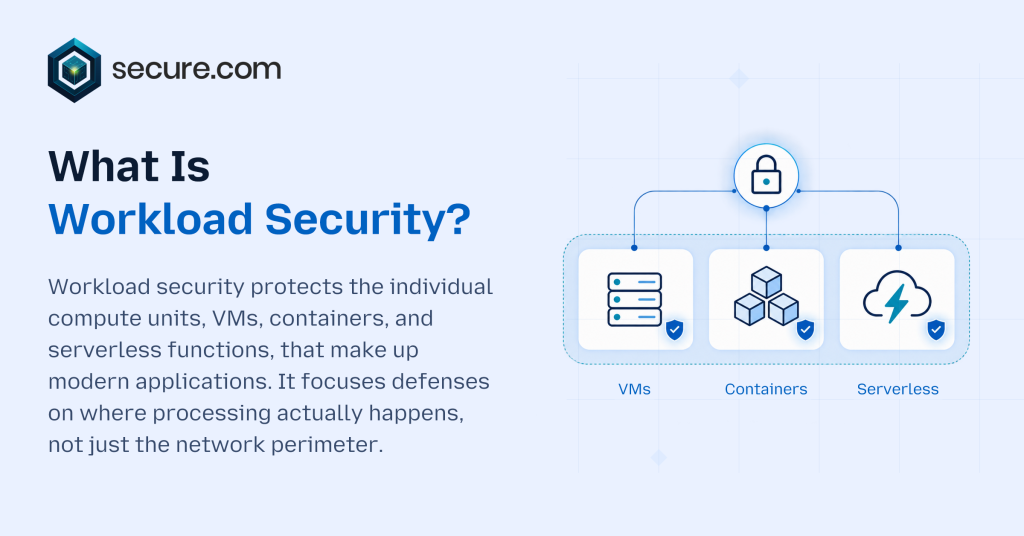
Workload security addresses these risks by focusing protection directly on the computing units that run applications and process data. Instead of relying only on network perimeters, workload security monitors and protects workloads themselves wherever they run—across public clouds, private clouds, and on-premises environments.
What is Workload Security?
Workload security refers to the set of technologies, policies, and practices used to protect computing workloads—including applications, virtual machines, containers, and serverless services—from cyber threats, unauthorized access, and operational risks.
A workload consists of the processes and resources that support an application and its interactions with users or other services. In cloud environments, this includes the application itself, the data it processes, and the underlying infrastructure used to run it.
Workload security focuses on protecting these operational components throughout their lifecycle. This includes preventing vulnerabilities, monitoring behavior at runtime, detecting malicious activity, and ensuring that workloads operate according to defined security policies.
The goal is to maintain the confidentiality, integrity, and availability of applications and data, regardless of where the workload is deployed or how frequently it changes.
How Workload Security Works?
Workload security operates across multiple stages of the application and infrastructure lifecycle.
Visibility and asset discovery
The first step is identifying all active workloads within an environment. Because workloads can scale dynamically or run for short periods of time, organizations must maintain continuous visibility into virtual machines, containers, and other compute resources.
Vulnerability and configuration management
Workloads are regularly scanned for vulnerabilities, outdated software packages, and insecure configurations. Misconfigurations—such as open ports or excessive permissions—are one of the most common causes of cloud security incidents.
Identity and access controls
Access to workloads is tightly controlled through identity and access management policies. These controls ensure that users, services, and applications only receive the minimum permissions required to perform their tasks.
Runtime monitoring
Once workloads are running, security tools monitor behavior to detect suspicious activity such as unauthorized processes, abnormal network communication, or attempts to escalate privileges.
Threat detection and response
If suspicious behavior or malware activity is detected, workload security systems trigger alerts, isolate affected workloads, or block malicious actions to prevent further compromise.
Key Characteristics of Workload Security
Workload-centric protection
Traditional security models focus on network boundaries. Workload security instead protects the application components themselves, regardless of where they are deployed.
Continuous monitoring
Because workloads frequently change and scale automatically, security monitoring must operate continuously rather than relying on periodic scans.
Environment-agnostic protection
Workload security applies across multiple environments, including public cloud platforms, private data centers, and hybrid infrastructures.
Runtime visibility
Effective workload security monitors the behavior of applications while they are running, allowing organizations to detect threats that static scans might miss.
Technologies and Controls Used in Workload Security
Vulnerability scanning
Automated scans identify outdated libraries, insecure packages, and known software vulnerabilities that could be exploited by attackers.
Configuration management
Security policies enforce safe configurations across workloads, reducing exposure from misconfigured systems or excessive permissions.
Runtime threat detection
Monitoring tools analyze workload behavior to identify malware, unauthorized commands, or suspicious communication patterns.
Network segmentation
Workloads are restricted to communicate only with approved services or systems, reducing the risk of lateral movement during an attack.
Integrity monitoring
Changes to critical files, system configurations, or application components are tracked to detect unauthorized modifications.
Applications and Importance of Workload Security
Protecting cloud-native applications
Modern applications built with microservices and containers rely on many interconnected workloads. Securing these components helps prevent attackers from exploiting weak links.
Securing hybrid and multi-cloud environments
Organizations often run workloads across multiple cloud providers and on-premises systems. Workload security provides consistent protection across these environments.
Preventing lateral movement
If attackers gain access to one system, they often attempt to move across workloads to reach more valuable assets. Workload security helps limit this spread.
Supporting regulatory compliance
Monitoring and protecting workloads helps organizations meet regulatory requirements related to data protection, system integrity, and security controls.
Challenges and Risks in Workload Security
Limited visibility across environments
Distributed cloud environments can make it difficult to track every workload, especially when new instances are created automatically.
Misconfigurations
Incorrect access controls, exposed services, or insecure APIs can create entry points for attackers.
Rapid infrastructure changes
Frequent deployments and scaling events can introduce new vulnerabilities faster than traditional security processes can detect them.
Fragmented security tools
Using multiple disconnected security products can create blind spots and overwhelm security teams with alerts.
The Future of Workload Security
As organizations continue to adopt cloud-native architectures, workloads will become even more distributed and short-lived. Security strategies are evolving to provide deeper visibility into runtime behavior and tighter integration with development pipelines.
Future approaches will emphasize continuous monitoring, automated risk detection, and integrated security platforms that unify visibility across applications, infrastructure, and identities. These capabilities will help organizations detect threats earlier and maintain stronger control over rapidly changing environments.
Frequently Asked Questions
What is workload security?
What counts as a workload?
Why is workload security important in the cloud?
What threats target workloads?
How is workload security different from network security?
How can teams secure their workloads?
Conclusion
Workload security plays a critical role in protecting modern digital infrastructure. By focusing security controls directly on the applications and computing resources that power business operations, organizations can detect vulnerabilities earlier, monitor behavior in real time, and respond quickly to emerging threats.
As cloud adoption accelerates and environments become more complex, protecting workloads themselves—rather than relying solely on traditional network boundaries—has become an essential part of modern cybersecurity strategy.