Organizations increasingly rely on a mix of on-premises infrastructure, private clouds, and public cloud services to run applications and store data. While hybrid cloud environments provide flexibility, scalability, and cost efficiency, they also introduce unique security challenges. Hybrid Cloud Security focuses on protecting data, applications, and workloads across these interconnected environments while maintaining compliance, visibility, and control.
A hybrid cloud security strategy is characterized by:
- Unified visibility: Centralized monitoring across on-premises and cloud resources to detect threats and misconfigurations.
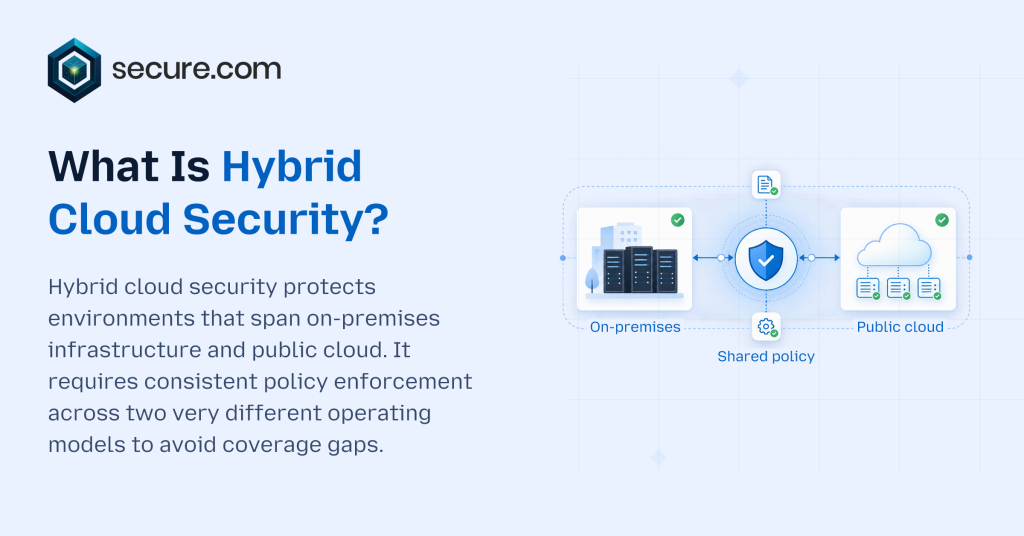
- Consistent policy enforcement: Ensuring security policies apply uniformly across different environments.
- Adaptive protection: Leveraging tools and automation to respond to evolving threats in a dynamic, distributed architecture.
Unlike traditional security, which focuses on a single perimeter, hybrid cloud security addresses a distributed and fluid landscape, balancing accessibility, performance, and risk management.
What is Hybrid Cloud Security?
Hybrid Cloud Security safeguards data, applications, and workloads across private and public cloud environments. It aims at maintaining similar levels of security, identifying potential hazards, and ensuring compliance in different kinds of environments or infrastructures.
Key objectives of hybrid cloud security include:
- Preventing unauthorized access to cloud and on-premises resources.
- Protecting sensitive data during storage, transit, and processing.
- Ensuring regulatory compliance across multiple environments.
- Mitigating risks introduced by misconfigurations, identity misuse, and third-party services.
Hybrid cloud security is essential for enterprises adopting a cloud-first or cloud-augmented strategy, enabling them to scale efficiently without compromising security posture.
How Hybrid Cloud Security Works
Hybrid cloud security typically follows a multilayered approach:
1. Identity and Access Management (IAM)
- Centralized control of user access across on-premises and cloud systems.
- Enforces principles like least privilege, multi-factor authentication (MFA), and Role-Based Access Control (RBAC).
2. Data protection
- Encryption of data at rest and in transit across clouds.
- Data loss prevention (DLP) to monitor and block unauthorized transfers.
3. Network security
- Segmentation of workloads across environments to limit lateral movement.
- Secure VPNs, firewalls, and cloud-native network policies to protect traffic.
4. Threat detection and response
- Continuous monitoring using SIEM (Security Information and Event Management) or cloud-native security tools.
- Automated detection of anomalous behavior, misconfigurations, or suspicious activity.
5. Compliance and governance
- Continuous assessment against standards like ISO 27001, SOC2, GDPR, or HIPAA.
- Unified reporting and audit trails across multiple environments.
Key Characteristics of Hybrid Cloud Security
Unified control plane Both cloud and on-premises platforms are covered by security policies as well as monitoring instruments, ensuring uniform supervision.
Scalability and flexibility The security measures can change dynamically when workloads migrate across environments or increase/decrease to cater to business demands.
Automation-driven protection Automated workflows handle patching, configuration compliance, threat detection, and response at scale.
Shared responsibility Security is a joint responsibility between the cloud service provider (CSP) and the organization, requiring clear delineation of duties.
Technologies and Techniques Used in Hybrid Cloud Security
- Cloud Access Security Brokers (CASBs): Monitor and enforce security policies on cloud usage.
- Microsegmentation and zero-trust networking: Limit lateral movement and secure communications between workloads.
- Unified SIEM/SOAR platforms: Correlate events across hybrid environments for faster incident response.
- Encryption and key management: Protect sensitive data and maintain control of cryptographic keys.
- Automation and policy-as-code: Ensure security configurations are consistent and reproducible.
Applications and Impact of Hybrid Cloud Security
Data protection and privacy The privacy of sensitive client and business information is not compromised whether the data is moved within clouds or from cloud to local data centers.
Regulatory compliance Supports adherence to frameworks like HIPAA, SOC2, PCI DSS, and GDPR, reducing the risk of fines and reputational damage.
Business continuity and resilience Hybrid cloud security ensures that both on-premises and cloud workloads are safeguarded against attacks, misconfigurations, or operational failures.
Operational efficiency Automated controls and unified visibility reduce manual monitoring, incident response time, and human error.
Detecting and Defending Against Hybrid Cloud Threats
Continuous monitoring and logging Implement centralized dashboards that aggregate logs from on-premises servers, cloud workloads, and network devices.
Anomaly and behavior-based detection Identify deviations from normal activity, such as unusual user logins, data transfers, or privileged operations.
Threat intelligence integration Correlate hybrid activity with known threats, malware indicators, or advanced persistent threats (APTs) targeting cloud workloads.
Incident response orchestration Automate containment, isolation, and remediation steps to minimize exposure and downtime.
Challenges and Risks of Hybrid Cloud Security
- Complexity of multiple environments: Maintaining consistent controls across heterogeneous systems is difficult.
- Visibility gaps: Shadow IT, unmanaged cloud services, or misconfigured APIs can go undetected.
- Shared responsibility confusion: Misalignment between CSP and organization can lead to security lapses.
- Rapidly evolving threats: Attackers increasingly target cloud misconfigurations, identity flaws, and supply chains.
The Future of Hybrid Cloud Security
Hybrid cloud adoption continues to grow as organizations embrace multi-cloud strategies and containerized workloads. Security strategies are evolving toward:
- AI-driven detection and response across hybrid environments.
- Zero-trust frameworks as the standard model for access control.
- Policy-as-code and automation for continuous compliance.
- Integration with DevSecOps pipelines to secure cloud-native applications from development to deployment.
Organizations that embrace these approaches will be better positioned to protect data, maintain compliance, and respond to threats in increasingly complex hybrid infrastructures.
Frequently Asked Questions
What is hybrid cloud security?
Why is hybrid cloud harder to secure?
What are the main risks in a hybrid cloud?
How can teams secure a hybrid cloud?
Why is visibility important in hybrid cloud?
How does governance help hybrid cloud security?
Conclusion
Modern enterprises that use multiple-environment infrastructures must have hybrid cloud security today or they will risk everything. The combination of unified visibility, adaptive protection, automation, and compliance monitoring helps organizations mitigate risk while taking advantage of the flexibility and scalability offered by hybrid cloud deployments.
This kind of security in a hybrid cloud environment calls for careful strategy, round-the-clock surveillance, and cooperation among IT personnel, security teams, and cloud service providers in fighting ever-advancing cyber threats.