Traditional malware depends on files like executables written to disk, or malicious scripts stored on endpoints; payloads also leave clear forensic artifacts behind. Fileless malware completely disrupts this model.
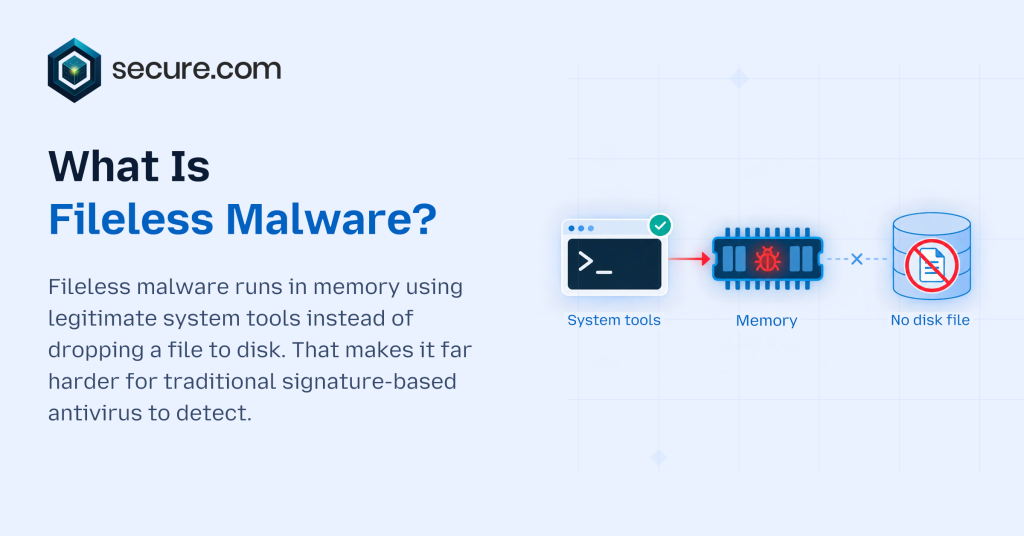
Fileless malware does not implant files but is mainly memory-resident and uses normal system instrumentation to carry out the malicious operations. In order to avoid disk-based artifacts, which would be easy targets for signature detection, the attacks are meant to circumvent traditional AV, and blend with the normal system activity.
Fileless malware has the following characteristics:
- No persistent files on disk: Malicious code executes in memory or through legitimate processes without creating executable files
- Abuse of trusted tools: Use of built-in utilities such as PowerShell, WMI, Windows Management Instrumentation, and legitimate administrative tools
- Stealth and evasion: Minimal forensic footprint, making detection and investigation significantly harder
These attacks are rarely detected because they leave minimal disk-based forensic artifacts. As a result, fileless malware can be experienced over long durations without detection, thereby giving the perpetrators continuous access to steal information or move around unnoticed by security systems.
What is Fileless Malware?
Fileless malware refers to cyberattacks where the harmful activity happens without using any files that would traditionally be written to disk. In other words, attackers employ scripts, in-memory code execution as well as legitimate system processes for their malicious purposes.
Conventional malware relies on binaries whereas fileless malware takes advantage of trusted OS components. Through this, an attacker can issue instructions, inject and keep their payloads in the memory space using registry entries, scheduled tasks or identity-based access as opposed to files.
Sophisticated threat actors often use fileless malware because they want to be stealthy, remain for long in the target system and have low chances of being detected or identified. Fileless techniques are commonly employed in advanced persistent threat (APT) campaigns, pre-ransomware reconnaissance, credential harvesting operations, and long-term espionage.
How Fileless Malware Works
Fileless malware typically follows a staged execution model that minimizes visibility and maximizes control.
Initial access
Attackers gain entry through methods such as:
- Phishing emails containing malicious macros or scripts
- Exploitation of unpatched vulnerabilities
- Stolen or compromised credentials
- Drive-by attacks or malicious web content
Rather than dropping malware files, attackers execute scripts or commands directly in memory.
In-memory execution
Once access is established, malicious code is executed in RAM using scripting engines or trusted processes. Common techniques include reflective DLL injection, PowerShell-based payloads, or shellcode execution within legitimate applications.
Abuse of legitimate tools
Fileless malware frequently relies on built-in system tools to perform malicious actions. Tools like PowerShell, WMI, rundll32, or scheduled tasks are used to execute commands, download payloads, or interact with remote systems while appearing legitimate.
Persistence mechanisms
Although no files are written, attackers establish persistence through registry modifications, scheduled tasks, startup scripts, or abuse of identity and access management systems to ensure continued access.
Command and control (C2)
Communication with attacker-controlled infrastructure is often encrypted, obfuscated, or disguised as normal web or cloud traffic. Some fileless attacks leverage trusted cloud services to further evade detection.
Data exfiltration or follow-on attacks
Depending on objectives, attackers may steal credentials, exfiltrate sensitive data, deploy ransomware, or establish long-term control for future operations.
Key Characteristics of Fileless Malware
Stealth and low visibility
By operating entirely in memory and using legitimate system tools, fileless malware avoids many traditional detection mechanisms that rely on file signatures or known binaries.
Reduced forensic footprint
Without malicious files on disk, forensic investigations become more difficult. Evidence may be lost upon system reboot, leaving defenders with limited artifacts to analyze.
Tool-based execution
Fileless attacks rely heavily on trusted system utilities, making it harder to distinguish malicious activity from legitimate administrative behavior.
High adaptability
Attackers can quickly modify scripts or execution methods, allowing fileless malware to evade static defenses and signature-based detection.
Technologies and Techniques Used in Fileless Malware Attacks
Script-based execution
Attackers execute malicious commands in memory using scripting engines such as PowerShell, JavaScript, and VBScript.
Living-off-the-land techniques
Attackers leverage built-in tools such as WMI, PowerShell, rundll32, or mshta to carry out attacks without introducing new binaries.
Memory injection
Attackers inject malicious code into legitimate processes using techniques such as reflective DLL injection or process hollowing, executing payloads without writing files to disk.
Credential abuse
To expand access without deploying additional malware, attackers leverage credential harvesting, token theft, and session hijacking to move laterally across the environment.
Applications and Impact of Fileless Malware
Credential theft and lateral movement
Fileless malware is frequently used to harvest credentials and move laterally across environments, targeting high-value systems and users.
Data exfiltration
Sensitive data can be quietly extracted over time using encrypted or disguised communication channels.
Ransomware and secondary payload delivery
Fileless techniques are often used as an initial stage before deploying ransomware or other destructive payloads.
Operational and business impact
The stealthy nature of fileless malware increases dwell time, leading to greater financial loss, regulatory exposure, and reputational damage.
Detecting and Defending Against Fileless Malware
Behavioral and anomaly-based detection
Since fileless malware leaves no file-based signatures, detection must focus on behavioral indicators such as abnormal process activity, suspicious script execution, or unexpected privilege escalations.
Endpoint and identity visibility
Comprehensive visibility into endpoint activity, identity usage, and access patterns is essential for detecting fileless attacks. Organizations should monitor endpoints continuously and track changes to identities and access rights.
Script and command monitoring
Organizations can identify suspicious or malicious use of legitimate tools by monitoring PowerShell, WMI, and command-line activity for anomalous patterns.
Rapid incident response
Upon detection, security teams should immediately quarantine affected hosts, terminate malicious processes, rotate compromised credentials, and remove persistence mechanisms to prevent reinfection.
Challenges and Risks of Fileless Malware
Limited visibility with traditional tools
Legacy antivirus and signature-based tools are often ineffective against fileless threats.
Short-lived evidence
Because malicious code resides in memory, evidence may disappear after reboot, complicating investigations.
False positives
Distinguishing malicious use of legitimate tools from normal administrative activity can be difficult, increasing the risk of false alerts.
Increasing attacker adoption
As defenses improve, attackers continue to shift toward fileless techniques to maintain stealth and effectiveness.
The Future of Fileless Malware
The prevalence and sophistication of fileless malware will continue to grow as operating systems become increasingly script-driven and cloud-connected. Fileless attacks are on the rise as attackers combine them with identity abuse, automation, and AI-assisted reconnaissance in order to get past conventional defense systems.
In response, modern security platforms are shifting toward behavioral analytics, continuous monitoring, and unified security architectures that correlate telemetry from endpoints, identities, and cloud environments in real time. Closing detection gaps and preventing abuse of legitimate tools will be critical to defending against fileless malware in the future.
Frequently Asked Questions
What is fileless malware?
Why is fileless malware hard to detect?
How does fileless malware run?
What is the difference between fileless malware and traditional malware?
How can teams detect fileless attacks?
Why is fileless malware growing?
Conclusion
The execution of cyberattacks has been fundamentally changed with the emergence of fileless malware. These attacks defy detection and response mechanisms as they do not make use of the conventional files; instead, they manipulate legitimate system tools.
Protecting against fileless malware requires moving beyond signature-based detection to embrace continuous monitoring, behavioral analysis, and rapid incident response. As attackers increasingly prioritize stealth over brute force, organizations must evolve their security strategies to detect low-footprint, high-impact threats that traditional defenses miss.