The cybersecurity threat landscape facing European organizations has intensified dramatically. According to the European Union Agency for Cybersecurity (ENISA), ransomware attacks and supply chain compromises have surged year over year, exposing critical infrastructure and essential services to significant disruption.
Organizations face an average of 11,000+ security alerts per day, with 70% going unaddressed due to resource constraints – a challenge NIS2’s incident reporting requirements will only intensify without automation. The original Network and Information Security (NIS) Directive, adopted in 2016, was the first EU-wide cybersecurity legislation, but its fragmented implementation across member states created inconsistent protection levels and enforcement gaps.
The NIS2 Directive (Directive (EU) 2022/2555) was adopted to address these shortcomings. It significantly expands the scope, strengthens security requirements, introduces stricter enforcement, and harmonizes cybersecurity obligations across all EU member states. With member states required to transpose NIS2 into national law by October 2024, the directive represents the most consequential regulatory shift in European cybersecurity to date.
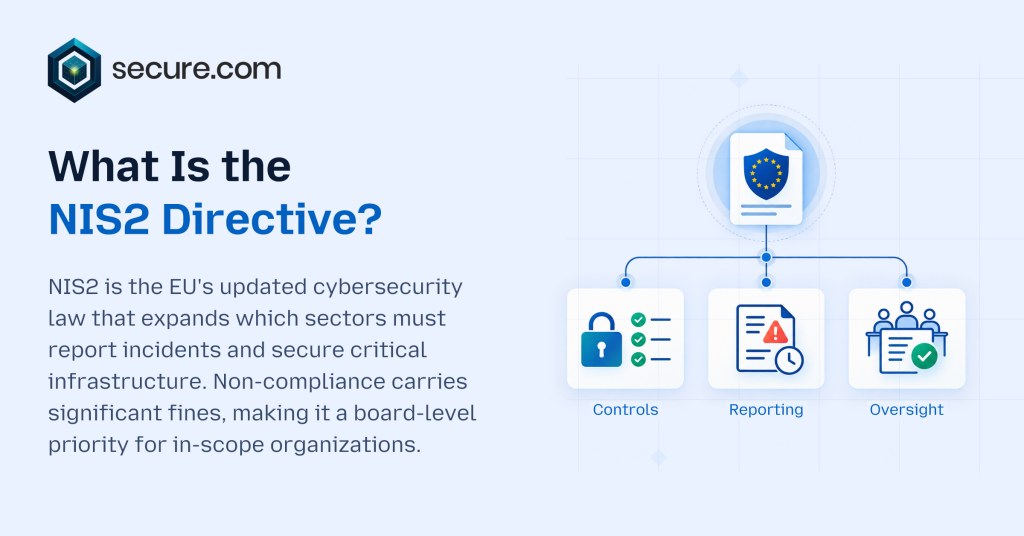
What Is the NIS2 Directive?
The NIS2 Directive is the European Union’s updated legislative framework designed to achieve a high common level of cybersecurity across all member states. It replaces and repeals the original NIS Directive (2016/1148), addressing the limitations that hindered its effectiveness.
NIS2 establishes minimum cybersecurity risk management and incident reporting obligations for organizations operating in sectors deemed critical to the economy and society. The directive categorizes entities into two groups:
- Essential entities: Organizations in sectors such as energy, transport, banking, financial market infrastructure, health, drinking water, wastewater, digital infrastructure, ICT service management, public administration, and space.
- Important entities: Organizations in sectors including postal and courier services, waste management, chemical manufacturing, food production and distribution, manufacturing of medical devices, electronics, machinery, motor vehicles, and digital providers such as online marketplaces, search engines, and social networking platforms.
Unlike the original NIS Directive, which left significant discretion to member states regarding which organizations fell within scope, NIS2 applies uniform size-based thresholds. Generally, medium-sized and large enterprises operating in covered sectors are automatically within scope, eliminating the inconsistency that plagued the original directive.
How the NIS2 Directive Works
Risk Management Obligations
NIS2 requires in-scope entities to implement appropriate and proportionate technical, operational, and organizational measures to manage cybersecurity risks.
These measures must address at minimum:
- Risk analysis and information system security policies
- Incident handling procedures
- Business continuity and crisis management
- Supply chain security, including security-related aspects of relationships with direct suppliers and service providers
- Security in network and information system acquisition, development, and maintenance
- Vulnerability handling and disclosure
- Policies and procedures for assessing the effectiveness of cybersecurity risk management measures
- Basic cyber hygiene practices and cybersecurity training
- Cryptography and encryption policies
- Human resources security, access control, and asset management
Incident Reporting Requirements
NIS2 introduces a structured, multi-stage incident reporting framework. Organizations must notify the relevant national Computer Security Incident Response Team (CSIRT) or competent authority as follows:
- Early warning within 24 hours of becoming aware of a significant incident
- Incident notification within 72 hours providing an initial assessment of severity and impact
- Final report within one month detailing root cause, mitigation measures, and cross-border impact
This tiered approach mirrors elements of GDPR’s breach notification framework while adding the early warning mechanism to enable faster coordinated response across member states.
Governance and Accountability
NIS2 places direct accountability on management bodies. Senior leadership must approve cybersecurity risk management measures, oversee their implementation, and can be held personally liable for non-compliance. The directive also mandates that management bodies undergo cybersecurity training and ensure similar training is offered to employees. This governance requirement represents a significant shift from treating cybersecurity as a purely technical function to recognizing it as a board-level responsibility.
Enforcement and Penalties
NIS2 establishes meaningful enforcement mechanisms:
- Essential entities face administrative fines of up to 10 million euros or 2 percent of total annual worldwide turnover, whichever is higher.
- Important entities face fines of up to 7 million euros or 1.4 percent of total annual worldwide turnover, whichever is higher.
- Competent authorities can impose binding instructions, security audit orders, and temporary suspension of certifications or authorizations for non-compliant essential entities.
Key Characteristics of the NIS2 Directive
- Expanded scope: NIS2 covers significantly more sectors and entities than its predecessor, bringing an estimated 160,000 organizations across the EU into scope.
- Harmonized requirements: Uniform baseline security measures and incident reporting obligations reduce fragmentation between member states.
- Supply chain focus: Organizations must assess and manage cybersecurity risks within their supply chains, reflecting the growing threat of third-party compromises.
- Management accountability: Direct liability for senior leadership elevates cybersecurity governance to the executive level.
- Cross-border coordination: Enhanced cooperation mechanisms, including the EU Cyber Crises Liaison Organisation Network (EU-CyCLONe), improve collective incident response.
- Alignment with existing frameworks: NIS2 complements GDPR, the Digital Operational Resilience Act (DORA), and the Critical Entities Resilience Directive (CER), creating a layered regulatory ecosystem.
Challenges and Risks of NIS2 Compliance
- Transposition inconsistencies: Despite harmonization goals, member states retain discretion in transposing certain provisions, potentially creating variations in enforcement and interpretation.
- Resource constraints: Small and medium-sized enterprises newly brought into scope may lack the cybersecurity maturity, budget, and personnel to meet compliance requirements quickly.
- Supply chain complexity: Assessing and managing cybersecurity risk across extensive supplier ecosystems demands significant operational effort and contractual renegotiation.
- Overlapping regulations: Organizations subject to NIS2, GDPR, DORA, and sector-specific regulations must navigate overlapping obligations, increasing compliance complexity.
- Incident reporting burden: The 24-hour early warning requirement demands robust detection capabilities and established internal escalation processes that many organizations have yet to implement.
The Future of the NIS2 Directive
NIS2 represents a foundational shift in how the European Union approaches cybersecurity regulation, but it is not the final step. The European Commission is expected to continue refining implementing acts and technical guidance that further specify security requirements for specific sectors and digital infrastructure providers.
As threat actors increasingly leverage artificial intelligence for attack automation and as critical infrastructure becomes more interconnected through IoT and operational technology, the regulatory framework will need to evolve accordingly. Organizations that treat NIS2 compliance as a baseline rather than a ceiling will be best positioned to adapt. Integration of NIS2 requirements with broader frameworks such as ISO 27001, SOC 2, and NIST CSF enables organizations to build resilient, auditable security programs that satisfy multiple regulatory obligations simultaneously.
Conclusion
The NIS2 Directive represents the European Union’s most comprehensive effort to establish consistent, enforceable cybersecurity standards across critical sectors. By expanding scope, mandating management accountability, strengthening incident reporting, and addressing supply chain risks, NIS2 moves cybersecurity from a technical concern to a governance imperative.
Organizations within scope must treat NIS2 not as a compliance checkbox but as an opportunity to mature their cybersecurity posture. Secure.com’s Digital Security Teammates transform compliance from a quarterly fire drill into continuous, automated assurance – freeing security teams to focus on strategic threat hunting rather than evidence collection. Those that invest in robust risk management, incident response capabilities, and supply chain oversight will not only meet regulatory obligations but build the operational resilience required to withstand an increasingly hostile threat environment.