Cyberattacks are no longer rare events—for most organizations, they are an operational reality that demands a new approach to security. Systems get compromised, credentials leak, software flaws appear, and attackers constantly search for weak points. Preventing every incident simply is not realistic.
That reality has shifted how security teams think about protection. Instead of assuming defenses will always hold, organizations now plan for what happens when something slips through.
This is where cyber resilience comes in.
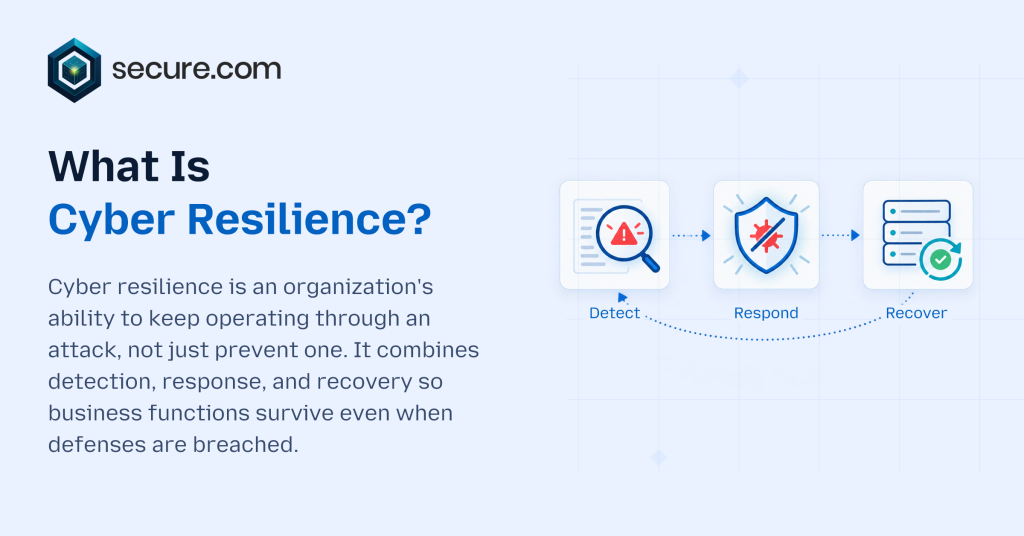
Cyber resilience focuses on keeping the business running even when security incidents occur. It combines prevention, detection, response, and recovery so an organization can absorb an attack, limit the damage, and return to normal operations quickly.
The idea is simple. A breach should not bring everything to a halt.
What is Cyber Resilience?
Cyber resilience refers to an organization’s ability to prepare for cyber threats, withstand attacks when they occur, and recover operations with minimal disruption.
Traditional cybersecurity focuses heavily on blocking threats. Cyber resilience takes a wider view. It assumes incidents will happen and builds the capability to keep systems available, protect critical data, and restore services quickly.
A resilient organization does more than defend its network. It understands which systems matter most to the business, prepares backup processes, practices incident response, and maintains clear recovery plans.
Most people think security success means zero incidents. In practice, resilience means the organization keeps functioning even when incidents occur.
How Cyber Resilience Works?
Cyber resilience relies on several coordinated capabilities that work together before, during, and after a cyber incident.
Preparation and risk awareness
The process begins with understanding risks. Organizations identify critical systems, map dependencies, and assess which assets would cause the greatest disruption if compromised.
This stage often includes vulnerability management, security assessments, threat modeling, and business impact analysis.
Continuous monitoring and detection
Because attacks rarely happen in a single moment, organizations monitor networks, endpoints, identities, and cloud systems for suspicious activity. Early detection reduces the time attackers can operate inside an environment.
Security teams track unusual login patterns, unexpected data movement, privilege changes, and system anomalies.
Incident response
When an incident occurs, response teams isolate affected systems, contain the threat, and begin investigating the root cause. Clear response playbooks help teams move quickly without confusion or delays.
Communication also plays a role here. Security teams coordinate with IT, leadership, and sometimes regulators or customers.
Recovery and restoration
Once the threat is contained, systems must return to normal operations. This may involve restoring backups, rebuilding servers, rotating credentials, or repairing compromised applications.
Recovery planning focuses on restoring the most critical services first so the organization can continue operating.
Learning and improvement
Every incident leaves behind lessons. Security teams analyze what happened, identify gaps, and improve controls so similar attacks are harder to repeat.
This feedback loop gradually strengthens the organization’s security posture.
Key Characteristics of Cyber Resilience
Operational continuity
A resilient organization can continue essential operations even during a cyber incident. Critical services remain available, and downtime stays limited.
Rapid recovery
The goal is not just surviving an attack but returning to normal quickly. Strong backup strategies, tested recovery procedures, and clear system ownership make this possible.
Visibility across systems
Security teams need insight into networks, endpoints, identities, cloud workloads, and applications. Without visibility, attackers can operate unnoticed for long periods.
Coordination across teams
Cyber resilience is not limited to security teams. IT operations, leadership, legal teams, and business units all play a role in maintaining continuity during incidents.
Continuous improvement
Threats change constantly. Resilient organizations review incidents, update procedures, and strengthen defenses over time.
Technologies That Support Cyber Resilience
Several security capabilities contribute directly to resilience.
Endpoint detection and response
These tools monitor devices for suspicious activity and help security teams contain threats quickly.
Identity and access management
Strong identity controls reduce the risk of compromised accounts spreading across systems.
Backup and disaster recovery systems
Reliable backups allow organizations to restore systems after ransomware attacks, system failures, or data corruption.
Security monitoring platforms
Security operations platforms collect and analyze activity across environments so teams can detect threats early.
Incident response automation
Automation helps security teams respond faster by reducing manual investigation steps and coordinating actions across tools.
Business Impact of Cyber Resilience
Cyber resilience protects more than infrastructure. It protects the organization’s ability to operate.
Reduced operational disruption
Resilient systems keep essential services running even during security incidents.
Lower financial losses
Downtime, data breaches, and ransomware events can be expensive. Faster detection and recovery reduce these costs.
Regulatory and compliance support
Many regulations now require organizations to demonstrate incident response planning, disaster recovery readiness, and data protection controls.
Customer trust
Organizations that handle incidents transparently and recover quickly are more likely to maintain customer confidence.
Challenges in Building Cyber Resilience
Complex technology environments
Modern infrastructures span cloud services, on premise systems, remote endpoints, and third party integrations. Monitoring and protecting all of them is difficult.
Limited visibility
Security teams often rely on multiple tools that do not share information easily. Important signals can get buried in alert noise.
Skill shortages
Cybersecurity expertise is in high demand. Many organizations struggle to staff incident response and monitoring teams.
Growing attack sophistication
Attackers continue refining their techniques. Ransomware operations, supply chain attacks, and identity based intrusions are increasingly common.
The Future of Cyber Resilience
As organizations adopt cloud infrastructure, remote work, and AI driven systems, resilience will become even more important. Security strategies are shifting toward continuous monitoring, faster detection, and automated response capabilities.
Companies are also investing in stronger recovery planning, including immutable backups and tested disaster recovery processes.
Most organizations have already learned a hard lesson. Perfect prevention is unrealistic. Resilience is what keeps the business running when something goes wrong.
Conclusion
Cyber resilience reflects a practical shift in how organizations approach security. Instead of focusing only on blocking attacks, it prepares businesses to withstand them.
With clear visibility, strong response planning, and reliable recovery processes, organizations can limit damage and return to normal operations quickly.
Security incidents may still happen. A resilient organization is ready for them.