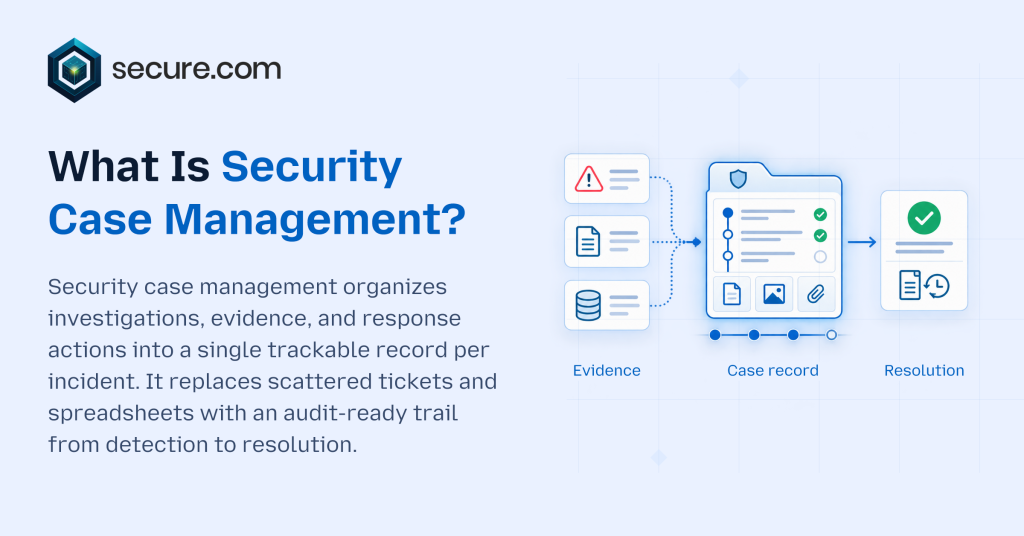
Security Case Management is the process of organizing, tracking, investigating, and resolving security incidents and related alerts within a structured case. It helps Security Operations Center teams bring together relevant information, tasks, evidence, and investigation activity so analysts can manage security events from initial detection through resolution.
Instead of treating every alert as an isolated event, security case management helps teams connect related activity and manage the broader security issue as a single investigation.
What is Security Case Management in a SOC?
In a SOC, security case management provides a structured workflow for handling security investigations. A case can be created when one or more alerts indicate a potential security incident or require further investigation.
A security case may include:
- Related alerts and events
- Affected users and identities
- Impacted endpoints, applications, or cloud resources
- Investigation notes and analyst findings
- Supporting evidence and logs
- Assigned owners and investigation tasks
- Severity and priority information
- Response and containment actions
- Remediation steps
- Case status and resolution details
The purpose is to provide a central record of the investigation so analysts can understand what happened, track actions, and maintain continuity as the case moves through the incident response process.
How does Case Management group related alerts?
Case management groups related alerts by identifying shared context, relationships, or patterns that suggest the alerts are part of the same security issue.
Alerts can be grouped based on factors such as:
- Shared identity: Multiple alerts involving the same user or service account.
- Common asset: Alerts affecting the same endpoint, server, application, or cloud resource.
- Similar activity: Events involving related techniques or suspicious behavior.
- Time proximity: Alerts occurring within a relevant timeframe.
- Network relationships: Events connected through the same IP addresses, domains, or network activity.
- Attack sequence: Multiple events that appear to represent different stages of the same attack.
- Threat intelligence: Alerts associated with the same known malicious indicator or threat.
For example, a suspicious login, an unusual privilege change, and abnormal data access involving the same user could be grouped into a single case rather than investigated as three unrelated alerts.
Grouping related alerts gives analysts a broader view of the potential incident and can reduce duplicate investigation work.
Why is Security Case Management important?
SOC teams often receive large volumes of alerts from multiple security systems. Investigating each alert independently can create duplicated work and make it difficult to understand the full scope of an incident.
Security case management helps teams:
- Consolidate related alerts and events
- Maintain investigation context
- Reduce duplicate investigation work
- Assign ownership and track responsibilities
- Standardize investigation workflows
- Preserve evidence and investigation history
- Improve collaboration between analysts and teams
- Track incidents from detection through closure
A structured case can also make it easier to review how an incident was handled and identify opportunities to improve future response processes.
Common Security Case Management Use Cases
Alert Consolidation
Multiple alerts associated with the same security issue can be grouped into a single case to reduce duplicate investigations.
Incident Investigation
Analysts can collect evidence, investigation findings, and related events within a central case.
Task and Workflow Management
Cases can include assigned tasks, owners, escalation steps, and response actions to help teams coordinate investigations.
Evidence Tracking
Relevant logs, files, alerts, and other evidence can be associated with the case for investigation and review.
Incident Reporting
Case records can provide a structured history of the incident, including what occurred, what actions were taken, and how the issue was resolved.
Challenges of Security Case Management
Security case management can become difficult when teams manage large numbers of alerts, incidents, and data sources.
Common challenges include:
- Alert volume: High volumes of alerts can create too many cases or duplicate investigations.
- Tool fragmentation: Relevant information may be spread across multiple security systems.
- Incomplete context: Analysts may need to manually gather information from different sources.
- Inconsistent workflows: Different analysts may investigate and document cases differently.
- Case duplication: Multiple analysts may create separate cases for the same underlying incident.
- Prioritization: Teams must determine which cases require immediate attention.
- Manual workload: Creating, updating, and documenting cases can consume significant analyst time.
The Future of Security Case Management
Security case management is increasingly becoming more automated and context driven. Rather than requiring analysts to manually create cases and collect related information, modern approaches can automatically correlate alerts, enrich cases, and suggest investigation steps.
Future capabilities are likely to focus on:
- AI assisted case creation
- Automated alert correlation
- Automatic evidence enrichment
- Risk based case prioritization
- Recommended investigation workflows
- Automated response actions
- End to end case lifecycle management
This can help SOC teams spend less time organizing security information and more time investigating and responding to meaningful threats.
Frequently Asked Questions
What is security case management?
Why do SOC teams use case management?
What goes into a security case?
How does case management improve response?
What is the difference between an alert and a case?
How does case management support audits and reporting?
Conclusion
Security Case Management provides a structured way for SOC teams to organize, investigate, and resolve security incidents. By grouping related alerts, centralizing evidence, assigning tasks, and tracking response actions, it helps teams manage the full lifecycle of a security case. As SOC environments become more complex, automated correlation and AI assisted workflows can further reduce manual work and help analysts respond more effectively to security threats.