As organizations expand their cloud footprint, relying on a single provider is becoming less common. Many businesses now run workloads across Amazon Web Services (AWS), Microsoft Azure, Google Cloud Platform (GCP), and other cloud providers to improve resilience, reduce vendor dependence, meet regulatory requirements, and access specialized services.
While this flexibility delivers business advantages, it also creates a broader attack surface. Every cloud provider has its own identity model, networking architecture, security controls, and management tools, making consistent protection increasingly difficult.
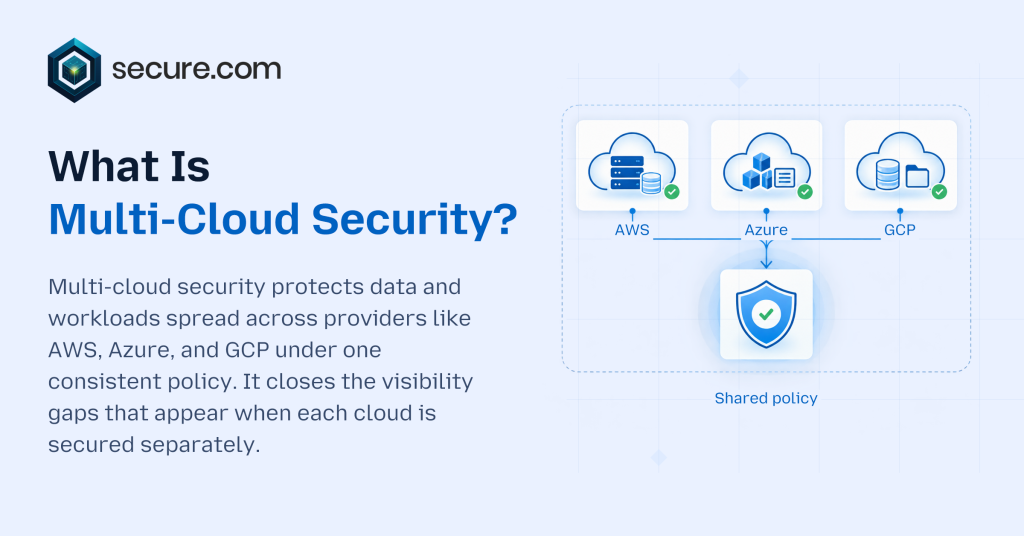
Multi cloud security is the practice of securing applications, workloads, identities, networks, and data across multiple cloud providers using centralized visibility, consistent policies, and continuous monitoring. Rather than protecting each cloud independently, organizations aim to create a unified security strategy that reduces complexity and improves threat detection.
This guide explains what multi cloud security is, why it matters, the biggest challenges organizations face, and the best practices for securing modern multi cloud environments.
What Is Multi Cloud Security?
Multi cloud security refers to the policies, technologies, and processes used to protect workloads distributed across two or more public cloud providers. Its objective is to ensure consistent security regardless of where applications or data are hosted.
An effective multi cloud security strategy typically includes:
- Centralized visibility across cloud environments
- Identity and access management
- Continuous configuration monitoring
- Workload protection
- Network security
- Data encryption
- Threat detection and response
- Compliance monitoring
It is important to distinguish multi cloud from hybrid cloud. A hybrid cloud combines private infrastructure with one or more public clouds, while a multi cloud strategy involves using multiple public cloud providers. Many enterprises operate both, increasing the need for unified security management.
Why Do Organizations Choose Multi Cloud?
Businesses adopt multi cloud strategies for several reasons, including avoiding vendor lock in, improving business continuity, supporting global operations, optimizing costs, and using the best services from different providers.
Although these benefits increase operational flexibility, every additional cloud environment introduces new identities, APIs, workloads, and configurations that security teams must manage. Without centralized governance, organizations can quickly lose visibility into their expanding cloud infrastructure.
Why Is Multi Cloud Security Harder Than Single Cloud?
Securing one cloud environment is challenging enough. Managing several clouds significantly increases operational complexity because every provider implements security differently.
AWS, Azure, and GCP each have unique identity systems, networking models, logging formats, and native security services. As a result, security teams often manage multiple dashboards and inconsistent security policies, making it difficult to maintain a complete view of organizational risk.
Questions such as “Which workloads are publicly exposed?”, “Who has excessive permissions?”, or “Where is sensitive data stored?” become much harder to answer without centralized monitoring.
What Are the Biggest Multi Cloud Security Challenges?
Several common challenges make multi cloud environments difficult to secure.
Cloud Sprawl
Cloud sprawl occurs when cloud resources grow faster than they can be monitored or governed. Unused virtual machines, forgotten storage buckets, abandoned development environments, and inactive identities increase the attack surface while remaining difficult to track.
Besides increasing security risk, cloud sprawl also drives unnecessary costs and complicates compliance efforts.
Inconsistent Security Policies
Every cloud provider implements security controls differently. Firewall rules, encryption settings, storage permissions, and identity policies often vary across environments, leading to inconsistent protection if organizations rely only on native tools.
Identity Management
Managing users, service accounts, roles, and permissions across multiple providers is significantly more complex than within a single cloud. Excessive permissions and poor credential management remain among the most common causes of cloud security incidents.
Limited Visibility
Fragmented monitoring prevents security teams from understanding how assets, identities, and workloads interact across cloud environments. These blind spots make it easier for attackers to move laterally and more difficult for defenders to investigate incidents.
What Does Unified Cloud Security Posture Mean?
A unified cloud security posture means managing security consistently across every cloud provider through centralized visibility and standardized policies.
Instead of reviewing AWS, Azure, and GCP separately, organizations evaluate risk through a single operational view that continuously monitors configurations, detects misconfigurations, tracks compliance, and prioritizes vulnerabilities.
Many organizations achieve this with a CNAPP (Cloud Native Application Protection Platform), which combines cloud security posture management, workload protection, vulnerability management, and runtime security into one solution.
What Is Multi Cloud Identity Management?
Identity is one of the most important security controls in any cloud environment. Multi cloud identity management focuses on providing consistent authentication and authorization across multiple providers.
A strong identity strategy includes centralized identity providers, multi factor authentication, least privilege access, role based permissions, privileged access monitoring, and regular credential reviews.
Since compromised credentials remain one of the most common attack vectors, securing identities across every cloud environment is essential for reducing organizational risk.
How Does the Shared Responsibility Model Change Across Multiple Clouds?
Every cloud provider follows a version of the shared responsibility model, where the provider secures the underlying cloud infrastructure while customers remain responsible for protecting their workloads, identities, applications, operating systems, and data.
Although this principle is consistent across providers, AWS, Azure, and GCP implement services differently. Organizations operating across multiple clouds must understand these differences to ensure policies remain consistent and security gaps do not emerge between environments.
What Is a Multi Cloud Security Architecture?
A multi cloud security architecture provides a framework for protecting resources consistently across cloud providers.
Key components typically include:
- Centralized identity management
- Unified logging and monitoring
- Network segmentation
- Workload protection
- Continuous vulnerability management
- Automated policy enforcement
- Encryption for data at rest and in transit
- Compliance monitoring
Rather than depending solely on cloud native security services, many organizations also adopt cloud agnostic security tooling that provides consistent controls across multiple environments.
What Is Multi Cloud Network Security?
Network security becomes increasingly complex as applications communicate across multiple cloud environments.
Multi cloud network security focuses on protecting traffic between cloud providers through segmentation, Zero Trust principles, firewalls, secure connectivity, traffic inspection, and continuous monitoring. Proper network segmentation helps prevent attackers from moving laterally if one environment becomes compromised.
Why Does Data Sovereignty Matter?
Data sovereignty refers to the legal requirement that data remains subject to the laws of the country where it is stored.
Organizations operating globally often distribute workloads across multiple cloud regions to satisfy local regulations. Security teams must ensure sensitive data remains within approved jurisdictions while maintaining encryption, access controls, and continuous compliance monitoring across every environment.
How Do Attackers Exploit Multi Cloud Environments?
Attackers frequently target cloud environments by exploiting misconfigured storage, exposed APIs, excessive permissions, compromised credentials, and unmanaged cloud resources. In large multi cloud deployments, cloud sprawl and fragmented visibility make these weaknesses easier to exploit.
Once attackers gain access to one environment, they often attempt to move laterally through interconnected identities, workloads, or networks. Continuous monitoring and centralized visibility are critical for identifying these attack paths before they escalate.
Best Practices for Multi Cloud Security
Organizations can reduce risk by adopting security practices that remain consistent across every cloud provider.
Key best practices include:
- Centralize identity and access management.
- Apply least privilege permissions.
- Continuously monitor cloud configurations.
- Reduce cloud sprawl through regular asset discovery.
- Standardize security policies across providers.
- Encrypt sensitive data at rest and in transit.
- Automate compliance monitoring.
- Implement network segmentation and Zero Trust access.
- Use cloud agnostic security tooling where appropriate.
- Continuously monitor workloads for suspicious activity.
These practices help simplify security operations while improving visibility, governance, and incident response.
Conclusion
Multi cloud strategies give organizations greater flexibility, resilience, and access to specialized cloud services, but they also introduce significant security challenges. Managing identities, configurations, workloads, networks, and compliance across multiple providers requires more than isolated security tools. It demands a unified approach that delivers consistent visibility and policy enforcement across every environment.
By reducing cloud sprawl, strengthening identity management, understanding the shared responsibility model, and adopting centralized security practices, organizations can minimize risk while maintaining the agility that multi cloud infrastructure provides. As cloud adoption continues to accelerate, building a consistent multi cloud security strategy will remain essential for protecting modern applications, data, and business operations.