
Pentesting simulates real-world cyberattacks against systems, applications, and networks to identify exploitable vulnerabilities, validate security controls, and measure actual business risk before malicious actors can strike.
Organizations face an ever-expanding attack surface driven by cloud adoption, remote workforces, and interconnected digital ecosystems. According to IBM, the average cost of a data breach reached 4.45 million dollars in 2023, with organizations that conduct regular security testing identifying and containing breaches significantly faster than those that do not. Despite investments in firewalls, endpoint protection, and monitoring tools, many organizations remain unaware of exploitable weaknesses lurking within their environments until an attacker finds them first.
Pentesting, short for penetration testing, addresses this gap. It is a controlled, authorized cybersecurity assessment in which skilled security professionals adopt the mindset, tools, and techniques of real-world adversaries to probe an organization’s defenses. The objective extends beyond simply listing vulnerabilities. Pentesting validates whether those vulnerabilities can be chained together and exploited to compromise systems, exfiltrate data, or disrupt operations, providing a realistic measure of security posture and business risk.
What Is Pentesting?
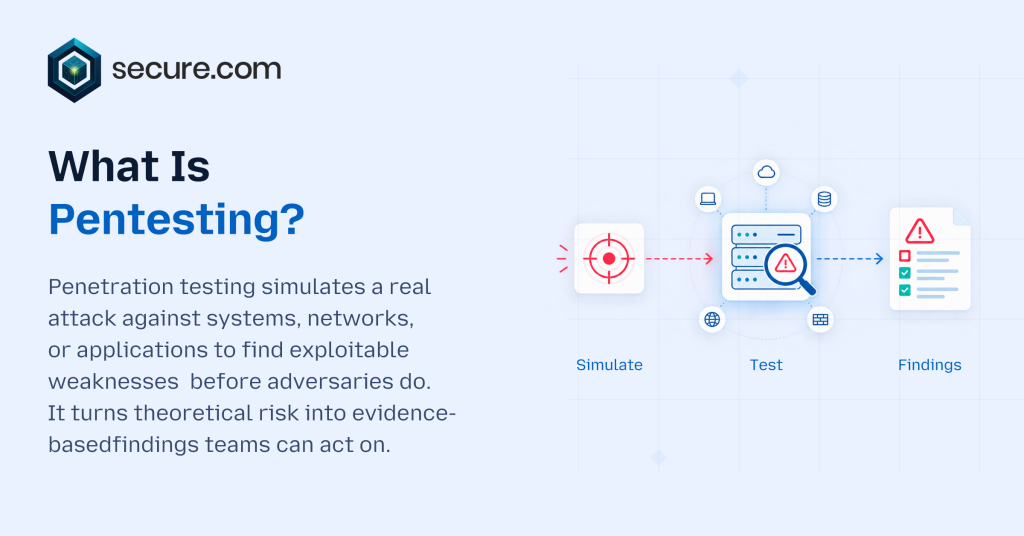
Pentesting is a methodical security evaluation where authorized professionals attempt to breach an organization’s systems, applications, or networks by simulating genuine attack scenarios. Unlike automated vulnerability scanning, which identifies potential weaknesses based on known signatures, pentesting involves human-driven analysis and exploitation that uncovers complex attack paths, business logic flaws, and chained vulnerabilities that scanners cannot detect.
The core objectives of pentesting include:
- Identifying exploitable vulnerabilities across infrastructure, applications, and human factors
- Validating the effectiveness of existing security controls and detection mechanisms
- Mapping realistic attack paths that adversaries could follow
- Assessing the potential business impact of a successful breach
- Delivering prioritized, actionable remediation guidance
Pentesting engagements operate under formal authorization with clearly defined rules of engagement, scope boundaries, and objectives. They are conducted by internal security teams, third-party ethical hackers, or specialized firms with deep expertise in offensive security.
How Pentesting Works
Planning and Scoping
Every pentest begins with defining the engagement parameters. This includes identifying which systems, applications, or environments fall within scope, establishing the testing approach, setting timelines, and agreeing on rules of engagement. Scoping ensures testing remains controlled, focused, and aligned with organizational priorities and risk tolerance.
Testing approaches include:
- Black box: Testers have no prior knowledge of the target environment, simulating an external attacker.
- White box: Testers receive full access to architecture documentation, source code, and credentials, enabling deep analysis.
- Gray box: Testers receive partial information, simulating an insider or a compromised user account.
Reconnaissance
Testers gather intelligence about the target using techniques that mirror real attacker behavior. This includes open-source intelligence collection, DNS and domain enumeration, technology stack fingerprinting, and employee information harvesting. Effective reconnaissance shapes the attack strategy and identifies potential entry points.
Vulnerability Identification
Using a combination of automated tools and manual analysis, testers identify weaknesses such as misconfigurations, unpatched software, weak authentication mechanisms, insecure APIs, and application logic flaws. The critical distinction from automated scanning is that pentesters validate whether each vulnerability is genuinely exploitable in the target context.
Exploitation
Testers attempt to exploit confirmed vulnerabilities to gain unauthorized access. This may involve bypassing authentication controls, obtaining remote access, escalating privileges, or extracting sensitive data. Exploitation is performed carefully to simulate realistic attacker behavior while minimizing operational disruption to the organization.
Post-Exploitation and Impact Analysis
After gaining initial access, testers assess how far an attacker could progress. This includes lateral movement across network segments, accessing sensitive databases, compromising domain controllers, and demonstrating data exfiltration paths. This phase reveals the true business impact a breach could inflict.
Reporting and Remediation
The engagement concludes with a comprehensive report containing detailed technical findings, risk severity ratings, proof-of-concept evidence, business impact assessments, and prioritized remediation recommendations. Effective reporting translates technical vulnerabilities into executive-level risk context.
Types of Pentesting
- Network Pentesting: Evaluates internal and external network security including firewalls, routers, exposed services, and segmentation controls.
- Web Application Pentesting: Targets application-layer vulnerabilities such as SQL injection, cross-site scripting, authentication flaws, and insecure session management.
- Cloud Pentesting: Assesses cloud environments, IAM configurations, storage permissions, and APIs across platforms like AWS, Azure, and Google Cloud.
- Mobile Application Pentesting: Identifies vulnerabilities in iOS and Android applications including insecure data storage and weak encryption.
- Social Engineering: Simulates human-targeted attacks such as phishing campaigns and pretexting to evaluate employee security awareness.
- Red Team Exercises: Comprehensive, multi-vector simulations that test detection and response capabilities across the entire organization over extended periods.
Key Characteristics of Effective Pentesting
- Real-world simulation: Pentesters employ the same tools, tactics, and procedures used by actual threat actors, providing an authentic assessment of defensive readiness.
- Human expertise: Skilled testers identify complex vulnerabilities, business logic flaws, and chained attack paths that automated tools cannot detect.
- Controlled and authorized: All testing operates under formal written authorization with defined scope, boundaries, and communication protocols.
- Business-impact focused: Findings are contextualized in terms of operational disruption, financial exposure, reputational damage, and regulatory consequences.
- Actionable outcomes: Reports deliver clear, prioritized remediation guidance rather than raw vulnerability lists.
Applications and Business Impact
- Regulatory compliance: Frameworks including PCI DSS, SOC 2, ISO 27001, and HIPAA require or strongly recommend periodic penetration testing as part of security validation.
- Risk validation: Pentesting confirms whether theoretical vulnerabilities translate into actual exploitable business risk.
- Security maturity measurement: Organizations gain insight into how effectively their controls detect, respond to, and contain attack behavior.
- Breach prevention: Gartner highlights that organizations conducting regular penetration testing experience fewer successful breaches by proactively eliminating exploitable weaknesses.
- Executive reporting: Pentest results demonstrate proactive risk management to boards, investors, regulators, and customers.
Challenges and Limitations
- Point-in-time assessment: A pentest captures security posture at a specific moment and may not reflect vulnerabilities introduced after the engagement concludes.
- Scope constraints: Budget and time limitations may restrict testing depth, potentially leaving areas unexamined.
- False sense of security: A clean pentest result does not guarantee immunity from evolving threats or zero-day exploits.
- Operational sensitivity: Testing production environments requires careful coordination to avoid service disruptions.
- Skill dependency: The quality and depth of findings depend heavily on the expertise of the testing team.
The Future of Pentesting
The pentesting landscape is evolving rapidly. Organizations are shifting from annual compliance-driven assessments toward continuous penetration testing models that provide ongoing visibility into emerging risks. AI-assisted vulnerability discovery is accelerating reconnaissance and identification phases, while automated attack surface validation platforms complement human-driven testing.
Integration with security orchestration and response platforms enables faster remediation workflows. As cloud-native architectures, DevSecOps practices, and zero-trust frameworks become standard, pentesting is embedding directly into development pipelines and continuous security validation programs, moving from periodic exercises to intelligence-driven, always-on security assurance.
Frequently Asked Questions
What is penetration testing?
Why do companies run pentests?
What is the difference between a pentest and a vulnerability scan?
How often should you run a penetration test?
What happens after a pentest is done?
How does continuous testing improve on a yearly pentest?
Conclusion
Pentesting is an indispensable component of modern cybersecurity strategy. By simulating real-world attacks under controlled conditions, organizations uncover exploitable weaknesses, validate defensive controls, and gain measurable insight into their true security posture. In a threat landscape defined by sophisticated adversaries and expanding attack surfaces, pentesting transforms security from assumption-based confidence into evidence-based resilience, helping organizations remediate risk before attackers exploit it.