Control Mapping is the process of connecting an organization’s security and compliance controls to the requirements of one or more regulatory or compliance frameworks. It helps teams understand which controls satisfy specific requirements and identify gaps where additional controls or evidence may be needed.
Instead of managing each framework separately, control mapping allows organizations to reuse relevant controls and evidence across multiple frameworks.
What is Control Mapping in Compliance?
Control mapping in compliance is the process of linking internal security controls to specific requirements across compliance frameworks, standards, or regulations.
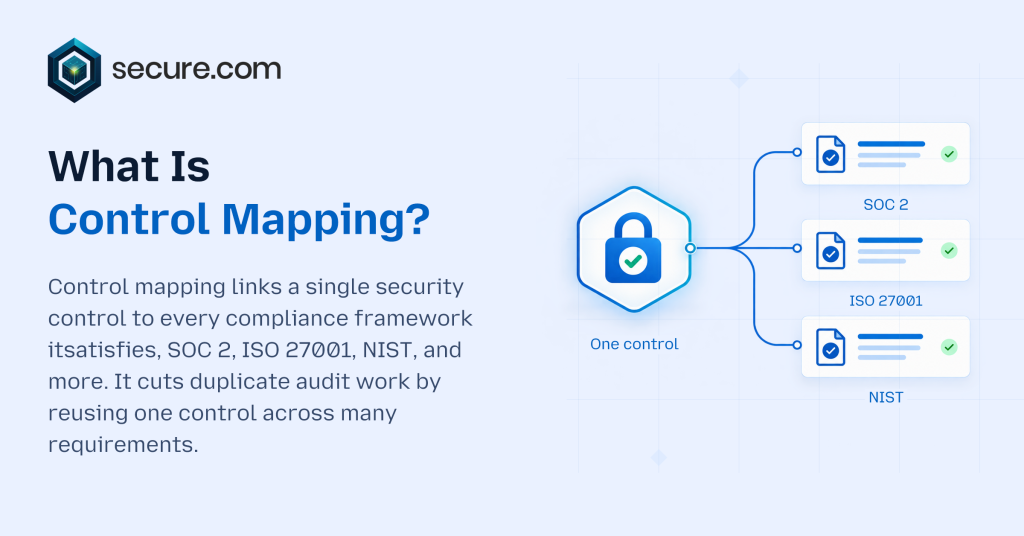
For example, a single access control policy may support requirements across frameworks such as SOC 2, ISO 27001, and NIST.
Control mapping typically involves:
- Identifying requirements: Breaking a framework into its individual requirements or controls.
- Defining internal controls: Documenting the policies, processes, and technical safeguards used by the organization.
- Mapping controls: Connecting internal controls to the requirements they address.
- Identifying gaps: Finding requirements that are not adequately covered by existing controls.
- Maintaining evidence: Linking relevant evidence to demonstrate that mapped controls are operating effectively.
This gives compliance teams a clearer view of how their existing security practices support different compliance obligations.
How does Control Mapping work across frameworks?
Control mapping works by identifying common requirements between different frameworks and connecting them to the organization’s existing controls.
For example, requirements related to access management may appear across multiple frameworks. Rather than creating a separate control for every framework, an organization can map its existing access management control to each applicable requirement.
The process generally involves:
- Comparing framework requirements: Identify overlapping or related requirements across frameworks.
- Creating a common control structure: Define internal controls that address recurring security and compliance requirements.
- Mapping controls to requirements: Connect each internal control to the relevant framework requirements.
- Reusing evidence: Use applicable evidence across multiple mapped requirements where permitted.
- Tracking framework changes: Update mappings when regulatory or framework requirements change.
This reduces duplicated compliance work and gives teams a centralized view of how their controls support multiple frameworks.
Why is Control Mapping important?
Control mapping helps organizations manage compliance more efficiently, particularly when they need to meet multiple frameworks at the same time.
It can help teams:
- Reduce duplicate compliance work
- Identify control and compliance gaps
- Reuse applicable controls across frameworks
- Organize evidence more efficiently
- Improve visibility into compliance coverage
- Prepare more efficiently for audits and assessments
Control Mapping vs. Control Testing
Control mapping and control testing serve different purposes.
Control mapping determines which internal controls address specific framework requirements. Control testing evaluates whether those controls are properly designed and operating effectively.
For example, an organization may map its user access review process to requirements in several frameworks. Testing then determines whether those access reviews are actually performed as required and whether the organization can provide sufficient evidence.
Both processes are important for maintaining an effective compliance program.
Challenges of Control Mapping
Control mapping can become complicated when organizations manage multiple frameworks, changing requirements, and large numbers of controls.
Common challenges include:
- Different terminology: Frameworks may describe similar security requirements using different language.
- Overlapping requirements: Several frameworks may contain requirements that partially overlap but are not identical.
- Complex environments: Organizations may have hundreds of controls spread across different teams and systems.
- Manual maintenance: Maintaining mappings in spreadsheets can become difficult as requirements change.
- Incomplete mappings: A control may appear to satisfy a requirement but may not fully address it.
- Changing frameworks: Updates to standards and regulations can make existing mappings outdated.
The Future of Control Mapping
Control mapping is increasingly becoming more automated as organizations manage larger compliance programs across multiple frameworks. Modern approaches can use centralized control libraries, automated evidence collection, and AI assisted analysis to identify relationships between requirements and existing controls.
Future approaches are likely to focus on:
- Automated framework cross mapping
- Continuous monitoring of control coverage
- AI assisted gap identification
- Automated evidence linking
- Real time updates when framework requirements change
- Unified compliance management across multiple frameworks
This can help organizations move away from manually maintaining separate compliance programs and toward a more continuous and connected approach to compliance management.
Frequently Asked Questions
What is control mapping?
Why is control mapping useful?
How does control mapping help with multiple frameworks?
What does a control map look like?
How does control mapping speed up audits?
How does automation help with control mapping?
Conclusion
Control Mapping helps organizations connect their internal security controls to requirements across multiple compliance frameworks. By identifying overlapping requirements, reusing applicable controls and evidence, and continuously maintaining mappings, teams can reduce duplicated work, identify compliance gaps, and build a more efficient and consistent compliance program.