Modern organizations rely on thousands of digital assets—laptops, servers, cloud workloads, applications, APIs, and connected devices. These assets constantly appear, change, and disappear as teams deploy new tools, spin up cloud environments, and connect remote devices.
Without a clear understanding of what assets exist and how they interact, security teams cannot reliably protect them. Untracked systems may run outdated software, exposed services may remain unpatched, and unmanaged devices may never send security telemetry to monitoring tools.
This is where asset visibility becomes essential.
Asset visibility refers to the ability to identify, track, and understand all technology assets across an environment. It provides a continuously updated view of what devices, systems, applications, and cloud resources exist, where they are located, and how they behave.
With accurate visibility, security teams can detect gaps, prioritize protection, and respond to emerging risks before attackers exploit hidden weaknesses.
What is Asset Visibility?
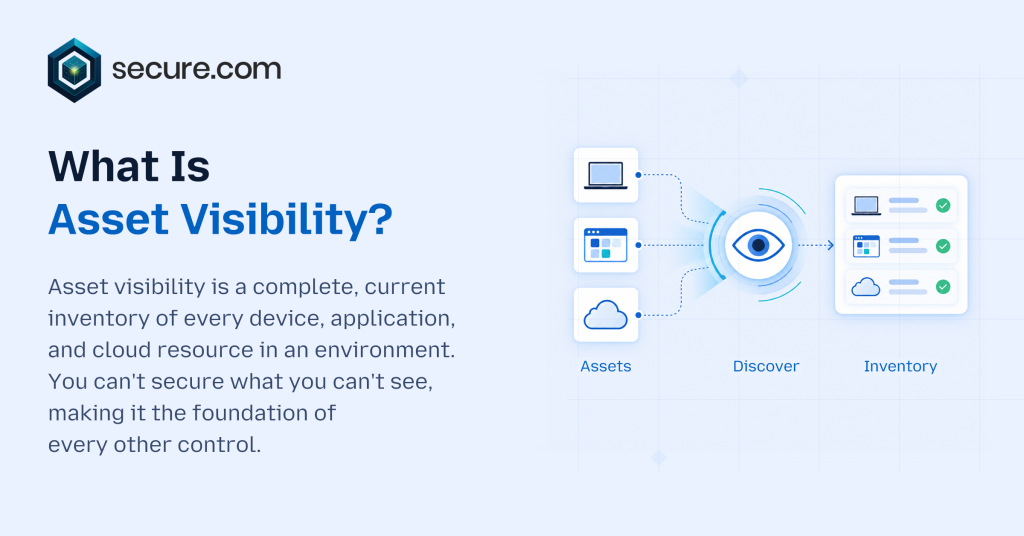
Asset visibility is the capability to maintain a comprehensive, up-to-date understanding of all IT and digital assets within an organization’s environment, including their configuration, ownership, status, and relationships to other systems.
These assets may include:
- Endpoints such as laptops, desktops, and mobile devices
- Servers and virtual machines
- Cloud workloads and SaaS applications
- Network infrastructure such as routers and firewalls
- IoT and operational technology devices
- Domains, APIs, and externally exposed services
The goal of asset visibility is not simply to maintain an inventory. It is to ensure that every asset connected to the environment can be monitored, secured, and managed throughout its lifecycle.
In cybersecurity, asset visibility forms the foundation for many other security practices—including vulnerability management, incident detection, and exposure management—because organizations cannot secure systems they do not know exist.
How Asset Visibility Works?
Asset visibility is typically achieved through a combination of discovery, monitoring, and inventory management processes.
Asset discovery
The first step is identifying all assets connected to an environment. Discovery techniques may include:
- Network scanning
- Endpoint telemetry collection
- Cloud account integration
- API-based discovery across SaaS platforms
- Passive network monitoring
These methods help uncover both known and previously unknown assets.
Asset inventory creation
Once discovered, assets are recorded in a centralized inventory. Each asset entry typically includes:
- Device type and operating system
- IP address and network location
- Owner or responsible team
- Security controls applied
- Installed software and configuration details
Maintaining this inventory allows organizations to track the full scope of their digital infrastructure.
Continuous monitoring
Because modern environments change constantly, asset visibility must be maintained continuously rather than through periodic audits. Continuous monitoring ensures that:
- New assets are quickly detected
- Configuration changes are recorded
- Unauthorized devices are flagged
- Security coverage gaps are identified
This ongoing visibility enables faster detection of security risks and operational issues.
Key Characteristics of Asset Visibility
Comprehensive asset awareness
Asset visibility provides a complete understanding of all systems connected to the environment, including devices, services, and infrastructure components.
Real-time or near-real-time updates
Because assets can be created or modified rapidly, effective visibility requires continuous updates rather than static records.
Contextual asset information
Beyond identifying an asset’s existence, visibility includes context such as configuration, software versions, ownership, and network relationships.
Cross-environment coverage
Modern environments span on-premises infrastructure, cloud platforms, and remote endpoints. Effective asset visibility covers all these domains.
Technologies and Methods Used for Asset Visibility
Network monitoring
Network monitoring tools observe traffic flows and communications between systems. This helps identify devices that connect to the network even if they are not formally registered.
Endpoint and device telemetry
Security agents installed on endpoints provide detailed information about system configuration, installed software, and security posture.
Cloud and SaaS integrations
Cloud environments require API-based integration with cloud platforms to discover workloads, storage resources, and user identities.
Configuration and asset management systems
Configuration management databases (CMDBs) and asset management systems help store asset records and track their lifecycle.
External attack surface discovery
Some tools monitor internet-facing infrastructure to identify domains, exposed services, and publicly accessible assets that may not appear in internal inventories.
Applications and Importance of Asset Visibility
Vulnerability management
Asset visibility enables organizations to identify which systems require patches or configuration updates and prioritize remediation based on risk.
Incident detection and response
Knowing what assets exist and how they normally behave helps security teams identify unusual activity or unauthorized changes.
Compliance and governance
Many security frameworks require organizations to maintain accurate asset inventories. Asset visibility supports compliance by documenting systems and their security controls.
Risk management
By understanding which assets exist and which are exposed to the internet, organizations can evaluate their potential attack surface and reduce security gaps.
Challenges and Risks of Poor Asset Visibility
Unknown or unmanaged assets
Untracked devices, shadow IT services, and forgotten servers often lack security controls, making them attractive targets for attackers.
Rapidly changing infrastructure
Cloud environments allow assets to be created and removed within minutes, making it difficult for manual processes to keep inventories accurate.
Fragmented tool environments
Different security tools may maintain separate asset lists, creating inconsistencies and gaps in visibility.
Incomplete external awareness
Internal asset inventories may not reflect what attackers can actually see from the internet, leaving exposed services undiscovered.
The Future of Asset Visibility
As digital environments continue to expand across cloud platforms, remote endpoints, and connected devices, maintaining asset visibility will become increasingly complex.
Organizations are moving toward integrated platforms that correlate data from multiple sources—endpoints, networks, cloud services, and identity systems—to create a unified understanding of their technology environments.
Greater automation, improved telemetry collection, and continuous discovery processes are helping organizations maintain accurate asset inventories even as infrastructure changes rapidly.
Conclusion
Asset visibility is the foundation of effective cybersecurity operations. By providing a clear and continuously updated understanding of all technology assets, it enables organizations to monitor systems, identify vulnerabilities, and respond to threats more effectively.
Without asset visibility, security programs operate with blind spots—leaving unmanaged systems exposed and increasing the likelihood of breaches. Establishing strong asset visibility practices ensures that every device, application, and service within an environment can be accounted for, monitored, and protected.