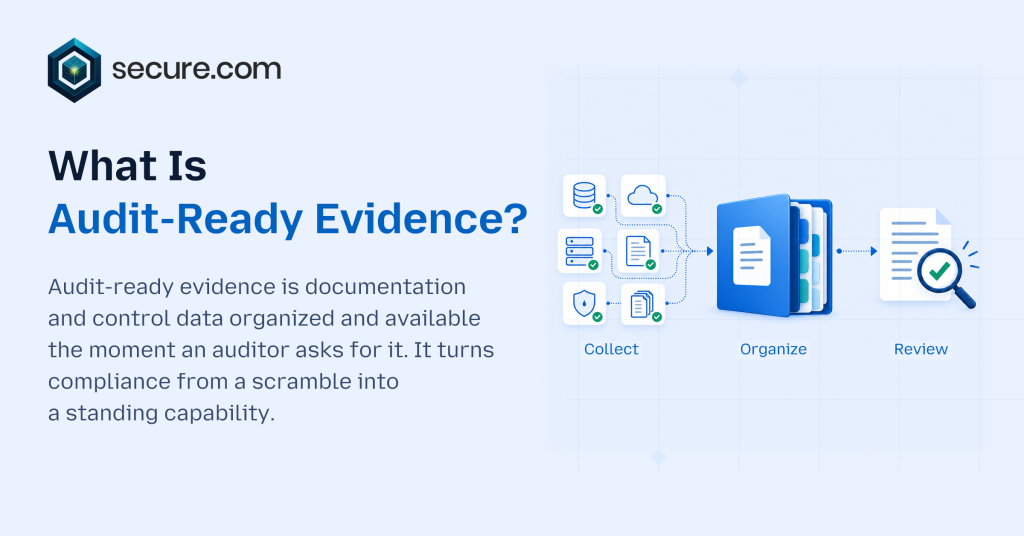
Audit Ready Evidence refers to the documentation, records, and supporting information an organization maintains to demonstrate that its security and compliance controls are operating as required. It provides auditors with verifiable proof that policies, processes, and controls are implemented and consistently followed.
Instead of collecting evidence only when an audit begins, organizations can maintain evidence continuously so it remains current, organized, and ready for review.
What is Audit Ready Evidence in Compliance?
Audit Ready Evidence is documentation and records that demonstrate an organization meets specific compliance requirements and that its controls are operating effectively.
Common examples include:
- Access control and user permission records
- Security policies and procedures
- Vulnerability scans and remediation records
- System and configuration logs
- Employee security training records
- Risk assessments
- Incident response records
- Vendor and third party assessments
- Monitoring and testing results
Audit ready evidence should be accurate, traceable, relevant to the applicable control, and supported by information that allows an auditor to verify when and how the control operated.
How do teams keep compliance evidence audit-ready?
Teams keep compliance evidence audit-ready by continuously collecting, validating, organizing, and updating evidence rather than preparing everything immediately before an audit.
Common practices include:
- Automating evidence collection: Pulling records directly from relevant systems and services where possible.
- Mapping evidence to controls: Connecting each piece of evidence to the specific compliance requirement or control it supports.
- Maintaining evidence continuously: Updating records as controls operate instead of waiting for the next audit.
- Tracking ownership: Assigning control owners who are responsible for maintaining evidence.
- Checking evidence quality: Reviewing evidence for accuracy, completeness, and relevance.
- Maintaining an audit trail: Recording when evidence was collected, updated, or reviewed.
These practices reduce manual preparation and make it easier to demonstrate that controls are operating consistently.
Why does audit evidence go stale between audits?
Audit evidence can become stale because the systems, configurations, employees, processes, and security controls represented by the evidence can change over time. Evidence collected during one audit may no longer accurately reflect the organization’s current environment.
For example, an access review completed six months ago may not account for employees who have since joined, changed roles, or left the organization.
Common causes of stale evidence include:
- Changes to systems or cloud environments
- Employee onboarding, role changes, or offboarding
- Updated security policies and procedures
- New vendors or third party services
- Changes to user permissions
- Expired screenshots, reports, or configuration records
- Controls that are no longer operating as originally documented
Continuous evidence collection helps organizations keep compliance records aligned with their current environment.
Why is Audit Ready Evidence important?
Audit ready evidence helps organizations demonstrate that their controls are not only documented but also operating as intended.
It can help teams:
- Reduce the time spent preparing for audits
- Respond to auditor requests more efficiently
- Demonstrate ongoing control effectiveness
- Identify missing or outdated evidence earlier
- Reduce reliance on manual evidence collection
- Maintain a clearer audit trail
Challenges of Maintaining Audit Ready Evidence
Maintaining reliable evidence can become difficult as organizations grow and their technology environments become more complex.
Common challenges include:
- Manual collection: Teams may spend significant time gathering screenshots, reports, logs, and other records.
- Evidence fragmentation: Evidence can be spread across multiple systems, teams, and storage locations.
- Ownership gaps: It may be unclear who is responsible for maintaining evidence for a particular control.
- Stale documentation: Evidence can become outdated when systems or processes change.
- Inconsistent formats: Evidence collected from different sources may be difficult to organize and compare.
- Limited visibility: Teams may not know that required evidence is missing until an audit is approaching.
The Future of Audit Ready Evidence
Compliance programs are increasingly moving toward continuous evidence collection and automated control monitoring. Rather than treating audits as periodic events, organizations can use technology to continuously monitor controls and maintain supporting evidence.
Future approaches are likely to focus on:
- Continuous compliance monitoring
- Automated evidence collection
- Real time control validation
- AI assisted evidence classification and organization
- Automated detection of missing or stale evidence
- Continuous mapping between controls and evidence
This can help organizations maintain a more accurate view of their compliance posture throughout the year rather than rebuilding evidence shortly before an audit.
Frequently Asked Questions
What is audit ready evidence?
Why does audit ready evidence matter?
What counts as good audit evidence?
How is audit ready evidence different from raw logs?
How can teams keep evidence audit ready?
How does automation help produce audit ready evidence?
Conclusion
Audit Ready Evidence provides the verifiable records organizations need to demonstrate that their compliance controls are implemented and operating effectively. By continuously collecting, validating, organizing, and updating evidence, teams can reduce audit preparation effort, identify gaps earlier, and ensure their evidence reflects the organization’s current environment.