Key Takeaways
- An AI SOC learns from your alert history, SOPs, and entity data, not from a vendor’s generic training set
- Context is the difference between a noisy tool and a genuinely useful one
- Analyst feedback drives the tuning loop that improves accuracy over time
- Past investigations build institutional memory that stops your team from solving the same problem twice
- A coachable AI SOC gets sharper the more your analysts actually use it
Introduction
According to the 2025 SANS Detection and Response Survey, 73% of security teams say false positives are their single biggest detection challenge. That number is climbing every year. Most of the time, the culprit is the same: an AI tool running on generic logic that has no idea what your environment actually looks like.
Here is how the ones that work fix that.
What Data Does an AI SOC Need to Learn Your Environment
This is where most deployments get it wrong.
A generic AI SOC scores alerts based on broad threat patterns. A good one scores them based on your network, your users, and your business risk. The gap between those two is context, and without it, you are just trading one kind of noise for another.
To learn your environment, an AI SOC ingests several layers of data:
- Alert history. Past alerts tell the system what normal looks like in your organization. A spike in login attempts at 2am might be suspicious for a retail company but completely expected for a fintech firm with engineering teams in multiple time zones.
- Standard operating procedures (SOPs). When the AI reads your existing runbooks, it stops guessing how to respond and starts acting the way your team actually would.
- Entity data. Who are your admins? Which servers hold sensitive data? What does a typical day of user behavior look like? This layer gives the AI the context it needs to separate signal from noise.
- Organizational context. What are your crown jewel assets? What counts as a high-risk action in your business specifically? This is the layer that makes triage decisions actually meaningful.
How Organizational Context Shapes Triage Decisions
A flagged cloud login from a new country looks very different when the system knows your CEO just flew to Singapore. Without that context, everything is a potential threat. With it, the AI can reason through the situation the same way a senior analyst would.
This is also where the false positive problem gets solved. According to the SANS 2025 survey, more than 60% of security teams encounter false positives frequently or very frequently. Context is what cuts through that noise. The AI is not just pattern-matching anymore. It is evaluating each alert against your specific environment, your specific risk profile, and your specific business logic.
That is a fundamentally different kind of intelligence.
How an AI SOC Remembers Past Investigations
If your AI SOC has no memory, your team keeps solving the same problem twice.
That is not automation. That is faster paperwork.
A mature AI SOC builds what is sometimes called a context lake. It stores past investigation outcomes, analyst decisions, case history, and custom classifications so the system can pull from that knowledge the next time a similar alert appears. This is institutional memory in a form that does not leave when your analyst does.
What a Context Lake Actually Does
Think about how long it takes an L1 analyst to get good at their job. Months of watching alerts, learning which ones to dismiss and which ones to dig into, picking up patterns that never get written down anywhere. A context lake gives the AI that same depth of judgment, built from real decisions made by your actual team.
Specifically, it stores:
- Investigation outcomes (was this a true positive or a false positive?)
- Analyst reasoning and decisions at each step
- Historical case patterns for recurring alert types
- Custom labels and classifications your team has applied over time
When a new alert comes in, the system pulls from this history. It compares the incoming signal to past cases, applies the logic your analysts used before, and routes it accordingly. The result is faster, more accurate triage that actually fits your environment rather than a vendor’s training set.
Why Institutional Memory Matters for Lean Teams
High analyst turnover is one of the most expensive problems in security operations. IBM’s Cost of a Data Breach Report 2025 showed that US breaches now average $10.22 million, and staffing gaps are a major factor in response delays. Every time an experienced analyst leaves, their knowledge walks out the door with them.
A context lake prevents that erosion. The AI retains the logic, the patterns, and the judgment calls your team built up, even as your roster changes. New team members get the benefit of every investigation that came before them, on day one.
That alone makes a compelling case for context-driven AI in the SOC.
What It Means for an AI SOC to Be Coachable
Coachability is not a marketing term. It is the actual mechanism by which an AI SOC improves after it goes live.
A coachable AI SOC takes feedback from your analysts and uses it to get more accurate over time. When an analyst marks a false positive, that correction becomes a training signal. When they add context to an escalated case, the system notes that reasoning too. When they confirm a containment action, that confidence gets baked in. The tuning loop tightens with every interaction.
This is what separates a system that plateaus from one that keeps getting better.
How Analysts Give Feedback to an AI SOC
Most well-built platforms make this feedback process simple. Analysts do not need to retrain the model manually or file tickets with a vendor. Instead, feedback happens naturally inside normal workflows:
- Flagging an incorrect triage decision (this alert should have been dismissed)
- Adding missing context to a case the AI escalated without full reasoning
- Confirming or overriding automated response actions
- Labeling a new alert type the system has not encountered before
Each of these inputs feeds the tuning loop. The AI adjusts. The next time a similar alert appears, it handles it better.
Research published in The Hacker News on continuous feedback in AI SOC environments confirms this: continuous learning does not rebuild detection logic from scratch. It tunes existing logic based on verified outcomes. The foundation stays intact. Feedback improves specific components so they fit your environment more accurately over time.
The Human in the Loop Is Not a Bottleneck
There is a common concern that keeping humans in the loop slows everything down. In a poorly built system, that is true. In a well-built one, it is not.
Human oversight is strategic, not universal. It focuses analyst attention on edge cases, novel alert types, and situations where automated logic has genuine gaps. Routine triage runs automatically. The result is speed where it matters and control where it counts.
Analysts move from doing to validating. They gain leverage without losing visibility. Every decision they make makes the system smarter for the next shift.
How an AI SOC Adapts to New Alert Types and Tunes Over Time
Deployment is not the finish line. An AI SOC that stopped learning the day it went live would become stale within weeks. Threats evolve. Environments change. New tools get added. Coverage has to keep up.
The Continuous Tuning Loop
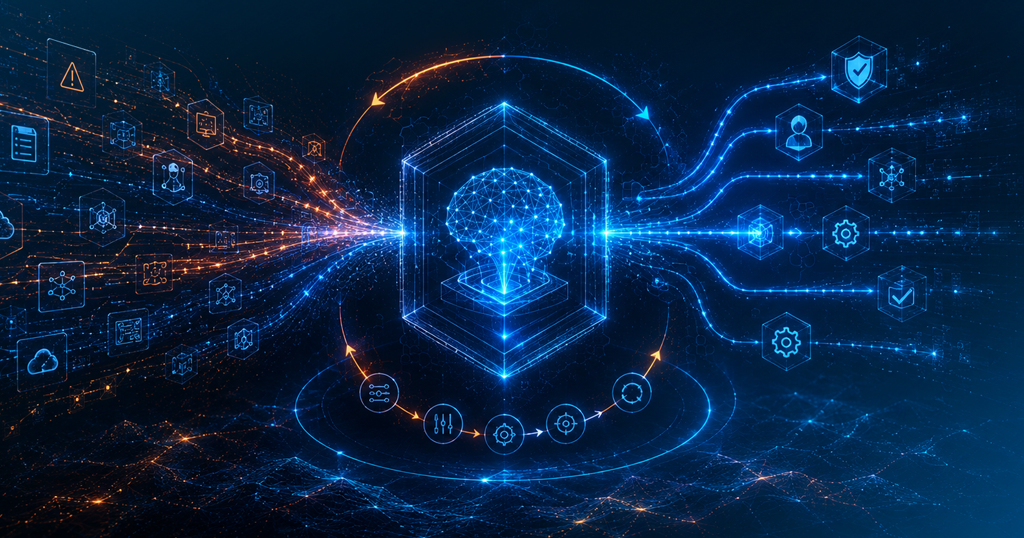
Continuous tuning works like this:
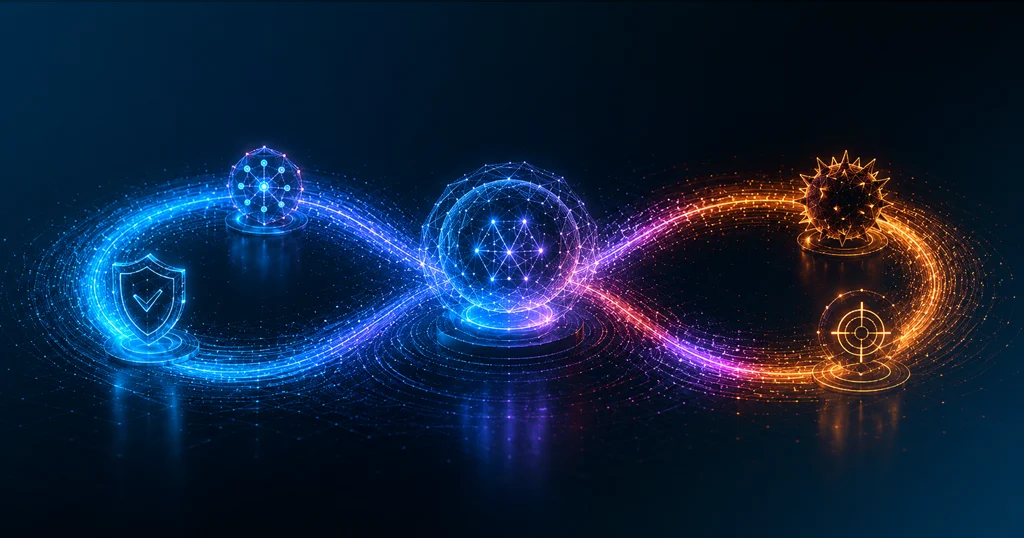
The Feedback Loop That Makes
an AI SOC Sharper Every Day
An AI SOC that stops learning goes stale in weeks. Every analyst decision feeds this loop — tightening accuracy without anyone rewriting rules manually.
This loop runs constantly in the background. Over time, the AI becomes more accurate not because someone rewrote its rules, but because it learned from real cases in your real environment.
The 2025 SANS survey found that plans to expand AI and machine learning in SOC operations surged this year, marking a shift from proof-of-concept to actual production use. The reason teams are moving forward is that this kind of adaptive approach is proving itself in practice.
How an AI SOC Adapts to a New Alert Type
This is where generic AI tools break down completely. They have no reference point for something they have never seen, and they either flag everything as suspicious or miss it entirely.
A well-built AI SOC handles novel alert types differently. It does not just fail silently on something unfamiliar. It flags the unknown, enriches the alert with every piece of available context, and routes it to a human with enough information to make a fast and confident decision. Then it learns from however that analyst handles it.
Over time, enough real examples of a new alert type build into a recognizable pattern. The system starts handling it autonomously. What started as an edge case becomes standard coverage. This is adaptive AI in practice, and it is the only realistic way to stay ahead of a threat landscape that keeps changing.
Live in 30 minutes.
Learning your environment from minute one.
The SOC Teammate starts mapping your environment and building context within the first 30 minutes of deployment — ingesting alert history, entity data, and SOPs before your first alert even comes in.
If you want to see how a coachable AI SOC operates inside your existing stack, learn more about how Secure.com builds context-driven security.
FAQs
How does an AI SOC learn your environment?
What data does an AI SOC need to learn your environment?
What does it mean for an AI SOC to be coachable?
How does an AI SOC adapt to a new alert type?
Conclusion
An AI SOC is not smart because of what it knows when you first turn it on. It gets smart because of what it learns from your environment, your investigation history, and your team.
Context, coachability, and continuous tuning are not optional features to look for in a vendor pitch. They are the actual mechanics of whether an AI SOC works in your organization or just adds to the noise.
The more your team teaches it, the sharper it gets. That is the only model worth building on.