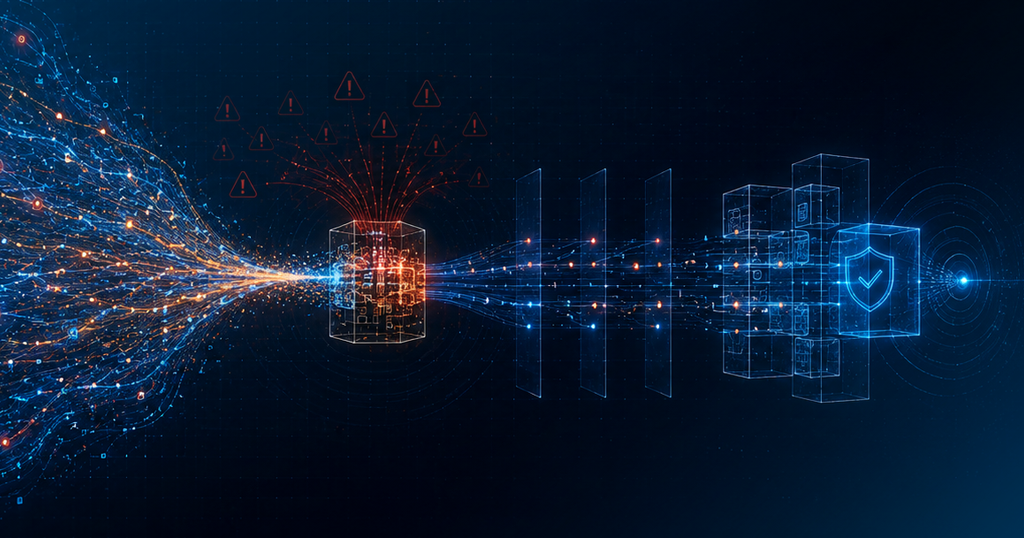
Key Takeaways
- 90% of SOCs are overwhelmed by false positives and backlogs (Osterman Research)
- Analysts handle up to 174 alerts per day, yet only 22% actually require investigation
- 71% of SOC analysts experience burnout, and 64% are considering leaving their role within a year
- Organizations with understaffed security teams see attacker dwell times multiply by 3x or more
- The average enterprise SOC runs between 25 and 45 different security tools
- Teams using AI and automation shorten their breach lifecycle by 80 days and save $1.9 million per incident on average (IBM, 2025)
The average data breach takes 194 days to detect. That is not a technology problem. That is what happens when security teams are buried in noise, short on staff, and jumping between dozens of tools just to investigate a single alert.
What Should Security Teams Do When SIEM Generates Too Many Alerts
Your SIEM is doing its job. That is part of the problem.
Organizations face an average of 960 security alerts daily, with enterprises over 20,000 employees seeing more than 3,000. That constant flood causes analysts to become desensitized to warnings, potentially overlooking critical threats hidden among thousands of false positives.
Security experts spend 27% of their time handling false positives. That is more than two hours out of every eight-hour shift spent chasing alerts that go nowhere.
Alert Fatigue Is a Security Risk, Not Just a People Problem
Alert fatigue is what happens when the volume and repetitiveness of incoming alerts outpaces what a team can humanly handle. Analysts stop trusting the system. They start dismissing alerts faster. Real threats slip through.
Here is what that looks like at scale:
- Only 22% of alerts require genuine investigation
- 20% to 30% of alerts are ignored or never investigated in time (CardinalOps)
- A Fortune 500 financial services SOC receiving more than 15,000 daily alerts found roughly 85% were false positives
The SANS 2024 SOC Survey found that 66% of SOC teams say they cannot keep pace with alert volumes. When teams cannot investigate every alert, they are not just slow. They are blind.
Why False Positives Are More Dangerous Than They Look
False positives do more than waste time. Over time, analysts start treating every alert with skepticism. That skepticism is rational when 80% of what you see is noise. But the moment a real threat shows up, it looks exactly like everything else.
That is when breaches happen.
So what should security teams do when SIEM generates too many alerts? Start here:
- Tune your detection rules regularly. 18% of all rules in production SIEMs cannot fire because they reference misparsed fields, missing log sources, or configuration errors.
- Deduplicate alerts from overlapping tools
- Prioritize based on asset criticality, not just alert severity
- Use AI-based triage to filter noise before it ever reaches the analyst queue
Tuning helps. It does not solve the staffing problem sitting underneath.
What Happens When SOC Teams Are Understaffed
This is the part most security leaders already know but rarely say out loud.
55% of security teams are understaffed, according to ISACA’s 2025 State of Cybersecurity report. The global cybersecurity workforce gap sits at 4.8 million unfilled positions, with demand rising 8.1% while active hiring grew only 0.1% (ISC2, 2024).
IBM’s 2024 Cost of a Data Breach Report puts the global average breach cost at $4.88 million, a 10% spike year over year. Organizations with understaffed security teams and no 24/7 coverage see dwell times multiply by 3x or more.
The Burnout-to-Attrition Loop That Breaks SOC Teams
When teams are short on staff, the analysts who remain carry more. More alerts, more triage, more repetitive work with no clear end.
71% of SOC analysts experience burnout, and 64% are considering leaving their roles within a year. The SANS 2025 survey found that 62% of organizations do not retain talent adequately.
When they leave, here is what follows:
- New analysts arrive without institutional knowledge of the environment
- Remaining team members absorb even more volume
- Alert backlogs compound
- Detection quality drops
- The team is now more understaffed than before
It is a loop. And it is getting worse.
Night Shifts and Skeleton Crews Are a Liability
Attackers do not work business hours. Most sophisticated intrusions begin at 2 a.m. on a Saturday, precisely because that is when organizations run their smallest crews.
Many organizations lack sufficient staffing to maintain effective 24/7 SOC operations, creating vulnerability windows during off hours when skeleton crews handle the same alert volumes that overwhelm full-strength day shifts (State of AI in the SOC, 2025).
Building a full in-house SOC is expensive. It requires 10 to 12 analysts at roughly $98,000 each before benefits and overhead, a SOC manager at $120,000 to $150,000, and SIEM/SOAR/XDR licensing at $200,000 to $500,000 annually. For most mid-market organizations, that math does not work.
How Context Switching Between Tools Hurts SOC Performance
Ask any SOC analyst what slows them down. It is rarely the actual threat. It is the tools.
The average enterprise SOC uses between 25 and 45 different security tools (ESG, 2024). Resolving a single alert requires gathering context across roughly 50 different platforms. This constant switching, nicknamed swivel chair syndrome in the industry, makes critical decisions harder and productivity nearly impossible to maintain.
Tool Sprawl Is Slowing Your Response Down
When an analyst has to jump between a SIEM, EDR, threat intelligence platform, ticketing system, and cloud console just to piece together one alert, they lose time at every step. They also lose context. Each tool shows a different slice of the picture. Putting it together manually takes time that attackers are actively using to move laterally.
The cost of context switching is measurable:
- Cognitive load increases with every tool transition
- Decisions get made on incomplete, fragmented context
- Junior analysts particularly struggle to correlate signals across siloed platforms
- Documentation suffers, which hurts post-incident analysis
Teams that consolidate investigation into a unified workflow cut investigation time significantly. Most legacy SOC setups were not built with that in mind.
How AI Reduces Attacker Dwell Time in Security Operations
This is where the numbers start to shift in the defender’s favor.
Organizations using AI and automation extensively shortened their breach lifecycle by 80 days and saved $1.9 million per incident compared to those without (IBM, 2025).
How does AI reduce attacker dwell time in security operations? It does several things that manual teams simply cannot do at scale:
- Correlates signals across multiple data sources in real time
- Flags behavioral anomalies without waiting for a human to work through the queue
- Suppresses false positives before they reach the analyst
- Operates 24/7 with no fatigue, no shift changes, and no cognitive limits
By enabling SOCs to handle hundreds of investigations in parallel, agentic AI can reduce MTTR by as much as 90%.
How Lean Security Teams Reduce Attacker Dwell Time with AI
A 3-person SOC team cannot manually cover the same ground as a 10-person team. With AI, they can come much closer.
Here is what that looks like in practice:
- AI handles Tier 1 and Tier 2 triage autonomously
- Analysts only see escalations that need a human call
- Response playbooks run automatically for known threat patterns
- MTTD drops from days to minutes on high-priority alerts
Organizations using AI-powered security tools investigate 3.4 times more alerts than teams without AI augmentation, and report a 45% increase in team productivity (Enterprise Strategy Group). For a 3-person team, that is a meaningful capacity gain without adding a single headcount.
How Mid-Market Companies Reduce Attacker Dwell Time with AI
Mid-market organizations face a specific version of this challenge. They have enough infrastructure to be a genuine target. They rarely have the budget to staff a proper SOC.
AI SOC tools fill that gap in a way that managed services alone cannot. They give mid-market security teams real-time detection, automated triage, and escalation workflows, without the full overhead of building and maintaining an in-house operation.
The result is shorter dwell times, lower MTTR, and a security posture that actually reflects the current threat environment rather than lagging months behind it.
FAQs
What should security teams do when SIEM generates too many alerts?
What happens when SOC teams are understaffed?
How does context switching between tools hurt SOC performance?
How does AI reduce attacker dwell time in security operations?
Conclusion
Manual SOC operations were built for a different threat environment. The alert volumes, staffing gaps, and tool sprawl that define modern security operations have outrun what any purely manual process can handle.
The numbers are consistent across every major research report. The turnover rates in analyst roles are telling the same story.
AI does not fix every SOC problem overnight. What it does is close the specific gaps that manual operations structurally cannot: coverage at 3 a.m., alert investigation at scale, and response times fast enough to matter before a breach becomes a catastrophe.
Secure.com’s SOC Teammate is where security teams start closing those gaps today.